TalkWithLead
AI Voice-First Lead Conversion

AI Voice Agents That Turn Website Visitors Into Real Conversations

TalkWithLead is the AI voice-first widget that turns a website visitor into a phone call. The visitor enters their number, the system rings them, and an AI voice agent talks with them — multilingual, extremely human-sounding, and free to call between a list of supported countries. More calls. More leads. More closed deals.

Extremely human-sounding voice 23 published languages out of the box Unlimited minutes on every plan Instant callback widget

Blog

  • AI Voice Agents for Real Estate Websites

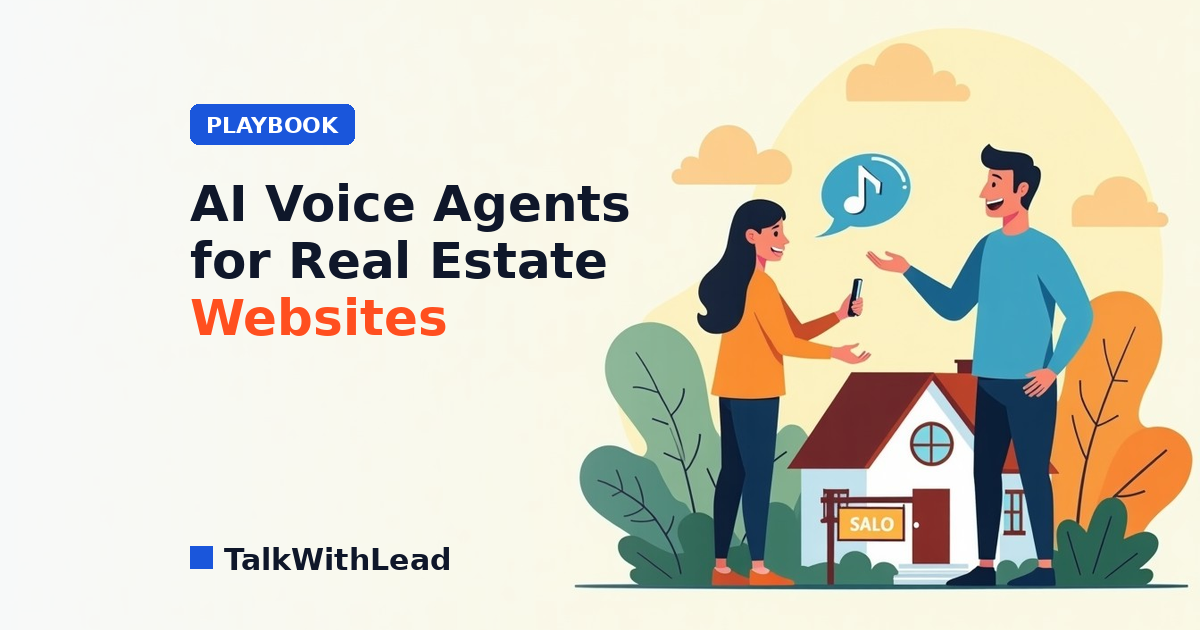
    AI Voice Agents for Real Estate Websites

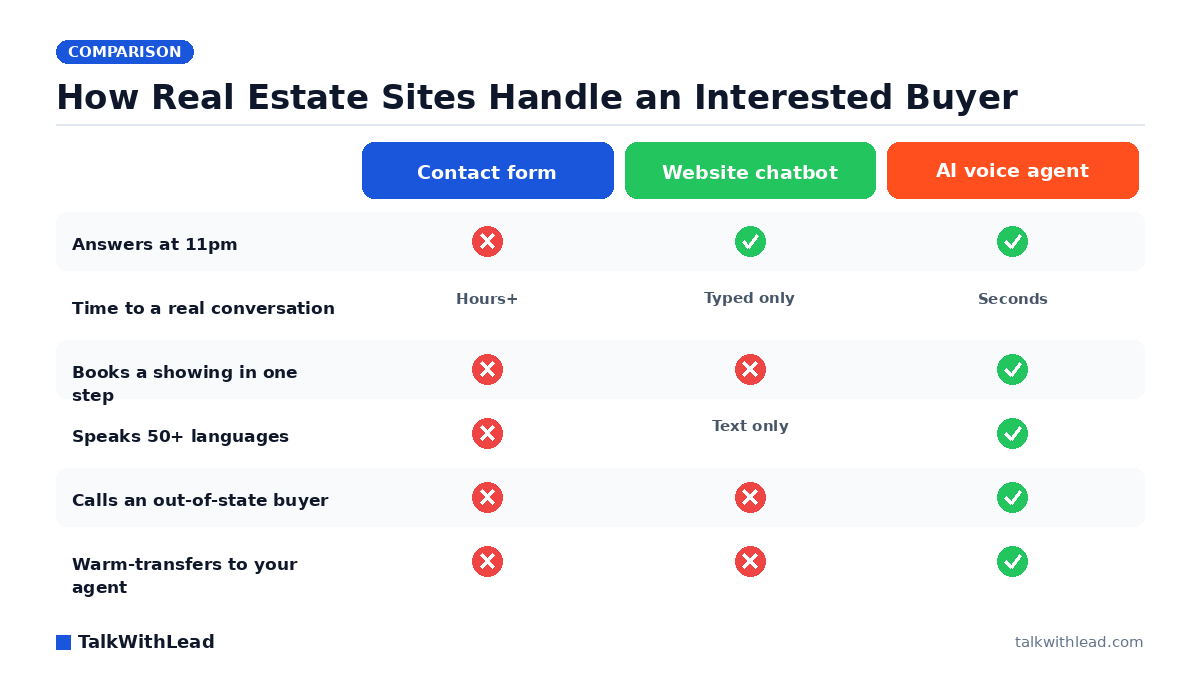
    How Real Estate Sites Handle an Interested Buyer — TalkWithLead original infographic (comparison diagram).
    How Real Estate Sites Handle an Interested Buyer

    A buyer finds your listing at 9:40pm, loves the kitchen, and wants to know if the seller will take an offer under asking. Your contact form promises a reply “within one business day.” By then they have already toured two other homes.

    TL;DR: AI voice agents for real estate websites answer that buyer instantly with a human-sounding voice, qualify the inquiry, and either book the showing or ring your phone while the visitor is still on the listing page. They work around the clock, hold the conversation in more than 20 languages, and place free long-distance calls between supported countries, so an out-of-state or overseas buyer converts the same way a local one does.

    Why real estate websites leak so many leads

    Real estate is a speed sport played on other people’s schedules. Buyers browse after dinner, on weekends, and from three time zones away. Agents are showing property, sitting in inspections, or driving — the exact hours when the website is busiest.

    The math is brutal. According to the MIT Lead Response Management study, you’re about 21× more likely to qualify a lead contacted within 5 minutes than one contacted at 30 minutes. A form that sits in an inbox overnight is not a lead-capture tool; it is a delay mechanism.

    And the phone line does not save you either. According to a 411 Locals study of 85 small businesses across 58 industries, only 37.8% of incoming calls were answered by a live person. Apply that to a listing page and the picture is clear: the visitor who actually reaches for the phone often gets voicemail, then calls the next agent.

    What is an AI voice agent on a real estate website?

    It is a widget on your site that starts a spoken conversation. The visitor taps once and an AI voice agent — one that sounds like a person, not a phone tree — greets them, asks what they are looking at, answers questions about the property, price range, and timeline, and moves them toward a booked showing or a live call you are on from the start.

    Three capabilities separate it from every text-based widget:

    • Real voice, immediately. No typing, no “an agent will be with you shortly.” The conversation starts in seconds.
    • more than 20 languages. The relocating family, the overseas investor, the local buyer who is simply more comfortable in Spanish, Hindi, or French — all get served in their own language without you hiring for it.
    • Free long-distance calling between supported countries and instant callbacks. The agent can call the visitor back on their phone, wherever they are, and can bridge them to your line while intent is still hot.

    If you want to see how the voice actually sounds before you decide anything, the fastest route is the live demo — thirty seconds tells you more than any feature list.

    AI voice agent vs form vs chatbot for real estate

    Every real estate site already has some way to capture interest. The question is what each one costs you in conversations.

    DimensionContact formWebsite chatbotAI voice agent
    Response timeHours to next business dayInstant, but typedInstant, spoken
    After-hours coverageCollects onlyYesYes
    Books a showing in one interactionNoSometimes, via a formYes, in conversation
    Handles non-English buyersNoText translationmore than 20 spoken languages
    Reaches out-of-area buyers by phoneNoNoFree long-distance calling between supported countries
    Puts the buyer on a call with the listing agentNoRarelyInstant callback or live bridge
    Emotional read of the buyerNoneLowTone, urgency, objections

    Chatbots are not useless — they are just the wrong shape for a six-figure decision. A buyer weighing a mortgage payment wants a person’s voice, and they want to ask the awkward question out loud. Our deeper breakdown of that trade-off lives in AI Voice Agent vs Chatbot: Which Is Better for Real Estate?, and if you’re comparing widget types specifically, see Click-to-Call vs Callback Widget vs AI Voice Agent.

    How much business does a slow response actually cost?

    Let’s do labeled, illustrative math — these are assumed rates, not measured results from any client.

    Illustrative example. Say a mid-sized brokerage site gets 900 visitors a month and 40 of them show real intent (they click a listing CTA, request info, or start a call). Assume half of that intent arrives outside staffed hours — 20 people. Assume only 1 in 4 of those leave a form and, of those, say 1 in 5 eventually converts to a signed client. That is one client a month from after-hours traffic.

    Now assume an AI voice agent calls all 20 of those after-hours website leads back and, say, 1 in 8 becomes a signed client. That is 2.5 clients a month instead of 1. On a modest average commission, the difference is not a rounding error — it is the reason to install the widget this week rather than next quarter.

    Want to run your own numbers instead of mine? Use the free missed-call revenue calculator with your own traffic and commission figures. And when you’re ready to see plans, the pricing page lists them plainly.

    The five moments an AI voice agent earns its keep in real estate

    1. The 10pm listing browse. Peak buyer curiosity, zero staff. The agent answers, qualifies budget and timeline, and books tomorrow’s showing.
    2. The open-house weekend crush. You’re standing in a kitchen with four people. The website keeps talking to everyone else.
    3. The relocating buyer. They’re in another state or country. Free long-distance calling between supported countries means the callback actually happens instead of dying on a toll charge.
    4. The non-English-speaking family. A conversation in their language converts; a translated chat window usually does not. See how that plays out in AI Voice in Hindi for Real Estate.
    5. The comparison shopper. They are on three agents’ sites in one session. The one whose site talks back first usually gets the appointment.

    How do you actually put one on a real estate site?

    Faster than most agents expect. You add a small script to your site — WordPress, Wix, Squarespace, an IDX-powered template, or a custom build — and the voice widget appears. You then tell it three things: what you sell, what questions it should ask a buyer or seller, and where to route a hot lead.

    Practical setup notes worth getting right:

    • Route by intent, not by page. A seller asking about a valuation and a buyer asking about a showing should not land in the same bucket.
    • Give it your qualifying questions. Pre-approval status, timeline, target neighborhoods, price band. The agent asks them naturally, in conversation.
    • Set a routing rule. Decide which enquiries the AI handles alone and which ones ring your phone from the start of the call — usually a buyer with a timeline under 60 days.
    • Keep it on every page, not just Contact. Intent spikes on the listing, not on the form.

    You can have this running today with a free signup, and if you’d rather hear it first, the live demo takes under a minute.

    Honest verdict: is this right for your brokerage?

    Best for: solo agents, small teams, and brokerages whose website gets meaningful traffic but who cannot staff a phone from 7am to 11pm — especially anyone serving relocating, investor, or multilingual buyers.

    Not the right fit if: your jurisdiction or brokerage policy requires a licensed human on every first contact with a consumer, you get so few web visitors that a personal callback is already instant, or your leads come almost entirely from referrals rather than your site.

    The honest framing is this: an AI voice agent does not replace a good agent. It replaces the silence between the visitor’s interest and your availability — and in real estate, that silence is where most deals quietly die. If you’re weighing it against the widget you already have, Live Chat Alternative for Real Estate Agents compares them side by side.

    FAQ

    What is an AI voice agent for a real estate website?

    It’s a widget that lets a website visitor start a spoken conversation with a human-sounding AI. It answers questions about listings, qualifies the buyer or seller, books showings, and can call the lead back instantly, or in human mode ring your agent and the lead together — 24 hours a day.

    Do AI voice agents work better than chatbots for real estate leads?

    For high-value, emotional decisions like a home purchase, voice generally moves people further in one interaction. A buyer will ask an awkward question out loud that they’d never type, and a showing can be booked inside the conversation instead of through a follow-up form.

    Can an AI voice agent speak to buyers in other languages?

    Yes. TalkWithLead’s voice agent handles conversations in more than 20 languages, which matters for relocating families, international investors, and any market where buyers prefer their first language over English.

    Will it call buyers who are out of state or overseas?

    Yes — free long-distance calling between supported countries is included, so an instant callback reaches a buyer in another state or country the same way it reaches a local one. That’s often the difference between capturing a relocation lead and losing it.

    How fast should a real estate lead be contacted?

    As close to immediately as you can manage. Harvard Business Review research found companies that reach a web lead within an hour are nearly 7× more likely to qualify it than those that wait even an hour longer, per their study of online sales leads. More detail in Speed to Lead Real Estate.

    How long does it take to set up on my site?

    Adding the script is a few minutes on most platforms, including WordPress and hosted IDX sites. Configuring your qualifying questions and routing rules typically takes another sitting — you can start with a free signup and adjust the script as you learn what buyers ask.
  • AI Voice in Spanish for Real Estate: Stop Losing Leads

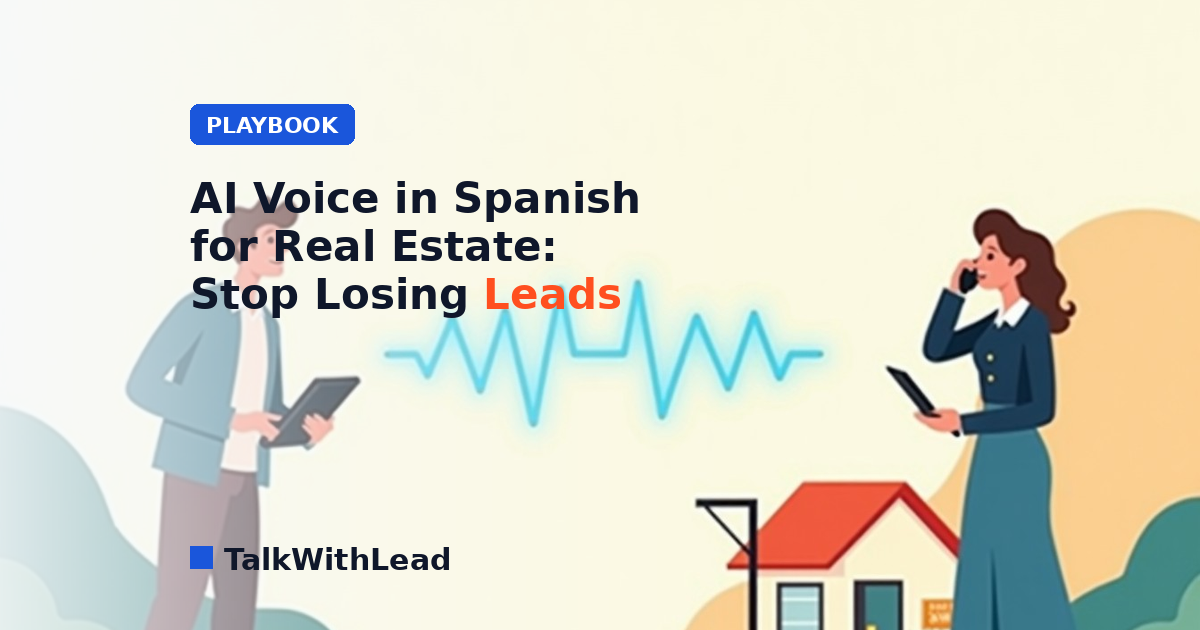
    AI Voice in Spanish for Real Estate: Stop Losing Leads

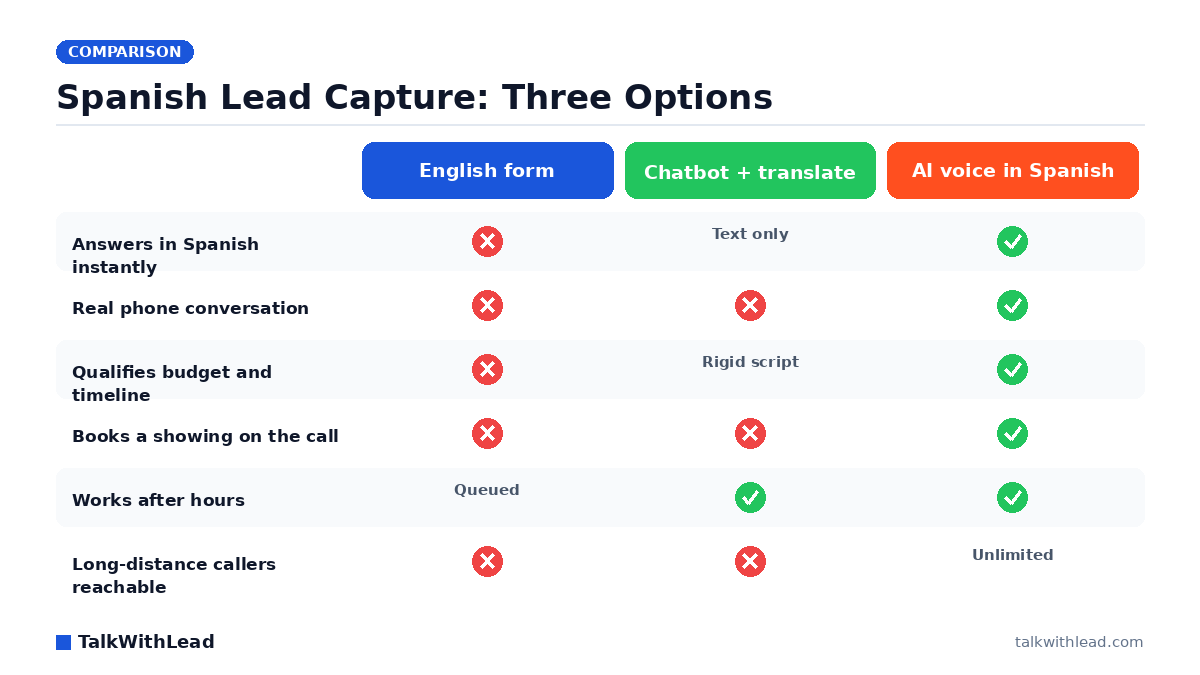
    Spanish Lead Capture: Three Options — TalkWithLead original infographic (comparison diagram).
    Spanish Lead Capture: Three Options

    A Spanish-speaking family finds your listing at 8:40 p.m., loves the kitchen photos, and hits your contact form. The form is in English. They close the tab and call the agent whose sign is in their neighborhood. That lead was never lost to price or product — it was lost to language and to silence.

    Short answer: AI voice in Spanish for real estate puts a human-sounding voice agent on your website that answers Spanish-speaking visitors in seconds, asks about budget, timeline, and neighborhood in their own language, and books the showing or, in human mode, rings you and the visitor together from the start of the call. It runs 24/7, handles more than 20 languages on the same widget, and converts visitors into phone conversations instead of unanswered form submissions.

    Why Spanish-speaking real estate leads disappear before you ever see them

    Real estate is a spoken business. Buyers want to ask whether the HOA covers the roof, whether the seller will take a 45-day close, whether the school zone is the one their cousin mentioned. Those questions are awkward to type in a second language and easy to say out loud in a first one. When your site only offers an English form or an English chat box, you are asking your Spanish-speaking visitors to do the hardest possible version of contacting you.

    The fallback is the phone — and that’s where the second leak opens. According to a 411 Locals study of 85 small businesses across 58 industries, only 37.8% of incoming calls were answered by a live person — meaning roughly 6 out of 10 calls went unattended. Agents are showing property, not sitting by a desk phone. So the Spanish-speaking caller gets voicemail in a language they may not want to leave a message in, and moves on.

    Picture a listing page pulling 400 visits a month with a third of that traffic Spanish-speaking. Say even 5% of those visitors would have talked to a live voice — that’s roughly 6 real conversations a month you never had, in a business where one closing pays for the year’s marketing.

    How does an AI voice agent in Spanish actually work on a real estate site?

    The widget sits on your listing pages and your homepage. A visitor taps it, and within a couple of rings an AI voice agent picks up — not a bot reading a menu, but a natural-sounding voice that speaks conversational Spanish, understands regional phrasing, and answers back without the robotic pauses buyers associate with automated systems.

    From there it does the work a good ISA does on a first call:

    • Qualifies in Spanish — price range, financing status, timeline, whether they’re selling something first.
    • Answers listing questions — square footage, availability, showing windows, what’s included.
    • Books the showing or triggers an instant callback to your cell while the visitor is still interested.
    • Speaks the visitor’s language — the same widget covers more than 20 languages, so a bilingual household never hits a wall.
    • Takes long-distance calls — free long-distance calling between supported countries means an out-of-state relocation buyer or a family member calling from abroad reaches you without a toll charge killing the call.

    You can hear the difference in about two minutes on the TalkWithLead live demo — talk to the agent yourself, in Spanish, and judge whether a buyer would keep talking.

    AI voice in Spanish vs. the alternatives real estate teams usually try

    Most agents have already tried something. Here’s how the common options compare on the dimensions that decide whether a Spanish-speaking lead turns into a showing.

    CapabilityEnglish contact formChatbot with translationBilingual answering serviceAI voice agent in Spanish
    Responds in Spanish immediatelyNoText onlyDepends on staffingYes, in seconds
    Real spoken conversationNoNoYesYes
    Available nights and weekendsForm queuesYesOften surchargedYes, always
    Qualifies budget and timelineStatic fieldsRigid decision treeYes, if trainedYes, conversationally
    Books the showing on the spotNoRarelySometimesYes
    Long-distance / overseas callersN/AN/AUsually billed per minuteFree long-distance calling between supported countries
    Cost scales with volumeFree but leakyLowPer-minute, climbs fastFlat plan

    Best for: agents, teams, and brokerages whose listing traffic includes a meaningful share of Spanish-speaking buyers or renters, and who cannot answer every call live during showings.

    Not the right fit if: your entire pipeline comes from referrals you already answer personally within minutes, or your market has essentially no Spanish-speaking demand — in that case a voice agent solves a problem you don’t have.

    If you’re weighing voice against the tools you already pay for, the deeper breakdowns are here: AI voice agent vs chatbot for real estate and the live chat alternative for real estate agents.

    How fast do you have to answer a Spanish-speaking lead?

    Faster than you think, and faster than a callback form allows. The MIT Lead Response Management study found you’re about 21× more likely to qualify a lead contacted within 5 minutes than one contacted at 30 minutes. That window is the whole game in real estate, where a serious buyer is inquiring on four listings in one evening.

    An AI voice agent collapses that window to zero. The visitor doesn’t wait for you to check your phone between showings — the conversation starts on the page, in Spanish, at 8:40 p.m. on a Tuesday. If the lead is hot, the agent books the showing and alerts you the moment the call ends. If it’s early-stage, you get a qualified summary instead of a name and an email address.

    Run your own numbers on what the delay costs with the free speed-to-lead ROI calculator, or read the fundamentals in speed to lead for real estate.

    What it costs, and the math that decides it

    Bilingual answering services generally bill per minute or per call, so cost rises exactly when your marketing is working. An AI voice agent runs on a flat monthly plan — see current tiers on the TalkWithLead pricing page.

    Illustrative ROI math (assumptions stated, not a customer result): assume your average commission per closed transaction is $8,000, and assume a Spanish voice agent recovers 6 conversations a month that previously bounced. Assume a conservative 5% of those convert to a closing within your normal cycle. That’s roughly one extra closing every three to four months — around $2,400 per month in expected commission against a flat software cost. Your own commission, traffic, and conversion rate change the answer, which is why the math should be run on your numbers, not ours.

    Rolling it out without breaking what already works

    Start narrow. Put the voice agent on your three highest-traffic listing pages and your homepage, set the greeting to open in Spanish when the browser signals a Spanish locale, and leave your existing form in place for people who prefer typing. Give the agent a short script for the questions you answer forty times a week: availability, price flexibility, pet policy, showing windows, financing prerequisites.

    Then check two things after the first two weeks — how many conversations happened outside business hours, and how many of them you would otherwise have missed entirely. That’s the honest measure. Teams running the same play in other languages describe it here: AI voice in Hindi for real estate.

    When you’re ready to put it on a live page, start free with TalkWithLead and have the Spanish voice agent answering on your listings today, or try the live demo first and hear what your buyers would hear.

    FAQ

    Does the AI voice agent actually sound natural in Spanish, or like a robot menu?

    It speaks conversationally — natural pacing, natural phrasing, and it responds to what the caller actually said rather than reading a menu tree. The fastest way to judge it is to call it yourself in Spanish on the live demo and decide whether you’d keep talking.

    What happens if a caller switches between Spanish and English mid-conversation?

    The same agent handles both, along with more than 20 languages. Bilingual households switch constantly, and the conversation continues instead of restarting or dropping the caller into a different queue.

    Can it book a showing, or does it only take messages?

    It qualifies the lead and can book the appointment or trigger an instant callback to your phone while the visitor is still on the listing page. You get a qualified summary rather than a bare name and email.

    Do out-of-state or overseas buyers pay long-distance charges to reach me?

    No. Free long-distance calling between supported countries is included, so a relocation buyer in another state or a family member calling from abroad can reach your listing without a toll charge ending the conversation.

    Is this better than hiring a bilingual assistant?

    It’s different. A bilingual assistant is better at nuanced negotiation and relationship work; the AI voice agent is better at never missing the 9 p.m. inquiry and never charging more when your traffic spikes. Many teams run both — the agent catches everything, the human handles what matters most.

    How long does it take to get a Spanish voice agent live on my site?

    Installing the widget is a snippet on your pages, so most agents are answering the same day they sign up. Start with your top listing pages, then expand once you see where the after-hours conversations come from.

  • Click-to-Call vs Callback Widget vs AI Voice Agent

    Click-to-Call vs Callback Widget vs AI Voice Agent

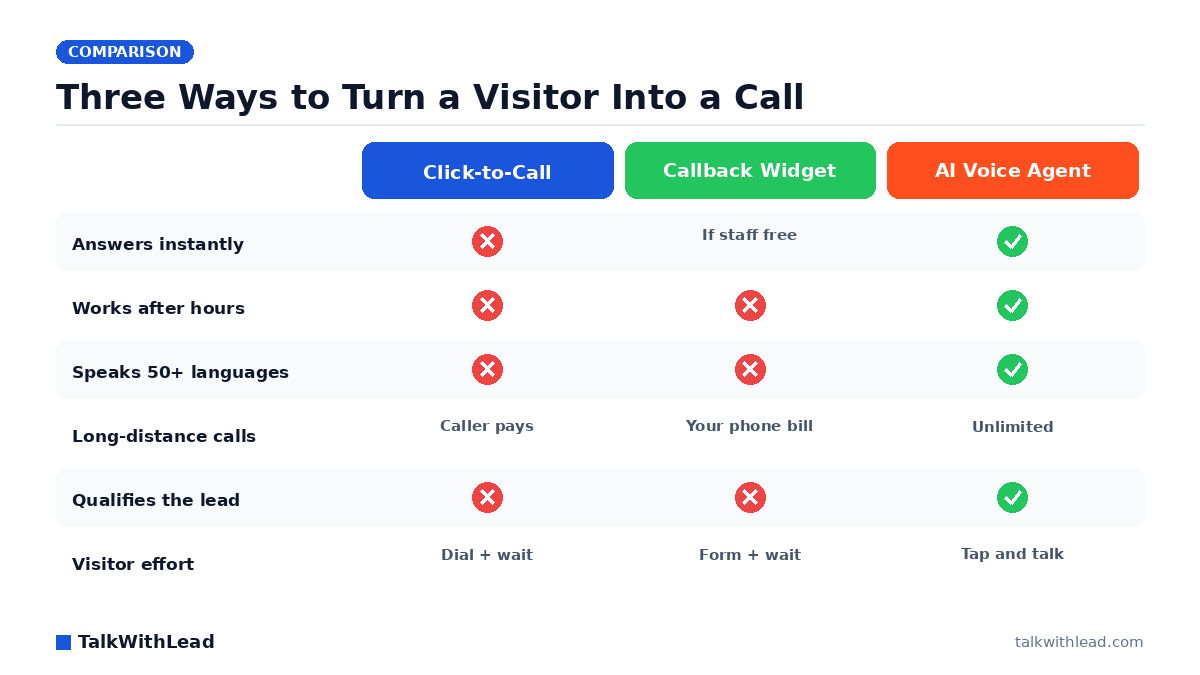
    Three Ways to Turn a Visitor Into a Call — TalkWithLead original infographic (comparison diagram).
    Three Ways to Turn a Visitor Into a Call

    Every visitor who leaves your site without talking to a human is a lead your competitor gets to call first. The click-to-call vs callback widget vs AI voice agent decision is really one question: how long does a ready buyer have to wait before a voice answers? Three seconds, three hours, or never.

    TL;DR: Click-to-call only helps visitors already willing to dial and wait on hold. A callback widget captures more intent but still queues the lead behind a human’s availability. An AI voice agent calls back the moment a visitor taps — 24/7, in more than 20 languages, with free long-distance calling between supported countries — so the conversation happens while interest is at its peak. For most websites, the AI voice agent converts the most because it removes the wait entirely.

    What each option actually does

    These three tools look similar on a page — a button, a bubble, a phone icon — but they behave completely differently once a visitor engages.

    • Click-to-call is a tel: link. The visitor taps, their phone dials your number, and everything after that depends on whether someone picks up. On desktop it often does nothing useful at all.
    • Callback widget collects a phone number and promises a call back — sometimes in 28 seconds, sometimes whenever your team gets to it. It converts the visitor into a task in someone’s queue.
    • AI voice agent rings the visitor’s phone the moment they enter their number and starts a real, spoken conversation. A human-sounding voice greets the visitor, answers questions, qualifies them, and books the next step or, in human mode, rings you and the visitor together from the start of the call.

    Only one of those three guarantees a voice on the other end. That distinction decides the conversion rate.

    Which one converts more website visitors?

    Conversion follows response speed, and the evidence on that is unusually blunt. The MIT Lead Response Management study found you’re about 21× more likely to qualify a lead contacted within 5 minutes than one contacted at 30 minutes. Every minute a lead spends waiting is conversion you already lost.

    Now map that to the three tools. Click-to-call is instant only if your line is answered instantly — and answering is the weak link. According to a 411 Locals study of 85 small businesses across 58 industries, only 37.8% of incoming calls were answered by a live person. A callback widget shifts the wait to your team’s response time, which on a busy Tuesday afternoon is rarely five minutes. An AI voice agent has no queue and no lunch break.

    Want to hear what that sounds like before you decide? Take the Live Demo and talk to the agent yourself.

    Side-by-side comparison

    DimensionClick-to-CallCallback WidgetAI Voice Agent
    Time to first voiceHowever long the phone ringsMinutes to hoursSeconds
    Works after hoursNoRequest logged onlyYes, fully
    Desktop visitorsPoor (no dialer)GoodGood
    LanguagesWhoever answersWhoever calls backmore than 20 languages
    Long-distance leadsCaller pays, many won’tYour phone billFree long-distance calling between supported countries
    Lead qualificationManualManualAutomatic, during the call
    Staffing neededFull coverageFull coverageNone for first contact
    Best useMobile, ready buyersTeams with fast callersAny site, any hour

    Read the rows top to bottom and a pattern shows up: the first two options are fine when a person is sitting there ready to answer. The third one is the only one designed for the hours and languages when nobody is.

    The math on the leads you never hear from

    Here’s an illustrative example, not a customer result. Say your site gets 4,000 visitors a month and, imagine, even 3 in 100 of them would happily talk to someone about buying. That’s 120 conversations available. If click-to-call captures the handful already dialing and your callback queue reaches half the rest within an hour, you might touch 60 — leaving 60 conversations on the table each month.

    Apply your own average deal value to those 60 and the number gets uncomfortable fast. You can run your own version of this math with the free missed-call revenue calculator — put in your real traffic and close rate rather than trusting anyone’s blog arithmetic.

    The point isn’t the exact figure. It’s that both click-to-call and callback widgets quietly depend on a human being available, and human availability is the single most expensive thing on this list. Pricing for an always-on AI voice agent sits well below the cost of staffing evenings, weekends, and second languages. For the vendor-by-vendor numbers behind that, AI voice agent pricing compared across platforms lays out the per-minute and per-plan models in USD with the date each figure was read.

    When a click-to-call button is still the right call

    Click-to-call earns its place on mobile-heavy sites where visitors arrive already decided — an emergency plumber, a locksmith, a walk-in clinic. If someone’s basement is flooding, they don’t want a conversation. They want your number dialing.

    The trap is treating it as your whole strategy. On desktop it’s inert, after hours it’s a voicemail box, and for a visitor who speaks Spanish or French it’s a gamble on who happens to answer. Compare the mechanics in detail in our breakdown of callback widget vs click-to-call vs live chat.

    When a callback widget beats both

    A callback widget shines for teams with disciplined sales floors and genuine coverage — a mortgage team with licensed loan officers on rotation, an inside-sales group with a five-minute SLA they actually hit. In those setups the widget is a clean intent capture and the human closes it.

    It falls apart the moment the callback becomes a to-do item. A lead who filled the form at 7:40 p.m. and gets called at 10:15 a.m. the next day has already spoken to two competitors. If your team can’t promise minutes, an AI voice agent should take the first conversation and pass warm leads to your people. That routing pattern is exactly what we cover in AI voice agent vs callback widget vs live chat.

    Why the AI voice agent wins most sites

    Voice does something no form or chatbot can: it lets a stranger explain their situation in their own words and get an answer in the same breath. A human-sounding AI voice agent picks up in seconds, asks the qualifying questions your best rep would ask, handles the accent and the language, and books the appointment, or, in human mode, rings your rep and the visitor together from the start of the call.

    Three capabilities carry most of the lift:

    1. Instant answer. No hold music, no “we’ll get back to you.” The conversation happens at peak intent.
    2. more than 20 languages. A visitor who’d have hung up on an English-only line stays on the phone and converts.
    3. Free long-distance calling between supported countries. Out-of-state and international prospects reach you without anyone weighing the cost of the call.

    Chatbots were supposed to solve this and mostly taught buyers to close the widget — we broke that down in AI voice agent vs chatbot. Typing is slower than talking, and slower loses.

    Honest verdict

    Best for: Any business whose website gets leads outside staffed hours, in more than one language, or faster than the team can call back — service businesses, clinics, law firms, real estate, contractors, and SaaS teams with global traffic.

    Not the right fit if: You’re a single-person shop with very low traffic who genuinely answers every call within a ring or two, or your sale legally requires a licensed human on first contact. In that case a plain click-to-call button is honest and sufficient. If you would rather build the agent yourself on a developer platform, what a configured callback agent costs next to Vapi, Retell AI and Bland AI is compared separately.

    If you fall in the first group, the fastest way to find out is to run it on your own site. Start free, drop the widget on your highest-traffic page, and count how many conversations happen this week that would otherwise have been silence.

    FAQ

    What is the difference between click-to-call and a callback widget?

    Click-to-call opens the visitor’s phone dialer so they call you and wait for someone to answer. A callback widget collects their number and puts a task in your team’s queue to call them back. The first depends on you answering; the second depends on you calling promptly.

    Does an AI voice agent replace my callback widget?

    It usually replaces the waiting part of it. The agent answers the visitor immediately, qualifies them, and either books the next step or routes a warm lead to a human. You can still offer a scheduled callback for people who prefer one — it just stops being the only option.

    Will visitors know they’re talking to an AI?

    The voice is designed to sound natural rather than robotic, and the agent identifies itself honestly. In practice most visitors care far more that someone answered in seconds than about who is on the line.

    Which converts better on mobile, click-to-call or an AI voice agent?

    Click-to-call converts the small group already committed to dialing. An AI voice agent also captures the much larger group who have a question first and won’t sit through a phone tree to ask it. On mobile, running both is reasonable — the tap-to-talk option catches everyone the dialer loses.

    How fast should I respond to a website lead?

    Minutes, not hours. Harvard Business Review research found companies that reach a web lead within an hour are nearly 7× more likely to qualify it than those that wait even an hour longer. That’s the entire argument for answering the moment the visitor is on your page.

    Do I need to change my phone system to use an AI voice agent?

    No. It runs as a widget on your website: the visitor enters their number and the AI voice agent calls their phone within seconds; in human mode it rings your existing number at the start of the call, so a human is on it from the beginning. You can try it on the Live Demo before touching anything in your phone setup.

  • AI Voice Agent vs Chatbot: Which Is Better for Real Estate?

    AI Voice Agent vs Chatbot: Which Is Better for Real Estate?

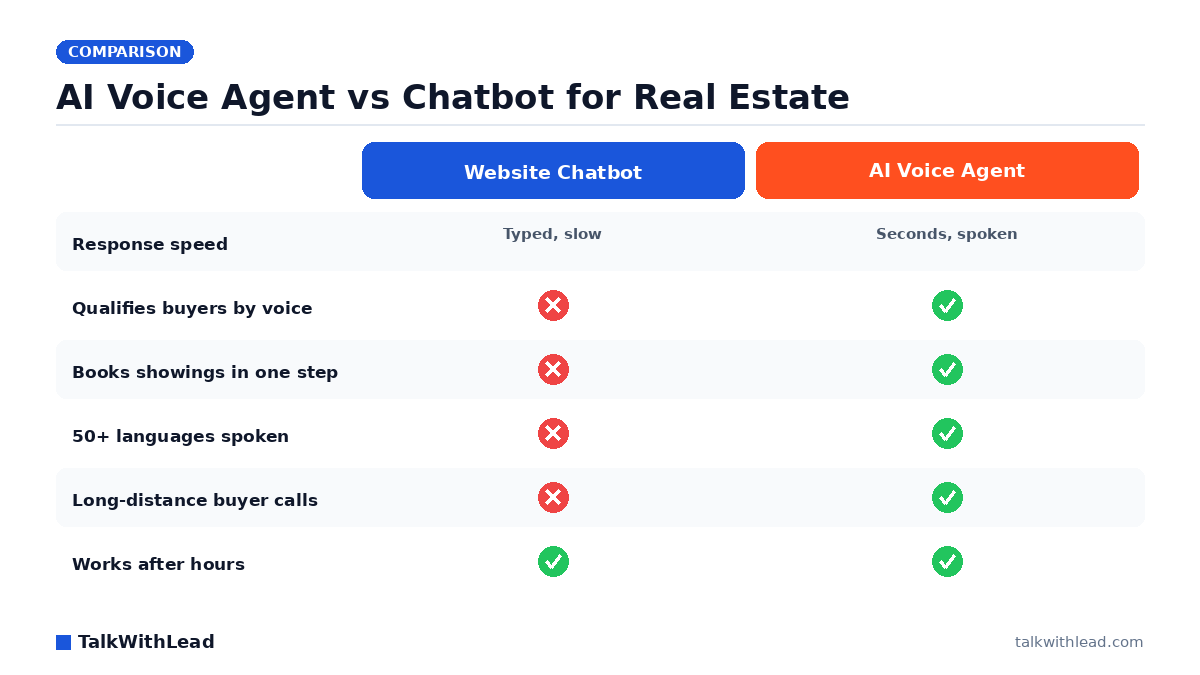
    AI Voice Agent vs Chatbot for Real Estate — TalkWithLead original infographic (comparison diagram).
    AI Voice Agent vs Chatbot for Real Estate

    The Showing Goes to Whoever Talks to the Buyer First

    A buyer lands on your listing page at 9:40 p.m., ready to ask about a showing. What happens next decides whether that commission is yours or your competitor’s. That is the real question behind the ai voice agent vs chatbot for real estate debate: which one turns that late-night visitor into an actual conversation before they open the next agent’s website?

    TL;DR: For real estate, an AI voice agent beats a chatbot for lead conversion. Voice engages the visitor in a real spoken conversation within seconds, qualifies budget, timeline, and financing, and books the showing in one step. A chatbot makes a motivated buyer type through a scripted menu — and motivated buyers don’t wait. Chatbots still work for low-stakes FAQ deflection, but the appointment goes to voice.

    Why Does Speed Decide Real Estate Deals?

    Real estate is the ultimate speed-to-lead business. Buyers shortlist several agents in one sitting, and sellers interviewing listing agents often sign with the first one who responds like a professional. The MIT Lead Response Management study found you’re about 21× more likely to qualify a lead contacted within 5 minutes than one contacted at 30 minutes. Five minutes is generous — a website visitor who gets no human-feeling response often leaves in under one.

    A chatbot technically “responds” instantly, but it responds with a widget the buyer has to operate: click a bubble, pick from canned options, type answers on a phone keyboard. That’s homework, not a conversation. An AI voice agent flips it — the visitor talks, the agent talks back in a natural human-sounding voice, and inside two minutes you know whether this is a pre-approved buyer who wants a Saturday showing or someone six months from a decision. We break down the response-time math in Speed to Lead Real Estate: Book More Showings.

    AI Voice Agent vs Chatbot for Real Estate: Head-to-Head

    Here’s how the two options compare on the dimensions that actually move commissions:

    DimensionWebsite ChatbotAI Voice Agent
    InteractionTyping through scripted menusNatural spoken conversation
    Time to real engagementMinutes of typing, often abandonedSeconds — visitor just talks
    Qualification depthShallow; buyers quit long forms-in-disguiseBudget, timeline, area, pre-approval in one call
    Emotional readNone — text can’t hear urgencyHears hesitation, urgency, seriousness
    LanguagesText translation, robotic feelSpeaks more than 20 languages naturally
    Out-of-town buyersSame typed widgetFree long-distance calling between supported countries, instant callbacks
    After-hours coverageYes, but low completionYes, with showing requests captured by voice
    Best useDeflecting simple FAQsConverting visitors into phone conversations

    Notice the pattern: everywhere the stakes are low, the chatbot is fine. Everywhere money changes hands — qualification, trust, booking — voice wins. That pattern isn’t unique to property; it shows up across industries in our conversion-rate comparison of voice agents and chatbots.

    What Can an AI Voice Agent Do That a Chatbot Can’t?

    Qualify like a top producer. A good buyer-qualification conversation covers price range, neighborhoods, timeline, financing status, and whether they’re working with another agent. Ask that through a chatbot and you’ve rebuilt a web form with extra steps. A voice agent asks it the way you would — conversationally, in order, adapting to the answers — and the buyer answers because talking is effortless.

    Speak the buyer’s language — literally. Real estate is a multilingual business. Relocating families, international investors, and first-generation buyers routinely prefer to discuss a six-figure purchase in their first language. A voice agent that handles more than 20 languages greets a Spanish-, Hindi-, or French-speaking visitor in their own language on the spot. We’ve covered vertical examples in AI Voice in Hindi for Real Estate.

    Reach buyers who aren’t local. The buyer for your lakefront listing might be two time zones away. Free long-distance calling between supported countries plus instant callbacks means a visitor in another state — or another country — taps once and is on a real call with your AI agent, no international dialing friction, no “we’ll email you back.”

    Capture the after-hours flood. Portals push traffic at night and on weekends, exactly when you’re at showings or asleep. A voice agent answers every one of those visits like a sharp assistant who never clocks out, then hands you a qualified summary and a booked slot.

    Want to hear how human it sounds before you believe any of this? Try the live demo — talk to the agent yourself for two minutes.

    Where Does a Chatbot Still Make Sense?

    An honest comparison admits the chatbot’s lane. If your main need is deflecting repetitive typed questions — “what are your office hours,” “do you handle rentals” — a chatbot does that cheaply. Some brokerages also use chat as a quiet-channel option for visitors browsing from an open-plan office who can’t speak out loud.

    But be honest about what a chatbot on a real estate site usually is: a slower form. The visitor does the work, the answers are shallow, and the handoff to a human still takes hours. If you’re weighing text-based options, our breakdown of live chat vs chatbot covers where each stalls — and why voice is the upgrade path for both.

    Best for: agents, teams, and brokerages whose revenue depends on booked showings and listing appointments, especially with after-hours traffic, out-of-town buyers, or multilingual markets.

    Not the right fit if: your website exists only to answer typed FAQs and you genuinely don’t want more phone conversations — a simple chatbot or FAQ page covers that for less.

    The Math: What Is One Missed Buyer Worth?

    Run an illustrative example — your numbers will differ, so plug in your own. Say your site gets 600 visitors a month and, like most real estate sites, the vast majority leave without ever making contact. Imagine a voice agent starts real conversations with just 30 of them — 5% — and a third of those turn into qualified buyer or seller appointments. That’s roughly 10 extra appointments a month. Now assume your average commission is $9,000, and say even one in ten of those appointments eventually closes — under those stated assumptions, that’s one additional closing a month: about $9,000 in GCI your website was quietly leaking.

    Those are stated assumptions, not promises — which is exactly why we built a free calculator so you can use your own traffic and commission numbers: estimate what missed conversations cost you here. And the urgency behind the math is well documented: according to Harvard Business Review research, companies that reach a web lead within an hour are nearly 7× more likely to qualify it than those that wait even an hour longer.

    How to Put an AI Voice Agent on Your Real Estate Site

    Getting started is deliberately boring:

    1. Add the widget. One snippet on your site — no rebuild, works alongside your IDX pages.
    2. Teach it your business. Service areas, buyer and seller qualification questions, showing availability, languages you serve.
    3. Turn it on. Visitors talk to a human-sounding voice agent in seconds, or request an instant callback; you get qualified conversations and booked appointments instead of anonymous traffic.

    Check plans and pricing — then weigh it against the value of a single extra closing. When you’re ready, start your free signup and have a voice agent answering your website today.

    FAQ

    Is an AI voice agent better than a chatbot for real estate?

    For converting website visitors into showings and listing appointments, yes. A voice agent starts a spoken conversation in seconds and qualifies budget, timeline, and financing naturally, while a chatbot asks a motivated buyer to type through a menu. Chatbots remain fine for simple typed FAQs, but the appointment-generating work belongs to voice.

    Will an AI voice agent sound robotic to my buyers?

    Modern AI voice agents are strikingly human-sounding — natural pacing, tone, and back-and-forth rather than the flat text-to-speech of a decade ago. The fastest way to judge is to talk to one in the live demo and decide with your own ears.

    Can an AI voice agent qualify real estate leads?

    Yes. It asks the same questions a sharp assistant would — price range, preferred areas, timeline, pre-approval status, whether they’re already working with an agent — and hands you a summary with the appointment. Because the buyer is speaking instead of typing, they answer more questions and abandon far less often than they do with forms or chat flows.

    What happens with leads that come in after hours?

    The voice agent answers them the moment they engage — nights, weekends, holidays. It holds the conversation, qualifies the lead, books the showing request or offers an instant callback, and you wake up to a qualified appointment instead of a stale form fill from eleven hours ago.

    Does an AI voice agent work for international or out-of-town buyers?

    Yes, and this is a real edge in property. It speaks more than 20 languages naturally, and free long-distance calling between supported countries with instant callbacks means a buyer in another state or country connects with one tap — no dialing costs, no time-zone email tag.

    Do I still need a contact form if I add a voice agent?

    You can keep one as a fallback, but treat it as the slow lane. The voice agent becomes the primary path because it converts intent while it’s hot; the form catches the small group who genuinely prefer to write. Most agents find the voice conversations are where the appointments actually come from.

  • AI Voice Agent vs Callback Widget vs Live Chat: What Converts?

    AI Voice Agent vs Callback Widget vs Live Chat: What Converts?

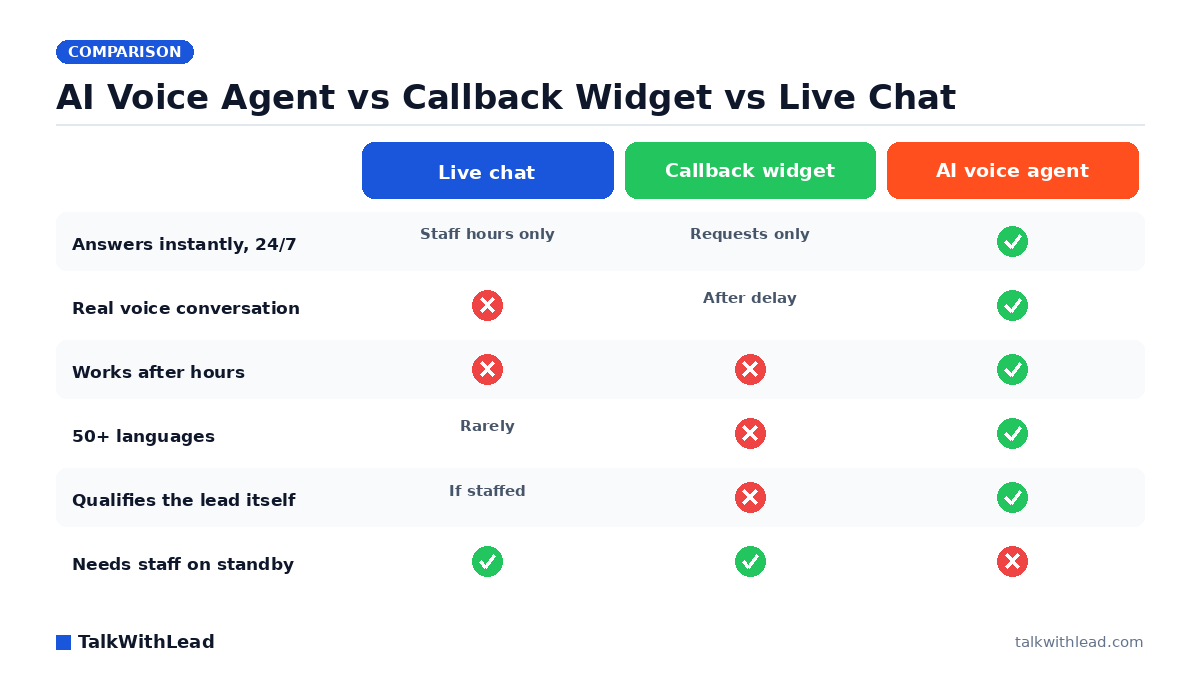
    AI Voice Agent vs Callback Widget vs Live Chat — TalkWithLead original infographic (comparison diagram).
    AI Voice Agent vs Callback Widget vs Live Chat

    The Real Question Behind This Comparison

    Every one of these widgets makes the same promise: turn an anonymous website visitor into a lead before they hit the back button. But the ai voice agent vs callback widget vs live chat decision is really a decision about who answers, and how fast. Pick wrong, and your best prospects click away to a competitor who picked right.

    TL;DR: Live chat converts only when a trained human is actually online. A callback widget captures phone numbers but inserts a delay between intent and conversation. An AI voice agent removes both weaknesses — it calls back every visitor instantly with a human-sounding voice, in more than 20 languages, at any hour — so for most businesses it converts more visitors into real sales conversations than either alternative.

    How Each Option Actually Works

    Live chat puts a text box in the corner of your site. When a visitor types, someone on your team is supposed to reply within seconds. In practice, chat sits unmanned during lunch, after 5 p.m., on weekends, and whenever the person covering it is on the phone. The visitor types a question, watches the cursor blink, and leaves. Even when it works, you get a typed exchange — not the phone call where deals actually close. We broke down that gap in Live Chat vs Chatbot: Pros, Cons, and the AI Voice Upgrade.

    A callback widget flips the interaction: the visitor enters their number, and your team calls them back. It respects a truth live chat ignores — serious buyers want to talk. But it still depends on a human dialing back quickly. If the callback lands in 30 seconds, it converts well. If it lands in an hour, the lead has often gone cold or gone shopping.

    An AI voice agent collapses the whole sequence. The visitor clicks, and an extremely human-sounding AI voice answers immediately — no number form, no queue, no waiting for a rep. It handles the conversation naturally, answers questions, qualifies the lead, books the demo or appointment, and offers an instant callback to the visitor’s phone if they prefer. Because it speaks more than 20 languages and supports free long-distance calling between supported countries, a prospect in Madrid or Mumbai gets the same instant conversation as one down the street. You can hear it live in a two-minute demo — the fastest way to understand why voice beats a text box.

    Which Converts More Website Visitors: AI Voice Agent, Callback Widget, or Live Chat?

    Conversion in this category comes down to three variables: response speed, conversation quality, and coverage. Here is how the three options compare on the dimensions that decide whether a visitor becomes a booked call:

    DimensionLive chatCallback widgetAI voice agent
    Response speedSeconds — if staffedMinutes to hoursInstant, always
    After-hours coverageNone (or a bot)Captures number onlyFull conversations 24/7
    Conversation mediumTextVoice, delayedVoice, immediate
    LanguagesWhatever your team speaksWhatever your team speaksmore than 20 languages
    Lead qualificationManual, if staffedManual, after callbackAutomatic, in the call
    Staffing requiredConstantOn-callNone
    Long-distance prospectsText onlyToll costs applyFree long-distance calling between supported countries included

    Why does speed dominate this table? Because the research on lead response is brutal. The MIT Lead Response Management study found you’re about 21× more likely to qualify a lead contacted within 5 minutes than one contacted at 30 minutes. Live chat can hit that window only during staffed hours. A callback widget hits it only when someone drops everything to dial. An AI voice agent hits it every single time, because “response time” is the time it takes the visitor to click. We go deeper on the speed math in Speed-to-Lead: Why the First 60 Seconds Win Most Deals.

    And the answer-rate problem is worse than most owners think. According to a 411 Locals study of 85 small businesses across 58 industries, only 37.8% of incoming calls were answered by a live person — meaning roughly 6 out of 10 calls went unattended. A callback widget that routes into that same overloaded team inherits that same failure rate.

    The ROI Math: What a Delay Actually Costs

    Here is an illustrative example — your numbers will differ, so plug in your own. Say your site gets 2,000 visitors a month, and imagine just 2% would talk to someone if a real conversation were one click away. That’s 40 potential conversations. Now assume a widget that depends on human availability catches only the ones arriving during staffed weekday hours — say half — and that delayed callbacks lose a further share to cooled-off interest. You could easily be having 15 conversations instead of 40. If even a modest fraction of those conversations become customers worth $1,000 each, the gap between the two setups is tens of thousands of dollars a year — from the same traffic you already paid to acquire.

    Don’t take the hypothetical on faith: run your own visitor count, close rate, and deal size through the free missed-call revenue calculator. It uses your inputs and labeled assumptions, and it takes about a minute.

    When Each Option Is the Right Choice

    Choose live chat if you have trained staff genuinely available during all your traffic hours and your buyers prefer typing — some support-heavy audiences do. Just be honest about coverage: an unmanned chat box converts worse than no widget at all, because it advertises a promise you’re breaking in real time.

    Choose a plain callback widget if your team reliably returns calls within a few minutes and your traffic is concentrated in business hours. It’s a real upgrade over a contact form. If you’re evaluating this route, our teardown of Callback Widget vs Click-to-Call vs Live Chat covers the implementation details.

    Choose an AI voice agent if you want every visitor — after-hours, weekend, overseas, or Spanish-speaking — to get an instant, human-sounding phone conversation without adding headcount. It’s the only option in this comparison where conversion doesn’t degrade when your team is busy, asleep, or on vacation. TalkWithLead’s agent also offers instant callbacks, so visitors who want the call on their own phone still skip the waiting.

    Best for: businesses whose leads arrive around the clock or from multiple countries, and any owner tired of paying for traffic that never becomes a conversation.
    Not the right fit if: your buyers must speak to a licensed or credentialed human on the first touch for regulatory reasons, and you already have that human answering within seconds during every hour your site gets traffic.

    How to Test This on Your Own Site This Week

    You don’t need a committee to settle the ai voice agent vs callback widget question — you need a week of your own data. First, try the live demo and judge the voice quality yourself; skepticism about “robotic AI” usually ends about ten seconds in. Second, check pricing against what one recovered deal is worth in your business — for most, a single saved lead covers months of the widget. Third, create a free account, drop the widget on your site, and count booked conversations after seven days. If you want the deeper comparison against text-based bots before you start, read AI Voice Agent vs Chatbot Conversion Rate.

    FAQ

    Is an AI voice agent better than a callback widget?

    For most businesses, yes — because it removes the delay a callback widget depends on. A callback widget captures a phone number and waits for a human; an AI voice agent starts the conversation the moment the visitor clicks, then can still place an instant callback to the visitor’s phone. You keep everything a callback widget offers and eliminate its weakest link.

    Does live chat or a voice conversation convert more website visitors?

    Voice tends to win for sales-intent visitors because phone conversations carry tone, urgency, and trust that typed chat can’t. Live chat also fails silently whenever no one is staffing it. A voice-first widget converts the same click into an actual sales conversation instead of a text thread that ends with “someone will follow up.”

    Do AI voice agents sound robotic to callers?

    Modern AI voice agents are strikingly human — natural pacing, interruptions handled gracefully, and conversational answers rather than scripted menus. The honest test is to listen for yourself: TalkWithLead’s live demo lets you have the exact conversation your visitors would.

    Can an AI voice agent handle visitors who don’t speak English?

    Yes. TalkWithLead’s agent conducts full conversations in more than 20 languages, so a Spanish-, Hindi-, or French-speaking visitor gets the same instant experience as an English speaker — without you hiring multilingual staff. Combined with free long-distance calling between supported countries, international prospects can reach you as easily as local ones.

    What happens to leads that arrive after business hours?

    With live chat, they usually bounce. With a callback widget, they leave a number and wait until morning — often after contacting a competitor. An AI voice agent answers at 2 a.m. exactly as it does at 2 p.m.: it holds the conversation, qualifies the lead, and books the appointment so your team starts the day with warm leads instead of cold voicemails.

    How much does an AI voice agent cost compared to staffing live chat?

    Staffing live chat across real coverage hours means salaries; an AI voice agent is a flat software subscription that never sleeps. As a one-line framing: it typically costs a small fraction of one part-time employee. Check the current plans on the TalkWithLead pricing page and weigh it against the value of a single recovered deal.

  • AI Voice Agent vs Chatbot for Mortgage Brokers: Which Wins?

    AI Voice Agent vs Chatbot for Mortgage Brokers: Which Wins?

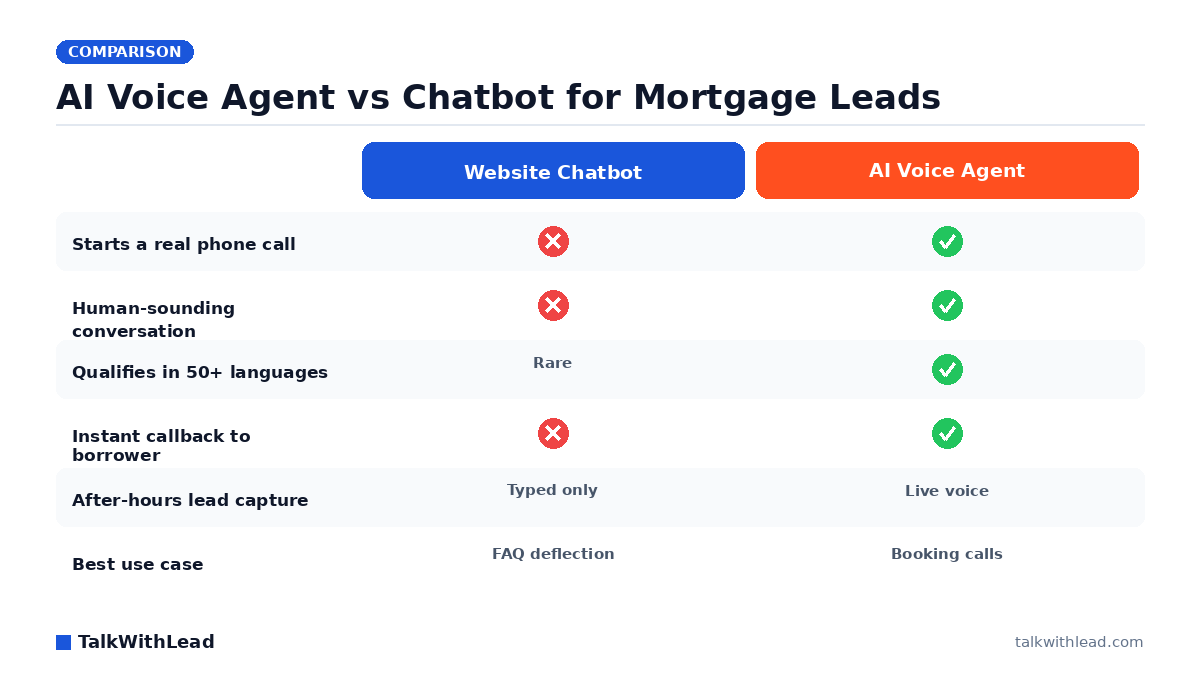
    AI Voice Agent vs Chatbot for Mortgage Leads — TalkWithLead original infographic (comparison diagram).
    AI Voice Agent vs Chatbot for Mortgage Leads

    Why This Choice Decides Who Wins the Loan

    A borrower comparing rates has three broker websites open at once, and the first broker who gets them talking usually gets the application. That is the real stakes behind the ai voice agent vs chatbot for mortgage brokers decision: it is not a software preference, it is a race for the file. Pick the tool that starts a phone conversation fastest and you win more of those races.

    TL;DR: For mortgage brokers, an AI voice agent beats a chatbot because it converts website visitors into live phone conversations instead of typed transcripts. A human-sounding voice agent calls back instantly, qualifies borrowers in more than 20 languages, and triggers instant callbacks around the clock, while a chatbot leaves the actual call — the moment a mortgage deal really starts — as a follow-up task for later. Chatbots remain useful only for simple FAQ deflection.

    What a Chatbot Actually Does With a Mortgage Lead

    A chatbot is a typing interface. A visitor lands on your rates page at 9:40 pm, opens the widget, and answers a scripted sequence: purchase or refinance, price range, credit band, email, phone. If they finish the script — and many abandon halfway through a form-like exchange — you receive a lead summary. Then the deal waits for a human to call back.

    That gap is the problem. A mortgage is the largest financial decision most people ever make, and typed answers do not build the trust that closes one. Worse, the borrower who just finished your chatbot script is now free to open a competitor’s site — one where a phone rings in the next sixty seconds. The MIT Lead Response Management study found you’re about 21× more likely to qualify a lead contacted within 5 minutes than one contacted at 30 minutes. A chatbot, by design, ends where that 5-minute clock begins.

    What an AI Voice Agent Does Differently

    An AI voice agent skips the transcript and starts the conversation. When a visitor engages the TalkWithLead widget, they talk to an extremely human-sounding AI voice agent — no hold music, no typing, no “an agent will reach out shortly.” The agent asks the same qualifying questions a sharp loan officer would: purchase or refi, timeline, property state, whether they are pre-approved elsewhere. It handles interruptions, follow-up questions, and small talk the way a person does.

    Three capabilities matter specifically for mortgage brokers:

    • more than 20 languages. A significant slice of purchase borrowers prefer to discuss a mortgage in Spanish, Hindi, Mandarin, or French. A voice agent that speaks the borrower’s own language captures borrowers your English-only chatbot quietly loses.
    • Free long-distance calling between supported countries. Out-of-state relocation buyers and cross-border investors can reach you — or be called back — without anyone thinking about toll charges.
    • Instant callbacks. A visitor who prefers their own phone gets a call within seconds, while your page is still open in front of them and their intent is at its peak.

    Hearing it is faster than reading about it: try the live demo and judge the voice quality yourself. For the numbers behind why voice outconverts typing, see our breakdown of AI voice agent vs chatbot conversion rates.

    Which Is Better for Mortgage Brokers: AI Voice Agent or Chatbot?

    For lead conversion, the voice agent wins on nearly every dimension a broker cares about. Here is the side-by-side:

    DimensionWebsite ChatbotAI Voice Agent (TalkWithLead)
    First contactTyped script; call happens laterLive phone conversation immediately
    Speed to a real conversationMinutes to days (depends on your follow-up)Seconds, via voice or instant callback
    Borrower trust on a six-figure decisionLow — feels like a formHigh — sounds like a human loan-desk call
    Language coverageUsually English, sometimes a few moreMore than 20 languages
    After-hours and weekendsCollects contact info for morning follow-upHolds the full qualifying conversation live
    Out-of-area borrowersNo calling capabilityFree long-distance calling between supported countries
    Best atDeflecting FAQ questionsBooking qualified phone calls

    Best for: mortgage brokers and loan officers whose website already gets rate-shopper traffic and who close deals over the phone — especially those serving multilingual or relocation borrowers.

    Not the right fit if: your only goal is deflecting routine servicing questions (‘what documents do I upload?’) for existing clients — a simple chatbot or help page handles that more cheaply.

    The Math: What a Faster First Call Is Worth

    Run an illustrative example on your own numbers. Say your site gets 600 visitors a month and 20 of them would talk to someone if talking were effortless. With a chatbot, imagine half abandon the script and half of the rest go cold before your callback — leaving you roughly 5 real conversations. With a voice agent answering instantly, suppose you hold 15 of those 20 conversations. If you convert conversations to funded loans at an assumed 1 in 5, that is 3 loans instead of 1 per month. At a typical broker commission per file, that gap pays for the software many times over — and you can plug in your own figures with our missed-call revenue calculator. These are stated assumptions, not customer results; the point is that the same traffic produces very different outcomes depending on how fast a conversation starts.

    Speed compounds, too. According to Harvard Business Review research, companies that reach a web lead within an hour are nearly 7× more likely to qualify it than those that wait even an hour longer. In a rate-shopping market, first-to-call wins the loan — we cover the mortgage-specific version in Speed to Lead Mortgage: Why First-to-Call Wins the Loan.

    When a Chatbot Still Makes Sense

    An honest comparison names the cases where the cheaper tool is enough. Keep a chatbot if your main need is answering repetitive servicing questions, linking existing clients to document portals, or triaging support tickets. A chatbot can also sit alongside a voice agent: let it handle ‘where do I upload my W-2?’ while the voice agent handles every new purchase and refinance inquiry. What a chatbot should never be is the only path between a high-intent borrower and your phone. Every typed exchange that ends with ‘someone will contact you soon’ is an invitation to call the next broker on the search results page.

    How to Put a Voice Agent on Your Mortgage Site This Week

    Setup is a widget install, not an IT project. Add the TalkWithLead widget to your site, tell the agent what to ask (loan type, timeline, state, preferred language), and decide whether the AI books the next step or the widget rings you and the borrower together from the start of the call. From that moment, every visitor — 2 pm or 2 am, English or Spanish, local or relocating from three time zones away — can start a real conversation instead of filling out a box.

    Start with the two-minute live demo to hear the agent handle a mortgage-style conversation. Then check pricing — it is a fraction of one funded file — and create your free account to put it on your site before the weekend’s rate shoppers arrive.

    FAQ

    Is an AI voice agent better than a chatbot for mortgage brokers?

    Yes, for lead conversion. A voice agent turns a website visit into a live phone conversation in seconds, which is where mortgage deals are actually won. A chatbot only collects typed answers and defers the call, and the MIT lead-response research shows how sharply qualification odds fall as that delay grows.

    Can an AI voice agent really qualify a mortgage lead?

    It can handle first-contact qualification: purchase vs refinance, timeline, property location, rough price range, and preferred language, then hand the borrower to you as a booked call or instant callback. Licensed advice, rate quotes, and structuring stay with you — the agent’s job is to make sure the conversation happens at all.

    What happens when a borrower visits my site after hours?

    The voice agent answers exactly as it does at noon: it holds the full conversation, qualifies the borrower, and either books a call for the morning or triggers a callback the moment you are available. A chatbot in the same situation leaves a transcript and hopes the borrower is still shopping tomorrow.

    Do AI voice agents work for borrowers who don’t speak English?

    TalkWithLead’s agent converses in more than 20 languages. For brokers in multilingual markets, that means Spanish-, Hindi-, or Mandarin-speaking borrowers get qualified in their own language instead of bouncing off an English-only widget.

    Should I remove my chatbot if I add a voice agent?

    Not necessarily. A sensible split is: chatbot for routine servicing questions from existing clients, voice agent for every new purchase or refinance inquiry. If you only keep one, keep the tool that produces phone conversations, because that is the one tied to revenue.

    How much does an AI voice agent cost compared to the leads it saves?

    Plans are published on the TalkWithLead pricing page and cost a fraction of a single funded loan’s commission. Run your own traffic and close-rate assumptions through the ROI framing above: if faster response saves you even one file a quarter, the software pays for itself many times over.

  • AI Voice Agent vs Chatbot for Local Businesses

    AI Voice Agent vs Chatbot for Local Businesses

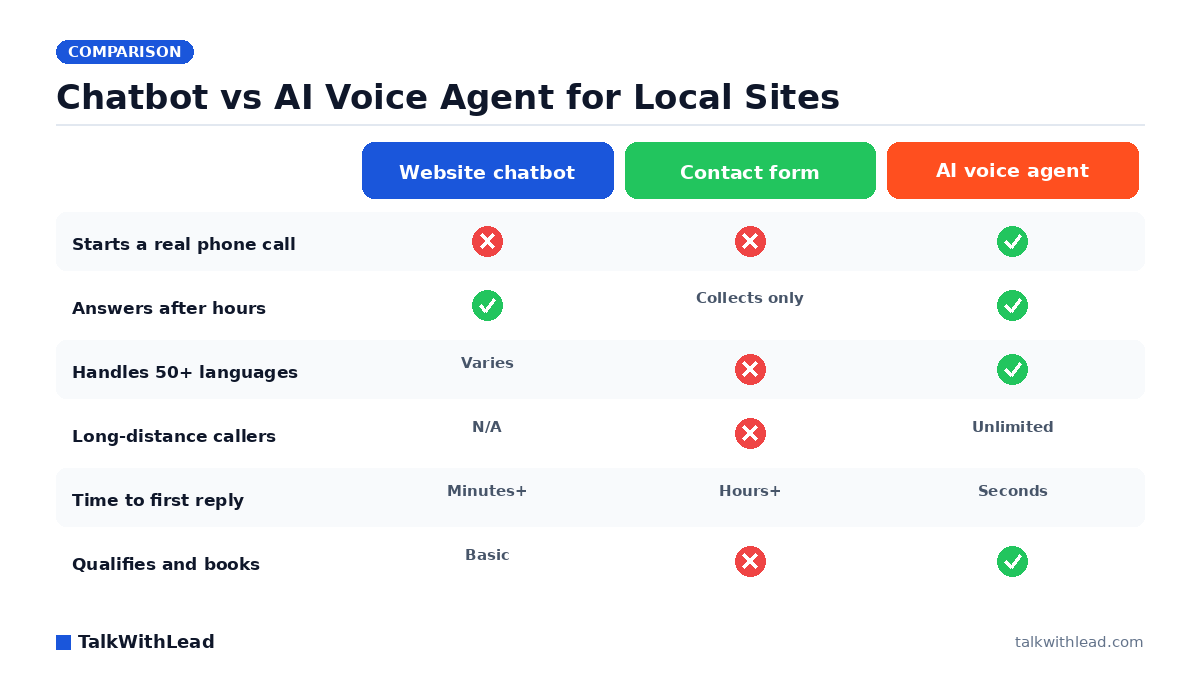
    Chatbot vs AI Voice Agent for Local Sites — TalkWithLead original infographic (comparison diagram).
    Chatbot vs AI Voice Agent for Local Sites

    A plumber’s website gets a visitor at 8:40pm with a leaking water heater. The chatbot asks for a name and email. The visitor closes the tab and calls the next company on Google. That is the whole argument in one scene.

    TL;DR: For most local businesses, an AI voice agent beats a chatbot because local buying decisions are urgent and conversational. A chatbot captures text and hands you a lead to call back later; an AI voice agent talks to the visitor immediately, answers questions in a human-sounding voice, and connects them to your business as a live phone conversation. Chatbots still earn their keep for order status and repeat-customer FAQs.

    What is the difference between an AI voice agent and a chatbot?

    A chatbot is a text interface. The visitor types, waits, reads, types again. Even a good one is a slow-motion version of a conversation, and every extra turn is another chance for the person to give up. A form is worse — it is a chatbot with no replies at all.

    An AI voice agent is a voice interface that lives on your site. The visitor clicks, speaks, and hears an extremely human-sounding voice answer back. It asks what they need, handles the qualifying questions a receptionist would ask, and turns the session into a real phone conversation — including an instant callback to their phone if they would rather talk that way. No typing, no queue, no “we’ll get back to you within one business day.”

    The distinction matters most for local service businesses, where the buyer usually has a problem right now: a burst pipe, a cracked tooth, an accident, a listing they want to see this weekend.

    Which one books more calls for a local business?

    Speed decides it. According to Harvard Business Review research, companies that reach a web lead within an hour are nearly 7× more likely to qualify it than those that wait even an hour longer. A chatbot transcript sitting in an inbox until morning is exactly the delay that research describes.

    The gap widens because most local businesses cannot answer the phone reliably in the first place. According to a 411 Locals study of 85 small businesses across 58 industries, only 37.8% of incoming calls were answered by a live person — meaning roughly 6 out of 10 calls went unattended. If the phone already leaks that badly, adding a text widget does not plug the hole. Answering the conversation instantly does.

    DimensionWebsite chatbotContact formAI voice agent
    Interaction modeTyped textOne-way submissionSpoken conversation
    Time to first human-quality answerMinutes to hoursHours to next business daySeconds
    After-hours coverageYes, text onlyCollects onlyYes, full conversation
    LanguagesVaries by vendorNonemore than 20 languages
    Out-of-area callersNot applicableNot applicableFree long-distance calling between supported countries
    Qualifies and books an appointmentBasic scripted flowsNoYes, conversationally
    Best useFAQ and order statusLow-urgency inquiriesNew high-value leads

    Want to see the voice side before you commit to anything? Take the Live Demo and talk to the agent the way a customer would. It takes about two minutes, and it settles the argument faster than any comparison chart.

    How much revenue does the slower option actually cost?

    Here is an illustrative model — your numbers will differ, and the assumptions are stated on purpose. Say a local contractor’s site gets 900 visitors a month and 40 of them start some kind of contact. Assume the chatbot captures 40 typed inquiries but only half get a reply before the person hires someone else, and assume an average job value of $600 with a 25% close rate on reached leads.

    • 20 leads reached × 25% close × $600 = $3,000 booked
    • The other 20 go cold: $3,000 in assumed lost revenue that month

    Now assume voice recovers even half of the cold half — 10 extra conversations, same close rate. That is roughly $1,500 a month recovered under these assumed rates, from traffic already on the site. Plug your own numbers into the free missed-call revenue calculator instead of trusting our example. Cost framing is simple: an AI voice agent generally lands well below the monthly cost of a part-time receptionist, and you can check the current tiers on the pricing page.

    What about customers who do not speak English — or do not live nearby?

    Two silent leaks hit local businesses harder than owners expect. The first is language. A roofing company in a mixed-language neighbourhood loses every caller who is not confident in English, and a chatbot in one language does nothing to fix that. A voice agent that handles more than 20 languages picks up those conversations in the caller’s own words — the same pattern covered in bilingual Spanish answering for contractors.

    The second is distance. Out-of-area buyers — a family relocating, an adult child arranging care for a parent, an investor buying a property two provinces away — often will not pay to call, and will not wait on a form. Free long-distance calling between supported countries removes that friction entirely, which is why voice, languages, and long distance work as a set rather than as separate features.

    When is a chatbot still the right call?

    Chatbots are not useless. They are just aimed at the wrong moment for most local lead generation. Keep the chatbot when the job is deflection rather than conversion:

    • Order and appointment status for existing customers who just want a quick lookup.
    • Repetitive policy questions — hours, service area, parking, what to bring to a first visit.
    • Silent environments, where the visitor genuinely cannot speak: an open-plan office, a hospital waiting room, a late-night browse next to a sleeping baby.
    • High-volume, low-value traffic where a human callback would not pay for itself.

    The strongest setup for most local sites is both, aimed correctly: voice as the primary path for new business, text as the fallback for logistics. If you want the deeper head-to-head on conversion behaviour, read AI voice agent vs chatbot conversion rate.

    Honest verdict

    Best for: local service businesses — contractors, clinics, law firms, real estate agents, med spas, home services — where a single new customer is worth hundreds or thousands of dollars, the buyer is usually in a hurry, and nobody can watch the phone all day.

    Not the right fit if: your visitors are mostly existing customers checking order status, your average order value is small enough that a live conversation costs more than it returns, or your audience genuinely prefers async text (some support-heavy software products fit here). In those cases a well-built chatbot is the cheaper, correct tool.

    How to switch without breaking what already works

    You do not have to rip anything out. Add the voice agent to the pages where high-intent visitors land — service pages, pricing, contact — and leave the chatbot on support and account pages. Watch which one produces booked conversations over two or three weeks and reallocate from there. Local businesses that have already run this play tend to follow the pattern described in this chatbot alternative guide.

    Three things worth setting up on day one: an instant-callback option so hesitant visitors can be called back on their own phone, after-hours coverage so evening and weekend traffic is not wasted, and a short qualifying script so the agent captures the details your team actually needs before the call is handed over.

    If the goal is more calls, more qualified leads, and more sales conversations from traffic you are already paying for, start with the Live Demo, then create your free account and put the voice agent on your busiest page this week.

    FAQ

    Is an AI voice agent better than a chatbot for a small local business?

    For generating new business, yes in most cases. Local buyers usually have an urgent problem and want to talk to someone now, and a voice agent starts that conversation in seconds instead of collecting text you answer later. A chatbot remains useful for status checks and repeat FAQs.

    Does an AI voice agent replace my receptionist?

    It covers the website enquiries your receptionist cannot — evenings, weekends, lunch breaks, and the moments when everyone is already on a call. Most businesses run both, with the agent catching what would otherwise ring out.

    Will website visitors actually talk to an AI voice agent?

    Many will, because the agent sounds human and answers instantly, which is what they wanted from the phone in the first place. For visitors who cannot speak right then, an instant callback lets them pick the moment instead of abandoning the site.

    What languages can an AI voice agent handle?

    TalkWithLead’s agent converses in more than 20 languages, so a caller who is more comfortable in Spanish, French, Punjabi, or Mandarin gets the same quality of conversation as an English speaker without you hiring for each language.

    How much does an AI voice agent cost compared to a chatbot?

    Chatbots are often cheaper per month, but they are priced against a different outcome — deflected questions, not booked jobs. The honest comparison is cost per booked conversation, and current plans are listed on the pricing page.

    Can I keep my chatbot and add a voice agent?

    Yes, and that is usually the smartest first move. Put voice on high-intent pages, leave the chatbot on support and account pages, and compare booked conversations from each over a few weeks before changing anything else.

  • AI Voice in Hindi for Real Estate: Stop Losing Leads

    AI Voice in Hindi for Real Estate: Stop Losing Leads

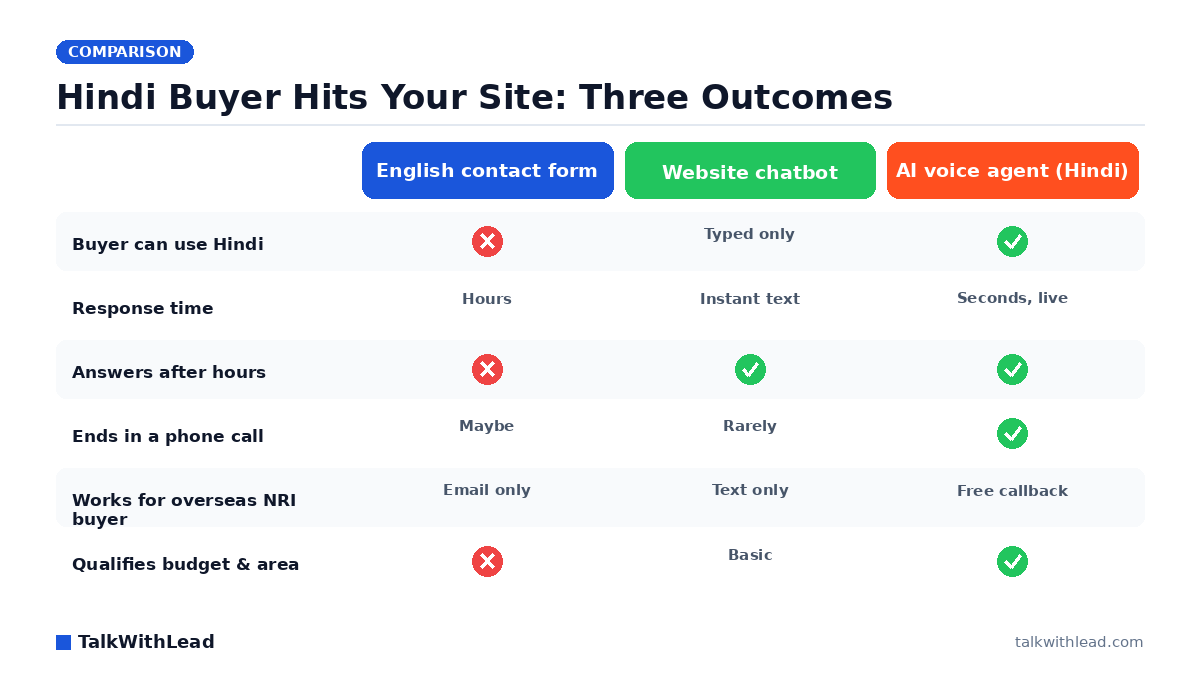
    Hindi Buyer Hits Your Site: Three Outcomes — TalkWithLead original infographic (comparison diagram).
    Hindi Buyer Hits Your Site: Three Outcomes

    Why Hindi-speaking buyers disappear from English-only real estate sites

    A family scrolling your listings at 10pm speaks Hindi at home. Your site speaks English, your form is in English, and the callback promise says “within one business day.” They close the tab and open the next agent’s site. That is the whole leak, and ai voice in hindi for real estate is how you plug it.

    TL;DR: An AI voice agent that speaks Hindi answers your website visitor by phone within seconds, in the language they actually think in, at any hour. Instead of a form fill you review tomorrow, you get a live conversation that captures budget, area, and timeline — and books the showing before a competing agent returns the call.

    Why Hindi-speaking buyers disappear from English-only real estate sites

    Property is an emotional, high-figure decision. People negotiate it in their first language. A buyer who is perfectly functional in English at work will still hesitate to describe a family budget, a joint purchase with parents, or a loan situation in a second language — especially in writing, where every sentence feels permanent and judged.

    So they do the quiet thing. They read your listings, they do not fill the form, and they leave no trace in your CRM. You never see that lead in a report, because a lead that never identifies itself is invisible. Imagine a site where eight in ten visitors browse and vanish without a single call — the visitors you never hear from are not “low intent,” they are un-served.

    The gap widens for NRI buyers. Someone shopping for a flat in Pune from Dubai or Mississauga is dealing with a time zone offset, an international dialing cost, and a form that promises a callback during your office hours. Every one of those is a reason to give up.

    How does an AI voice agent in Hindi actually work on a real estate website?

    A small widget sits on your listing pages. The visitor taps it, enters a number or asks for a call, and an extremely human-sounding AI voice agent calls them — usually within seconds. TalkWithLead’s agent handles the conversation in more than 20 languages, so the same widget that greets a Hindi speaker in Hindi greets the next visitor in English, Punjabi, Gujarati, or Tamil without you configuring three separate funnels.

    The conversation is not a menu tree. The agent asks what the buyer is looking for, which area, roughly what budget, whether they are financing, and when they want to see the place. It reads back what it heard, confirms a showing window, and pushes the qualified details to you. Free long-distance calling between supported countries means the buyer in Dubai pays nothing to talk to you, and you are not making an international call at 2am to catch them.

    Two things make this different from every callback promise you have made before: it happens instantly, and it happens at 11pm on a Sunday. You can hear the agent handle a live conversation yourself on the TalkWithLead live demo — it takes about a minute and it answers the “does it sound robotic” question better than any paragraph can.

    Hindi voice vs. chatbot vs. contact form: what each one actually gets you

    Agents usually already have a chatbot or a form. The honest comparison is not “voice good, text bad” — it is that each channel produces a different kind of lead.

    DimensionContact formWebsite chatbotAI voice agent (Hindi)
    Buyer’s effortType name, email, phone, messageType answers, in English usuallyTalk normally in Hindi
    Speed of first human-feeling contactHours to next business dayInstant text, no voiceSeconds, live on the phone
    Works after hours and weekendsCollects onlyYes, text onlyYes, full conversation
    Handles a Hindi speaker naturallyNoTyped Hindi at bestNative spoken Hindi
    Overseas / NRI buyerEmail tag, timezone lagText lagFree long-distance calling between supported countries callback
    Typical outcomeA row in a spreadsheetAn email addressA booked showing

    Chat is fine for “is parking included.” It is weak for “my parents are co-signing, we need possession before Diwali, and we can stretch to a certain number if the floor is higher.” That conversation happens out loud or it does not happen. If you are weighing the two channels more broadly, we broke it down in Live Chat Alternative for Real Estate Agents, and the same language logic applies to other markets — see AI Voice in French: Capturing Real Estate Leads You Lose.

    Why speed decides who gets the Hindi-speaking buyer

    Language removes the friction. Speed decides the winner. The MIT Lead Response Management study found you’re about 21× more likely to qualify a lead contacted within 5 minutes than one contacted at 30 minutes.

    Now stack the phone problem on top. According to a 411 Locals study of 85 small businesses across 58 industries, only 37.8% of incoming calls were answered by a live person — meaning roughly 6 out of 10 calls went unattended. An agent is showing a property, driving, or asleep. That is not a discipline problem; it is a coverage problem, and software fixes coverage problems better than willpower does.

    The deeper mechanics of response timing are in Speed to Lead Real Estate: Book More Showings if you want the full argument.

    What is a missed Hindi-speaking lead worth? An illustrative ROI example

    Numbers make this concrete. The following is an illustrative example with stated assumptions, not a customer result — swap in your own figures.

    • Assume your site gets 1,200 visitors a month and 300 of them are more comfortable in Hindi.
    • Assume only 3% of that Hindi-comfortable group currently fills your English form — that’s 9 inquiries, and 291 people you never met.
    • Assume a Hindi-speaking voice agent converts even 5% of the remaining 291 into a live conversation — about 14 extra qualified callers a month.
    • Assume a 5% close rate on those callers, at an average commission of $6,000.

    That’s roughly 0.7 additional closings a month in this scenario — call it $4,200 in monthly commission from conversations that previously did not exist. Against a tool that costs a fraction of one commission, the payback question stops being interesting after the first deal. Run your own version with the free missed-call revenue calculator, and check current tiers on the TalkWithLead pricing page.

    Best for: agents, brokerages, and developers whose website traffic includes a meaningful share of Hindi-speaking or NRI buyers, and who cannot staff a bilingual receptionist across evenings, weekends, and overseas time zones.

    Not the right fit if: your inquiry volume is a handful a month and you personally answer every call within minutes — at that size, a voice agent is convenience, not revenue recovery.

    Setting it up without breaking what already works

    Keep your existing form. It costs nothing to leave it and it catches the people who prefer typing. Add the voice layer on top and let the buyer pick.

    A practical rollout looks like this:

    1. Install the widget site-wide, then confirm it appears on individual listing pages — that’s where intent peaks.
    2. Feed the agent your real inventory language: neighbourhoods, project names, possession timelines, price bands, financing partners.
    3. Set the qualification questions you would ask on a first call. Budget, area, buy-or-invest, timeline, financing status.
    4. Decide the routing. A hot buyer with a firm timeline triggers an instant SMS and email alert to you; everyone else lands in your CRM with a transcript.
    5. Read the transcripts for two weeks. They are the cheapest market research you will ever get — you will find out exactly which objections kill your listings.

    The three capabilities that decide whether any of this converts — voice quality, language coverage, and long-distance reach — are covered in The Three Things an AI Voice Agent Needs to Convert. When you’re ready to run it against your own traffic, start a free TalkWithLead signup and point it at your busiest listing page first.

    FAQ

    Can an AI voice agent really hold a natural conversation in Hindi?

    Yes — the agent speaks conversational Hindi rather than reading a translated script, and it handles the Hindi-English code-switching most urban Indian buyers use naturally. The fastest way to judge it is to hear it: run the live demo and speak to it the way a buyer would.

    What happens if the buyer switches to English mid-call?

    The agent follows. Because it supports more than 20 languages in the same conversation layer, a buyer who starts in Hindi and drops into English for the numbers gets one continuous conversation rather than a restart.

    Will this work for NRI buyers calling from outside India?

    That’s one of the strongest use cases. Free long-distance calling between supported countries means the agent calls the buyer wherever they are at no cost to them, and because it runs around the clock, a buyer in Toronto or Dubai never has to match your office hours.

    How is this different from the chatbot already on my site?

    A chatbot collects text; a voice agent creates a phone conversation. For a property decision, spoken dialogue surfaces budget, urgency, and objections that nobody types into a chat window — and it ends in a booked showing rather than an email address.

    Do I lose control of my leads?

    No. You set the qualification questions, you receive the transcript and the contact details, and you decide which enquiries ring your phone directly in human mode. The agent is the first responder, not the closer.

    How much does an AI voice agent for real estate cost?

    Pricing is a monthly subscription tier rather than a per-minute answering-service bill, so cost stays predictable as volume grows. Current tiers are listed on the pricing page, and the missed-call revenue calculator will tell you how many recovered conversations it takes to pay for itself with your own numbers.

  • AI Voice in French: Capture Real Estate Leads You Lose

    AI Voice in French: Capture Real Estate Leads You Lose

    How French-Speaking Buyers Get Handled — TalkWithLead original infographic (comparison diagram).
    How French-Speaking Buyers Get Handled

    A francophone buyer opens your listing page at 9:40pm, reads three lines of English, and closes the tab. No form. No call. Nothing in your CRM. That lead did not go cold — it never got warm, because nobody on your site spoke their language at the moment they were ready to talk.

    TL;DR: AI voice in French real estate means a human-sounding AI voice agent on your website greets a French-speaking visitor in French, holds a real spoken conversation, answers questions about the listing, and books a showing or calls them back instantly — 24/7, in more than 20 languages, including long-distance. It converts visitors you currently lose to language friction and slow follow-up.

    Why French-speaking buyers vanish from English-only real estate sites

    Language friction is quiet. A buyer who cannot comfortably read your intake form does not complain, does not email, and does not call an English voicemail greeting. They go back to the search results and click the next agent. You never see the loss because there is no record of it.

    The pattern shows up wherever a market is genuinely bilingual: Montreal and the rest of Quebec, Ottawa-Gatineau, New Brunswick, francophone communities across Ontario and Manitoba, plus French buyers purchasing abroad — Florida, Morocco, the Caribbean. Picture a listing page that draws 400 visits a month and say a quarter of that traffic is more comfortable in French. That is 100 people a month deciding, in about four seconds, whether your business is for them.

    Adding a translated page helps discovery. It does not solve the conversation. The buyer still has to type into a form and wait for a callback that may arrive tomorrow, in English, from someone who mispronounces their name.

    How does an AI voice agent handle a French-speaking website visitor?

    The visitor clicks a call button on your listing page. Within seconds a natural-sounding AI voice agent picks up — in French, without a menu tree, without “press 1 for service en français.” It asks what they are looking for, which neighbourhood, what timeline, whether they are pre-approved. It answers the obvious questions about the property. Then it books the showing directly into your calendar or triggers an instant callback so the buyer is on the phone with your team while the listing is still open on their screen.

    Three things make that work in practice:

    • Voice, not typing. A buyer asking about a condo’s balcony, the school catchment, and whether the seller will move the closing date will say all of that in one breath. They will not type it.
    • more than 20 languages on the same widget. You are not choosing between English and French. Spanish, Portuguese, Mandarin and Arabic buyers get the same treatment on the same page.
    • Free long-distance calling between supported countries. An overseas buyer looking at a Canadian property is not going to pay international rates to ask a question. The callback goes out from your side.

    The fastest way to judge tone and pacing is to hear it yourself — try the live demo and ask it a listing question the way a real buyer would.

    Why speed matters more than polish in real estate

    Property buyers shop in parallel. They open five agents’ pages in five tabs. Whoever gets into a real conversation first usually gets the showing, and the showing usually decides the relationship.

    The MIT Lead Response Management study found you’re about 21× more likely to qualify a lead contacted within 5 minutes than one contacted at 30 minutes. And according to Harvard Business Review research, companies that reach a web lead within an hour are nearly 7× more likely to qualify it than those that wait even an hour longer.

    Now layer language on top of that clock. If the francophone lead has to wait for the one bilingual person on your team to be free, your five-minute window is gone before anyone dials. An AI voice agent removes both delays at once — the language wait and the staffing wait. For a deeper look at the timing side alone, see Speed to Lead Real Estate: Book More Showings.

    French AI voice vs. the alternatives on your listing page

    CapabilityEnglish contact formBilingual live chatFrench AI voice agent
    Responds in French immediatelyNoOnly when a French-speaking agent is onlineYes, every time
    Available nights and weekendsCollects onlyUsually noYes, 24/7
    Format of the conversationTyped, one-wayTyped, back-and-forthSpoken, real-time
    Handles overseas buyersNo callingNo callingFree long-distance calling between supported countries callback
    Books a showing without youNoSometimesYes
    Effort asked of the buyerHighMediumLow

    Best for: agents, teams and brokerages with meaningful French-speaking or multilingual traffic who lose leads after hours and cannot staff a bilingual desk around the clock.

    Not the right fit if: your entire market speaks one language, your call volume is low enough that you personally answer every inquiry within minutes, or your leads come from referrals rather than your website.

    If you are weighing voice against a chat widget more broadly, Live Chat Alternative for Real Estate Agents breaks down where each one actually converts.

    What is this worth? A labeled ROI example

    This is an illustrative scenario, not a customer result. Assume a brokerage site gets 1,200 sessions a month and say roughly 300 of those visitors would rather speak French. Suppose 6% of French-speaking visitors will engage with a voice agent that greets them in their language — that is 18 conversations a month that previously produced silence. Say 1 in 4 of those becomes a booked showing: 4 or 5 extra showings. If one closes every couple of months at an average commission you can plug in yourself, the arithmetic tends to settle quickly.

    Run your own numbers instead of trusting mine — the free missed-call revenue calculator takes about a minute. Then compare that figure against TalkWithLead pricing, which sits in the ordinary monthly-software range rather than the per-hour range of a staffed bilingual answering desk.

    How to roll it out on a real estate site without breaking anything

    Start narrow and measure. The rollout that works looks like this:

    1. Put the widget on listing pages first. That is where intent is highest and where language friction costs the most.
    2. Write the French qualification script the way you actually speak. Neighbourhood, budget range, pre-approval status, timeline, best time to view.
    3. Decide the routing rule. Some teams run human mode so a rep is on the call with every qualified francophone buyer from the start; others prefer the agent to book the slot and send the brief.
    4. Turn on instant callback for after-hours. A 10pm inquiry that gets a call at 10:01pm feels like service, not automation.
    5. Track one number: booked showings per 100 French-speaking sessions. Chat transcripts and “engagements” are vanity; a calendar entry is not.

    The same three ingredients apply in every vertical — voice, languages, and long-distance reach — real estate just punishes their absence faster because listings move.

    If your francophone traffic is already there and going quiet, the setup is short: start free, drop the widget on your listing template, and let the next 9:40pm visitor hear a voice that speaks their language. Prefer to hear it before committing? The live demo takes two minutes.

    FAQ

    Can an AI voice agent really hold a natural conversation in French?

    Yes. The voice is designed to sound human rather than robotic, and it handles interruptions, follow-up questions and clarifications the way a person would. Most buyers treat it as a phone call, not a menu system.

    The practical test is whether it can answer a specific listing question and then book a time. That is what to check during a demo.

    What happens if a French-speaking buyer asks something the agent can’t answer?

    It escalates. The agent takes the question, captures contact details and the context, and either alerts your team immediately or schedules an instant callback so a human closes the loop with the full conversation already summarized.

    Does it work for languages other than French?

    It covers more than 20 languages on the same widget, so a Spanish-speaking buyer and a Mandarin-speaking buyer get the same instant treatment as a francophone one. You do not have to build a separate site or hire per language.

    Will this replace my bilingual assistant?

    It usually replaces the hours nobody covers — evenings, weekends, showings, vacations — rather than the person. Your assistant stops fielding “what’s the square footage” and starts working pre-qualified buyers who already have a showing booked.

    Can it call international buyers looking at properties here?

    Yes. Free long-distance calling between supported countries means the callback goes out from your side, so a buyer in France or Morocco pays nothing to have a conversation about a property in Canada.

    How fast can I get this live on my listing pages?

    Adding the widget is a snippet on your site template, so most agents are live the same day. The longer part is deciding your qualification questions and alert rules, which is worth an hour of thought.

  • The Three Things an AI Voice Agent Needs to Convert

    The Three Things an AI Voice Agent Needs to Convert

    What a Voice Agent Needs to Convert — TalkWithLead original infographic (comparison diagram).
    What a Voice Agent Needs to Convert

    Most AI voice tools fail for a boring reason: they sound wrong, they only speak one language, or they refuse to dial the caller’s area code. The three things an AI voice agent needs to convert a website visitor are a voice a human will stay on the line for, language coverage that matches the traffic you actually get, and calling that never stops at a border.

    TL;DR: An AI voice agent converts website visitors when it does three things well — speaks with a human-sounding voice that survives the first ten seconds, handles the visitor’s own language across more than 20 options, and calls back anywhere without long-distance limits. Miss any one and the conversation ends before your sales team ever hears about it. TalkWithLead ships all three plus instant callbacks.

    What are the three things an AI voice agent needs to convert visitors?

    Strip away the demos and the dashboards. A website visitor converts when a real conversation happens — voice, in their language, on their phone. Everything else is packaging. The three requirements, in order of how fast they kill a lead when missing:

    • A human-sounding voice. The first ten seconds decide whether the visitor talks or hangs up.
    • Real multilingual coverage. A buyer who cannot explain their problem in their own words will not explain it at all.
    • Free long-distance calling between supported countries. A voice agent that cannot dial the number in front of it is a very expensive voicemail.

    Forms and chatbots fail on all three at once. A form takes text and a promise. A chatbot takes text and stalls. Voice takes the visitor straight to the outcome your business runs on: a phone conversation with someone who was on your pricing page thirty seconds ago.

    Thing one: a voice people do not hang up on

    Robotic prosody is the fastest exit ramp in lead conversion. Flat cadence, no breath, wrong emphasis — buyers recognize it instantly and treat it the way they treat an obvious robocall. Which is to say, they end the call. That is why voice quality belongs in the conversion column of your spreadsheet, not the branding column.

    An extremely human-sounding voice buys you the only thing that matters early: enough seconds for the visitor to say what they came for. Once they are talking, the agent can qualify, answer pricing questions, and book. Once they hang up, nothing downstream helps. Our own comparison of AI voice agents versus chatbots walks through where each one loses the visitor.

    Judge this with your ears, not a feature list. Call the agent yourself, interrupt it mid-sentence, ask something off-script, and listen to how it recovers. You can do exactly that on the TalkWithLead live demo — it takes about a minute and tells you more than any vendor page.

    Thing two: more than 20 languages, because your traffic is not monolingual

    Look at your analytics by country and browser language. Unless you sell something hyper-local, a slice of your traffic is reading your English page in their second or third language — well enough to browse, not comfortably enough to negotiate. Those visitors bounce quietly and you log it as “low intent.”

    A voice agent that handles more than 20 languages flips that. The visitor clicks, the agent greets them in their language, and the conversation happens at full fluency instead of at translation speed. That is not a nice-to-have in a market where a bilingual competitor is one search result away. We covered the same dynamic in French real estate leads in this breakdown of French-language voice capture.

    Picture a site pulling 4,000 monthly visitors where roughly one in eight prefers a language you do not answer in. Say even a tenth of that group would have booked a call if someone spoke their language — that is a handful of qualified conversations a month, gone, with no trace in your CRM to argue about. Framed math, not a measured statistic, but run it on your own numbers and the shape holds.

    Thing three: free long-distance calling between supported countries, or you are rejecting buyers by area code

    This is the requirement nobody puts on the shortlist and everybody regrets. Callback systems with metered or region-locked calling quietly decline the numbers that cost the most to dial. The visitor requested a call. Your system decided the call was too expensive. Nobody tells you.

    Free long-distance calling between supported countries removes that entire failure class. A prospect three time zones or one ocean away gets the same instant callback as someone across town. For anyone selling remotely — SaaS, brokerage, consulting, franchise services — that is not an edge case, it is a meaningful share of pipeline. The same logic drives SaaS demo request conversion on pricing pages, where the buyer’s location is essentially random.

    RequirementWeb formWebsite chatbotAI voice agent
    Human-sounding voiceNoneNoneYes, conversational
    Language coverageOne, as writtenText translation20+ spoken
    Long-distance reachNot applicableNot applicableUnlimited
    Time to first responseHours to daysMinutes, then queuedSeconds
    Output for sales teamForm fieldsChat transcriptLive phone conversation
    After-hours coverageCollects onlyDeflectsAnswers and books

    Why speed is the thread running through all three

    Each requirement exists to protect the same asset: the narrow window where a visitor is still interested. According to Harvard Business Review research, companies that reach a web lead within an hour are nearly 7× more likely to qualify it than those that wait even an hour longer. An agent that sounds human, speaks the visitor’s language, and can dial any number collapses that response window to seconds.

    The failure mode is easy to picture. A visitor fills out a form at 8:40 p.m. Your rep sees it at 9:15 the next morning. By then the visitor has talked to two competitors. Nothing about your product lost that deal — your response time did. That is the same argument we make in why the first 60 seconds win most deals.

    If you want to size the cost for your own business before changing anything, run your numbers through the free missed-call revenue calculator. It uses your inputs and states its assumptions instead of handing you a scary number with no math behind it.

    An illustrative ROI example

    Illustrative scenario, not a customer result. Assumptions are stated so you can swap in your own.

    Assume 3,000 monthly website visitors, an assumed 2% who would take a call if offered instantly (60 conversations), an assumed 25% of those becoming qualified opportunities (15), and an assumed close rate of 20% at an average deal value of $1,500. That works out to 3 closed deals a month, or roughly $4,500 in new revenue from conversations that previously ended as bounces. Change any assumption and the output changes — that is the point of showing the math instead of asserting a result.

    Against that, price the tooling honestly. Voice agent platforms in this category generally land in the tens-to-low-hundreds of dollars per month range depending on volume and features; you can see TalkWithLead’s tiers on the pricing page. The comparison worth making is not agent-versus-nothing, it is agent-versus-the-leads-you-are-currently-losing.

    Best for, and not the right fit if

    Best for: businesses with steady website traffic, a sales process that runs on phone conversations, and buyers spread across regions or languages — brokerages, agencies, clinics, contractors, and SaaS teams with self-serve traffic that needs a human nudge.

    Not the right fit if: your site gets very little traffic, your product genuinely closes without a conversation, or your buyers actively prefer async text and your existing chat already books at a rate you are happy with. A voice agent multiplies existing demand — it does not manufacture it.

    How to evaluate a voice agent in one afternoon

    Skip the feature matrix and test the three requirements directly:

    1. Call it and interrupt it. Talk over the greeting. A human-sounding agent yields; a script barrels on.
    2. Try it in a second language. Ask a question in Spanish, French, or Portuguese and hear whether it follows.
    3. Give it a distant number. Request a callback to an out-of-region or international line and confirm the call actually lands.
    4. Test after hours. Run the same three checks at 10 p.m. That is when your competitors’ forms are asleep.
    5. Check the handoff. A booked call is worthless if it does not reach the right person with context.

    If a tool passes all five, it will convert traffic you are already paying for. If it fails the third one, keep looking — long-distance limits are the defect you discover last and pay for longest. For a broader shortlist view, our general buyer’s guide to AI voice agents for small business covers the wider field.

    Ready to put all three on your own site? Start free with TalkWithLead, or try the live demo first and hear the voice your visitors would hear.

    FAQ

    What are the three things an AI voice agent needs to convert website visitors?

    A human-sounding voice that keeps the visitor on the line, spoken coverage across more than 20 languages so buyers can talk in their own words, and free long-distance calling between supported countries so no callback is blocked by geography. Instant callback speed ties the three together.

    Does an AI voice agent really sound human enough to work?

    Modern voice models handle natural cadence, interruptions, and follow-up questions well enough that most visitors simply have a conversation. The honest test is to call one yourself and try to break it — interrupt it, change topics, ask something off-script.

    Why does free long-distance calling between supported countries matter for lead conversion?

    Metered or region-limited calling silently declines expensive numbers, so out-of-region buyers who requested a call never get one. You lose the lead and never see it in a report. Unlimited calling removes that failure mode entirely.

    Is an AI voice agent better than a chatbot for converting website traffic?

    For anything that closes over the phone, yes — voice reaches the outcome directly instead of collecting text and queuing a human. Chatbots still fit self-serve products with async buyers. Our voice versus chatbot conversion comparison breaks down where each wins.

    How fast should a voice agent call a website visitor back?

    Seconds, not minutes. The visitor is still on the page with the problem fresh in mind. Research on lead response consistently favors the fastest responder, and an AI agent answering instantly is the only way to hit that window at every hour of the day.

    How much does an AI voice agent cost?

    Pricing in this category typically scales with call volume and feature tier, landing in the tens-to-low-hundreds of dollars per month for most small and mid-sized businesses. TalkWithLead’s current tiers are listed on the pricing page.

Your next lead is on your site right now — ready to talk.

TalkWithLead’s AI voice agent rings that visitor back in seconds, qualifies the lead in their language, and books the call before the prospect can open a competitor’s tab. Forms are slow. Chatbots make people type. Voice closes.

Just curious about plans? See pricing →