AI Voice Agents That Turn Website Visitors Into Real Conversations
TalkWithLead is the AI voice-first widget that turns a website visitor into a phone call. The visitor enters their number, the system rings them, and an AI voice agent talks with them — multilingual, extremely human-sounding, and free to call between a list of supported countries. More calls. More leads. More closed deals.
Bland AI pricing looks simple: each plan has a per-minute rate and a platform fee. The real monthly bill adds telephony and a separate transfer-time charge, and call caps can decide your plan before the rate does.
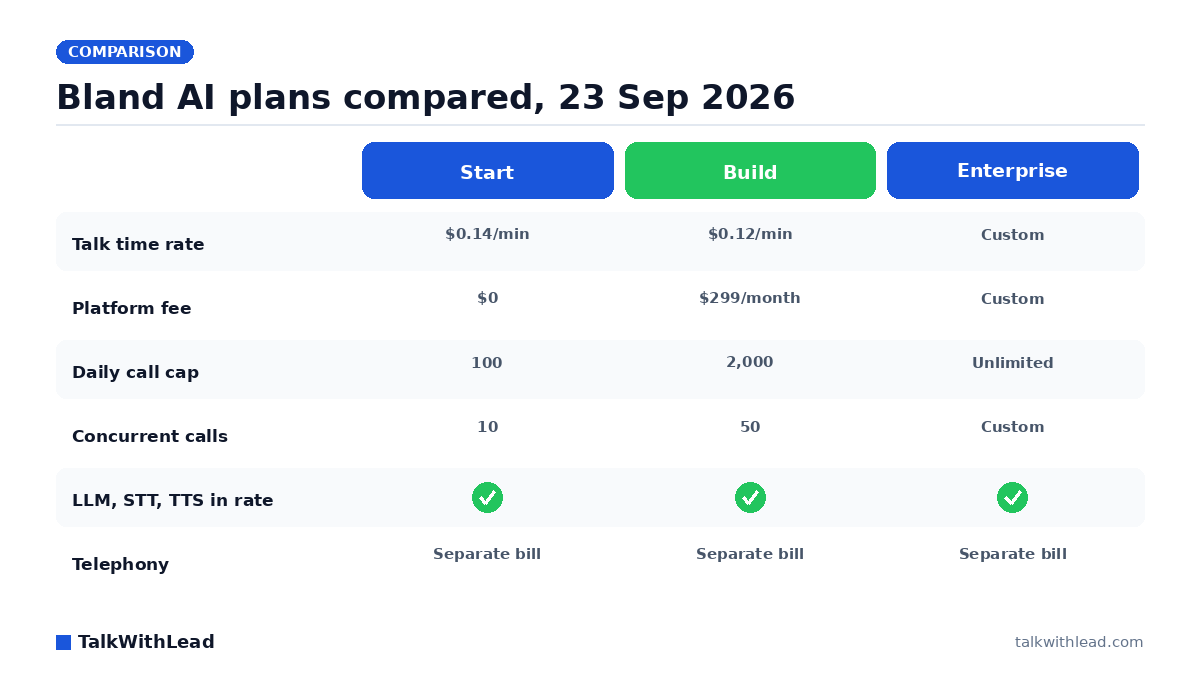
Direct answer: As of 23 September 2026, Bland’s pricing page lists three plans. Start costs $0.14 per minute with a $0 platform fee and no card required. Build costs $0.12 per minute plus a $299 per month platform fee. Enterprise is custom. The per-minute rate includes the LLM, speech-to-text and text-to-speech. Telephony is billed separately.
Every Bland figure below was read from that page on 23 September 2026 and is reported the way Bland prints it. Pricing pages can change without notice, so check the live page before you commit a budget.
Bland AI plans compared (observed 23 September 2026)
Bland describes Start as “for developers”, Build as “for teams” and Enterprise as “for organizations”. The table shows every published rate and limit for each plan.
Plan
Talk time rate
Platform fee
Transfer time rate
Daily call cap
Hourly call cap
Concurrent calls
Voices
Knowledge bases
Start
$0.14 per minute
$0
$0.05 per minute
100
100
10
1
10
Build
$0.12 per minute
$299 per month
$0.04 per minute
2,000
1,000
50
5
50
Enterprise
Custom
Custom
Custom
Unlimited
Unlimited
Custom
Unlimited
Unlimited
A few terms are not in the table. Start needs no card. Signing up gives you 2 credits and an inbound number, which Bland values at $15 per month. Enterprise rates and concurrency are custom and set by contract according to volume. Enterprise can also include on-prem or VPC deployment, a forward deployed engineer, a BAA, SSO and data residency. Bland prints a 99.9% uptime SLA for all tiers.
On timing, Bland’s FAQ says most teams deploy a first agent within a day on the self-serve plans. Enterprise deployments follow a 28-day deployment framework. On security, Bland states SOC 2 Type I and Type II, HIPAA eligibility with a BAA, GDPR and PCI DSS. Those are Bland’s own statements; this page has not verified them.
What the per-minute rate includes – and what it does not
Bland’s per-minute rate covers three things: the LLM, with no token charges; real-time speech-to-text; and premium text-to-speech voices. The model the agent runs on does not come with a separate token bill.
Three costs are billed outside that rate:
Telephony. Billed separately. You can use your own carrier or Bland’s built-in Twilio at pass-through cost. Bland also works with an existing Twilio account or SIP trunks.
Transfer time. A separate per-minute charge on Bland’s price list: $0.05 per minute on Start and $0.04 per minute on Build. Bland says customers who bring their own telephony pay no transfer fees. This page uses “transfer time” only as the name of a billing line. Check Bland’s documentation for what counts toward it.
The platform fee. $0 on Start, $299 per month on Build and custom on Enterprise. On Build it is a fixed monthly charge on top of the minutes.
To budget, multiply your talk minutes by the plan rate, then add the platform fee, telephony and any transfer minutes. Only the first two are fixed by the pricing page. Telephony depends on your carrier and the calls you make.
What Bland AI costs at real volumes
The calculations below use Bland’s list rates from 23 September 2026 and count talk minutes only. Telephony and transfer time are left out because both depend on your setup.
Illustrative example, not a quote: a team expects 2,000 talk minutes a month on Start. 2,000 × $0.14 = $280 a month, with no platform fee.
Illustrative example, not a quote: the same 2,000 talk minutes on Build. 2,000 × $0.12 = $240, plus the $299 platform fee = $539 a month.
Illustrative example, not a quote: Build saves $0.02 on every minute, so its $299 fee is paid back at 14,950 talk minutes a month ($299 ÷ $0.02). Below that volume, Start’s list rates give the smaller talk-time bill. Above it, Build’s do.
The caps can decide the plan before the price does. Start allows 100 calls a day, 100 calls an hour and 10 concurrent calls. Build raises those limits to 2,000 a day, 1,000 an hour and 50 concurrent. Illustrative example, not a quote: assume calls average three minutes. Start’s cap of 100 calls a day then allows at most 9,000 talk minutes in a 30-day month (100 × 30 × 3). That is well below the 14,950-minute break-even, so in this case the cap, not the rate, moves a team to Build. Size the plan on your busiest day and busiest hour first, then compare prices.
How Bland’s pricing compares with Vapi and Retell – by Bland’s own account
Bland’s FAQ includes its own comparison. According to Bland’s pricing page, Vapi lists $0.05 per minute and Retell about $0.07 per minute, and both figures cover voice infrastructure only. With typical providers added, Bland estimates the total at roughly $0.13-$0.30 per minute on Vapi and $0.11-$0.25 per minute on Retell.
These are Bland’s estimates, published by a company that competes with both. They are not our figures, and this page did not re-check Vapi’s or Retell’s prices. The real difference is how the prices are built. Bland puts the LLM, speech-to-text and text-to-speech into one rate. By Bland’s account, the Vapi and Retell headline rates leave those providers to be billed on top, so the total changes with the model, voice and carrier you choose.
None of these vendors comes out ahead on paper. A fair comparison needs your own average call length, provider choices and daily peak, checked against each vendor’s live page.
When you do not need a voice platform at all
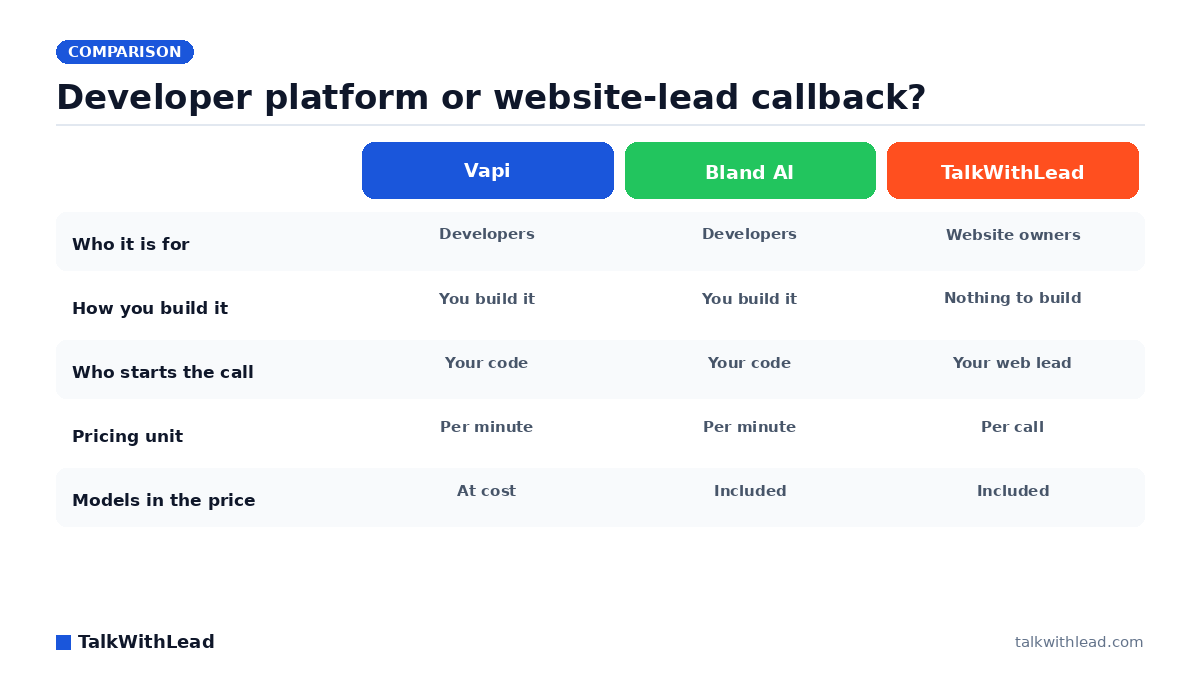
Bland, Vapi and Retell are platforms for building voice agents. You design the agent, supply or rent telephony, and pay for every minute it talks. Some teams looking up Bland AI pricing have a much narrower job in mind: calling back, quickly, the people who leave a phone number on their website. A different kind of product fits that job.
Speed is why that job matters. According to Harvard Business Review research (March 2011), companies that reach a web lead within an hour are nearly 7× more likely to qualify it than those that wait even an hour longer.
TalkWithLead does that one job. A visitor enters a phone number anywhere on your own website: the widget, a contact or quote form, or an abandoned-cart flow. A number can also come from your CRM or other software through the API. TalkWithLead then calls that number within seconds. Most customers let the AI voice agent speak with the person. In human mode, the system calls the visitor and your own staff at the same time, so the two people talk directly. The live demo page says the AI voice agent “can answer questions, collect contact details, qualify the lead, and help move that visitor closer to becoming a paying customer – even when you are busy, closed, or unavailable.”
Published features include:
custom fields on the widget, to ask for extra details before or after the visitor requests the call
optional call recording, with transcripts sent by email
callbacks that ring several of your reps at once or take turns in round-robin order
working hours you set; outside them, the widget offers a callback for when you are back
your own number as caller ID
an API for sending in numbers from other software
conversations in more than 20 languages
The pricing works differently too. Plans are priced by the number of calls. There is no per-minute meter, no LLM bill and no telephony bill:
Standard: $99.99 USD a month, 100 calls, 3 widgets
Advanced: $199.99 USD a month, 200 calls, 4 widgets
Professional: $299.99 USD a month, 400 calls, 6 widgets
Enterprise: $599.99 USD a month, 800 calls, 15 widgets
Paid plans need a card and also come with a 14-day trial. The full details are on the TalkWithLead pricing page. Illustrative example, not a result: a site that gets 100 callback requests a month fits the Standard plan at $99.99 USD a month, however long each conversation runs.
TalkWithLead is not a developer platform. There is nothing to build, no inbound number and no calling campaigns or list dialing. It has no call forwarding and no missed-call detection, and it does not text leads. Calls to the phone number on your site keep reaching you just as they do today. To hear it, open the live demo and enter your number in the widget. The AI voice agent will call you.
Who this is not for
TalkWithLead has real limits, and they matter if you came here to price Bland:
You cannot design, script or deploy your own voice agents with it.
It gives you no inbound number for people to dial.
It does not run outbound calling campaigns. It only calls numbers that come from your website, CRM or API.
It does not give you the developer-level control over the agent that Bland’s plans are built around.
It does not write to your calendar or update your CRM, and the Basic plan stops at 10 calls.
Best for: a business that wants every phone number left on its website, whether in the widget, a contact or quote form, or an abandoned cart, called back within seconds by an AI voice agent or its own staff, for a fixed price per plan based on the number of calls.
Not the right fit if: you are building your own voice agents, need an inbound number, run outbound calling campaigns or need Bland-style developer controls. For that work, choose Bland, Vapi or Retell.
If your job is the narrow one, Basic is $0 with no credit card, 10 calls and a 14-day trial: start on the Basic plan. If it is not, take the arithmetic above to Bland’s live page and size Start or Build on your busiest day.
FAQ
How much does Bland AI cost per minute?
As of 23 September 2026, Bland charges $0.14 per minute of talk time on Start and $0.12 per minute on Build. Enterprise rates are custom. The rate includes the LLM, speech-to-text and text-to-speech. Telephony is billed separately.
Is Bland AI free?
Start has a $0 platform fee and needs no card, but every talk minute is billed at $0.14. Signing up gives you 2 credits and an inbound number, which Bland values at $15 per month.
What is Bland AI’s platform fee?
$0 on Start, $299 per month on Build and custom on Enterprise, according to Bland’s pricing page on 23 September 2026. On Build, the fee is paid back by the lower per-minute rate at 14,950 talk minutes a month.
Does Bland AI charge for telephony?
Yes, separately from the per-minute rate. You can use your own carrier or Bland’s built-in Twilio at pass-through cost. Bland also works with an existing Twilio account or SIP trunks.
What are transfer minutes on Bland AI?
Transfer time is a separate billing line on Bland’s price list: $0.05 per minute on Start and $0.04 per minute on Build. Bland says customers who bring their own telephony pay no transfer fees. Check Bland’s documentation for what counts toward it.
Is Bland AI cheaper than Vapi?
The two price in different ways, so the headline rates do not compare directly. Bland’s own FAQ says Vapi lists $0.05 per minute for voice infrastructure only and estimates about $0.13-$0.30 per minute once typical providers are added. That is Bland’s estimate, not ours. The real answer depends on your call length, provider choices and volume, so neither one is cheaper in every case.
Vapi prices usage as a stack of parts: hosting per minute, model costs passed through, extra concurrency per line, add-ons per month, and an optional success package on top. Most of this page is written for developers and technical founders who want programmable voice infrastructure with a simpler bill; the short block after the direct answer is for readers who only need their own website leads called back.
Direct answer: the real Vapi replacements are Retell AI, Bland AI, Synthflow and ElevenLabs Agents: platforms where you build and run your own voice agents. TalkWithLead belongs on the list for one narrow job only, calling back the leads that arrive through your own website. It is not a developer platform: no agents built through an API, no inbound number, no calling campaigns.
If your job is calling back your own website leads
Not everyone comparing Vapi alternatives wants to build a voice agent. If what you need is website leads called back within seconds of entering their number, during the working hours you set and within your plan’s call allowance, TalkWithLead does that job with nothing to build:
The trigger: a visitor enters a phone number anywhere on your site, in the widget, a contact or quote form or an abandoned-cart flow, or your CRM sends the number through the API.
The call: TalkWithLead rings the lead in seconds, and an AI voice agent talks with them, answers their questions and qualifies the enquiry.
The booking: the AI voice agent can book the appointment into your business’s calendar.
The human option: in human-bridge mode the system calls the visitor and your own staff and puts the two of you on one call instead.
The boundary: it never answers calls placed to your own business number. Every call starts from your website or the API.
A fit if:
your leads arrive through your own website forms, the widget or your CRM, and you want them called back automatically without building or hosting anything;
you want the AI voice agent to qualify the lead and book it into your calendar, or you want your own staff on the call through human-bridge mode;
you would rather choose a plan by the number of calls than model per-minute costs.
Not a fit if:
you want to design, host and run your own voice agents through an API (use the platforms in the table below);
you need a phone number that answers inbound calls, or outbound calling campaigns to a list;
you measure spend in agent minutes rather than calls.
Every price on this page was re-read from the vendor’s own pricing page on 29 September 2026 and is linked so you can check it. No benchmarks, latency figures or quality rankings appear here, because none have been run.
Why people leave Vapi
Nothing below is a complaint about Vapi’s engineering. It is a list of the billing shapes that show up on the published pricing pages, because billing shape is usually the reason a team starts shopping.
Assembling component prices. On Vapi you pay $0.05 per minute for hosting, then speech-to-text, the LLM, text-to-speech and transport are each billed at the provider’s price with no markup. Your true per-minute figure depends on which models you pick, so you compute it yourself.
Per-line concurrency charges. Usage without a success package includes 4 concurrent calls, and the paid success packages include more; each extra line is $10 per line per month. A team planning for a launch spike budgets for lines it may use for a week.
Add-on and package pricing. The HIPAA add-on is $2,000 per month, and Zero Data Retention now comes only with a paid success package, which changes the economics for a small product that needs either one.
Enterprise-only vendors. Some alternatives publish only an enterprise contract. Synthflow’s pricing page lists engagements starting at $30,000 annually and documents no self-serve tier, which rules it out for a two-person team testing an idea.
Wanting the models inside the per-minute number. Bland AI publishes a per-minute talk-time rate with the LLM, speech-to-text and text-to-speech included and no token charges; transfer time has its own rate and telephony is billed separately. For teams tired of spreadsheets, that predictability is the whole pitch.
Two more details matter to production teams. Without a success package, raw call data is kept for 14 days and support is the Discord community plus email with no response SLA. Longer retention and support SLAs come with the paid success packages listed in the Vapi pricing detail below.
Vapi alternatives compared: who each option is for
The table lists the six options side by side. Cells hold only what each vendor publishes; “not documented” means the pricing page does not say.
Option
Who it is for
How you build or configure it
Who starts the call
Pricing model (observed 29 September 2026)
What you must supply
Vapi
Developers building their own voice agents
You build the agent; hosting is per minute, models pass through at cost
Your build decides
$0.05 per minute hosting plus models at cost; 4 concurrent calls without a package; Core $29 per month (10 lines), Pro 10% of hosting with a $999 monthly minimum (30 lines), Premier through sales; $10 per extra line per month
Your agent logic; your choice of model providers
Retell AI
Developers and technical founders
You build the agent; pay-as-you-go from $0 with $10 in free credits
Your build decides
Voice agents $0.07 to $0.31 per minute; chat from $0.002 per message; 20 concurrent calls included; enterprise custom
Your agent logic; voice and LLM choices set the rate
Bland AI
Developers who want the models included in the per-minute rate
You build the agent; two self-serve tiers plus enterprise
Your build decides
Start $0.14 per minute, no platform fee; Build $0.12 per minute plus $299 per month; enterprise custom
Telephony (billed separately); your agent logic
Synthflow
Enterprises
Scoped engagement covering telephony setup, integrations and launch support
Scoped in the contract
Enterprise contracts from $30,000 annually; no self-serve tier documented on the pricing page
Not documented on the pricing page
ElevenLabs Agents
Builders who want monthly minute bundles
You build the agent; six monthly plans
Your build decides
Free $0 (15 minutes, 4 concurrent) up to Business $990 per month (12,375 minutes, 40 concurrent); extra minutes $0.08; burst $0.16 per minute
LLM, billed separately; any external telephony provider bills you directly
TalkWithLead
Businesses that want leads from their own website called back
Nothing to build: add the widget, link forms or your CRM through the API, set working hours
TalkWithLead rings the lead after a number is entered on your site or arrives through the API
By call volume, quoted in USD: Basic $0 (10 calls, 1 widget, 14-day trial); Standard $99.99 (100 calls) up to Enterprise $599.99 (800 calls)
Your website and the numbers visitors enter; minutes and the AI voice agent are included
How much does Vapi cost per minute, and what do the alternatives charge?
Every figure below carries the date it was observed. Prices change; the link beside each vendor’s name goes to the page the numbers came from.
Usage with no success package: $0 to start with $5 in free credits; hosting $0.05 per minute.
Model provider costs (speech-to-text, LLM, text-to-speech) and transport are billed at the provider’s price with no markup; Vapi’s own telephony and SIP transport are listed as free.
Without a package: 4 concurrent calls, 1 Vapi phone number, 14 days of raw data retention, Discord community support and email support without an SLA.
Success packages: Core $29 per month (10 concurrent calls, 30 days retention, Zero Data Retention included); Pro 10% of the Vapi hosting fee with a $999 monthly minimum (30 concurrent calls, 180 days retention); Premier custom, direct sales only.
Add-ons on any package: HIPAA $2,000 per month; extra concurrent lines $10 per line per month; extra organizations $20 per month.
Retell AI (pricing page, observed 29 September 2026)
Pay-as-you-go starts at $0 with $10 in free credits and no commitment.
Voice agents are $0.07 to $0.31 per minute; chat agents start at $0.002 per message.
20 concurrent calls are included.
Published components: Retell voice infrastructure $0.055 per minute; platform text-to-speech voices $0.015 per minute or ElevenLabs voices $0.040 per minute; the LLM priced per model, for example $0.045 per minute for GPT 4.1 and $0.16 per minute for GPT 5.5 on the standard tier.
Telephony bought through Retell is priced by country; custom telephony and SIP trunking carry no Retell charge.
Enterprise pricing is custom.
Bland AI (pricing page, observed 29 September 2026)
Start: $0.14 per minute, no platform fee, no card required, 10 concurrent calls, 100 calls a day.
Build: $0.12 per minute plus a $299 per month platform fee, 50 concurrent calls, 2,000 calls a day.
The LLM, speech-to-text and text-to-speech are included in the per-minute talk-time rate with no token charges; telephony is billed separately, through your own carrier or Bland’s at pass-through cost.
Transfer time has its own rate: $0.05 per minute on Start and $0.04 per minute on Build. The pricing page says customers who bring their own telephony pay no transfer fees.
Enterprise is a custom contract.
Synthflow (pricing page, observed 29 September 2026)
The pricing page lists one option: enterprise contracts starting at $30,000 annually, scoped around call volume, concurrency, telephony setup, integrations, security needs and launch support.
A self-serve tier is not documented on the pricing page.
ElevenLabs Agents, now sold as ElevenAgents (pricing page, observed 29 September 2026)
Free $0 per month, 15 call minutes, 4 concurrent calls; Starter $6 per month, 75 minutes, 6 concurrent; Creator $22 per month, 275 minutes, 10 concurrent.
Pro $99 per month, 1,238 minutes, 20 concurrent; Scale $299 per month, 3,738 minutes, 30 concurrent; Business $990 per month, 12,375 minutes, 40 concurrent.
Additional call minutes $0.08 each; burst pricing $0.16 per minute above your concurrency limit; text messages $0.003 each.
The LLM is billed separately, by model. ElevenLabs adds no telephony fee; an external provider such as Twilio or a SIP trunk bills you directly for the carrier side.
TalkWithLead (pricing page, observed 29 September 2026)
Basic: $0, no payment method required, 10 calls, 1 widget, 14-day free trial. The plans below are quoted in US dollars.
Standard $99.99 USD a month (100 calls, 3 widgets); Advanced $199.99 USD a month (200 calls, 4 widgets); Professional $299.99 USD a month (400 calls, 6 widgets); Enterprise $599.99 USD a month (800 calls, 15 widgets). Paid plans require a card and also include a 14-day trial.
Plans are priced by call volume, not by minutes; every plan includes unlimited minutes.
Illustrative example, not a quote: assume a product that will use 2,000 call minutes in a month and set telephony aside because each vendor bills it differently. On Vapi without a success package the hosting component alone is 2,000 × $0.05 = $100, and speech-to-text, the LLM and text-to-speech are added at cost on top, so the final figure depends on the models you pick. On Bland AI Start the same minutes are 2,000 × $0.14 = $280 with the LLM, speech-to-text and text-to-speech included, before telephony and before any transfer time at $0.05 per minute. On Retell AI, the published range of $0.07 to $0.31 per minute puts the same minutes between 2,000 × $0.07 = $140 and 2,000 × $0.31 = $620, depending on the voice and model you choose; some models on Retell’s component table cost more than the top of that range, such as the GPT Realtime 2 speech-to-speech model at $0.38 per minute, so a stack built on one of them lands above $620. On ElevenLabs Agents, the Pro plan at $99 per month includes 1,238 minutes, and the other 762 minutes at $0.08 each add 762 × $0.08 = $60.96, about $160 in total; the Scale plan at $299 per month includes 3,738 minutes, so 2,000 minutes fit inside its bundle. On either plan the LLM is billed separately and any external telephony provider bills you directly. TalkWithLead does not price by the minute, so it does not fit this arithmetic; a plan there is chosen by the number of calls you expect.
The different job TalkWithLead does: calling back your website leads
TalkWithLead is in this comparison for one requirement, and precision about it matters. The trigger is a phone number entered anywhere on your own site: the widget, a contact or quote form, an abandoned-cart flow. A number can also reach TalkWithLead from your CRM or another tool through the API. TalkWithLead then rings that lead. In AI mode, the human-sounding AI voice agent speaks with them in more than 20 languages, qualifies the enquiry and books the next step. In human mode, the widget rings the visitor and your own staff together from the start of the call, so both people are on the call from its first second. The mode is chosen before the call, not during it.
Three things it does not do, stated plainly. It never answers a call placed to your published business number. There is no inbound number and there are no calling campaigns. And there is nothing to build: no agent to design, no prompt to maintain, no model keys, no telephony account. You add the widget, set your working hours, and outside those hours the widget offers the visitor a callback for when the business is open again.
What comes with every plan: unlimited minutes, both the AI voice agent and human mode, unlimited websites, free international calling between a published list of supported countries with pay-as-you-go elsewhere, automatic calls from web forms, your own number as caller ID, SMS and email notifications so you know the moment a lead comes in, call recording and transcripts, integrations and an API, and cancel anytime. Plans are priced by call volume, not by minutes, so the Basic plan’s 10 calls are a hard cap.
Why a business wants this job done fast: according to Harvard Business Review research, companies that reach a web lead within an hour are nearly 7× more likely to qualify it than those that wait even an hour longer. A callback that starts while the visitor is still on the page is the mechanical way to stay on the right side of that gap. The trade-offs between a plain callback widget, click-to-call and a voice agent are covered in Click-to-Call vs Callback Widget vs AI Voice Agent.
To hear it rather than read about it, open the live demo, click the widget and talk to the agent yourself.
Screen recording of the live-demo panel on our own site, made by our team on September 16, 2026. A visitor enters a number and the AI voice agent places the call to them. The details typed here are fictional examples; nothing is submitted and no call is placed. This is our own product, not a customer’s call.
Who this is not for
An honest limitations list for TalkWithLead, so nobody buys it for the wrong job:
You cannot build agents through its API. The API accepts phone numbers and lead data from your tools; it is not a platform for designing, hosting or running your own voice agents.
There is no inbound number. TalkWithLead is not in the path of calls placed to your existing business number.
There are no calling campaigns. Every call begins with a visitor entering a number on your site or a number arriving through the API.
Pricing is per call, not per minute, and the free Basic plan stops at 10 calls. Teams that model cost per minute of agent time will find the unit does not map.
No benchmarks, latency figures or accuracy scores appear on this page for any product, TalkWithLead included, because none have been run for this comparison.
Anything not on a vendor’s pricing page is marked not documented here rather than guessed.
Best for: a business whose leads arrive through its own website (forms, the widget, an abandoned-cart flow, or a CRM) and that wants those leads called back immediately without building or hosting anything.
Not the right fit if: you need to build and run your own voice agents through an API, you need an inbound number or calling campaigns, or your volume is best measured in agent minutes rather than calls. Pick Retell AI, Bland AI or ElevenLabs Agents for self-serve building, or Synthflow for an enterprise engagement.
How to choose a Vapi alternative
Match the requirement to the option; do not start from the price list.
You want to build your own agents and pay only for usage: Retell AI (pay-as-you-go from $0 with $10 in free credits) or Bland AI Start ($0.14 per minute, no platform fee, no card required).
You want the models included in the per-minute rate: Bland AI, which states the LLM, speech-to-text and text-to-speech are in its talk-time rate with no token charges; transfer time has its own rate and telephony is billed separately.
You want a monthly bundle of minutes and a predictable invoice: ElevenLabs Agents, from the Free plan’s 15 minutes to Business at $990 per month with 12,375 minutes.
You want a scoped enterprise engagement with launch support: Synthflow, whose pricing page documents contracts starting at $30,000 annually.
You want to keep Vapi’s model flexibility: stay on Vapi, where model costs pass through with no markup, and budget $10 per month for each concurrent line beyond your package’s allowance (4 with no package; the Vapi pricing detail above lists each package’s allowance).
You want leads from your own website called back and have nothing to build: TalkWithLead. Start on the Basic plan, which is $0 with no credit card, 10 calls, 1 widget and a 14-day trial, and compare paid tiers on the pricing page. To size the value of a faster callback with your own assumptions first, use the free speed-to-lead ROI calculator.
It depends on the job. For building and running your own voice agents on usage pricing, Retell AI and Bland AI publish self-serve per-minute rates; ElevenLabs Agents sells monthly minute bundles; Synthflow documents only enterprise contracts from $30,000 annually. For the single job of calling back leads that arrive through your own website, with nothing to build, TalkWithLead is the option on this list. No ranking is implied, because no benchmarks were run for this page. If Bland AI is already on your shortlist, a tier-by-tier breakdown of Bland AI pricing sets out its per-minute rates and limits in USD with the date they were read.
Is there a Retell AI alternative that is not a developer platform?
For agent building, every option in the table except TalkWithLead is a developer platform or an enterprise engagement. If the actual requirement is narrower, calling back people who entered a phone number on your website, TalkWithLead does that without an integration project or an agent to build. Its API exists to accept numbers from your CRM and other tools, not to construct agents.
What is a good Synthflow alternative for a small business website?
Synthflow’s pricing page documents enterprise contracts starting at $30,000 annually and no self-serve tier. A small business that only needs website leads called back can start on TalkWithLead Basic at $0 with no credit card, 10 calls and a 14-day trial. A small business that wants to build its own agent has self-serve entry points at Retell AI (starts at $0 with $10 in free credits), Bland AI Start (no platform fee, no card required) and the ElevenLabs Agents Free plan (15 minutes).
How much does Vapi cost per minute?
Observed 29 September 2026, Vapi’s hosting fee is $0.05 per minute, and speech-to-text, the LLM, text-to-speech and transport are added at the provider’s price, so the all-in rate depends on the models you pick. For a per-minute cost breakdown across voice agent platforms, see AI voice agent pricing.
Do I need my own telephony account to use these platforms?
Bland AI bills telephony separately, through your own carrier or Bland’s at pass-through cost. ElevenLabs Agents adds no telephony fee, but an external provider such as Twilio or a SIP trunk bills you directly. Retell AI sells telephony priced by country and charges nothing extra for custom telephony, and Vapi lists its own telephony and SIP transport as free while third-party carriers bill their own rates. Synthflow scopes telephony setup inside the enterprise contract. TalkWithLead includes unlimited minutes and free international calling between its supported countries, with pay-as-you-go elsewhere, so there is no separate telephony account.
Can I get a Vapi alternative without writing code?
For calling back website leads, yes: TalkWithLead has nothing to build. You add the widget or link your forms, set working hours, and calls are placed automatically when a visitor enters a number. For building your own agents, the platforms above are developer products. Their pricing pages, re-read on 29 September 2026, list these building tools: ElevenLabs Agents includes a Workflow Builder on every plan from Free up, Retell AI lists pre-built agent templates on pay-as-you-go, and Bland AI lists Conversational Pathways among its core features; Vapi’s pricing page lists no builder feature. None of those pages says how much can be set up without code, so check the product documentation or a free tier before assuming.
What are the alternatives to Bland AI?
For building your own voice agents, the self-serve options in this comparison are Retell AI (pay-as-you-go from $0 with $10 in free credits), Vapi ($0.05 per minute for hosting, with model costs passed through at cost) and ElevenLabs Agents (monthly minute bundles, starting with a Free plan of 15 minutes); Synthflow documents only enterprise contracts from $30,000 annually. The difference from Bland is mostly the shape of the bill: Bland folds the LLM, speech-to-text and text-to-speech into its per-minute talk-time rate, while Vapi and Retell price those components by the models and voices you choose. If the only job is calling back leads from your own website, TalkWithLead does it with nothing to build. For cost detail across vendors, see AI voice agent pricing.
Vapi vs Retell AI: which one fits, and is there a no-code option?
Both are developer platforms where you build the agent yourself. Vapi charges $0.05 per minute for hosting and passes speech-to-text, LLM and text-to-speech costs through at cost, with 4 concurrent calls before you add a paid success package for support SLAs, longer data retention and more lines. Retell AI publishes a range of $0.07 to $0.31 per minute for voice agents, set by the voice and LLM you choose, though some models on its component table cost more (GPT Realtime 2 is $0.38 per minute); 20 concurrent calls are included and enterprise pricing is custom. On building tools, Retell AI’s pricing page lists pre-built agent templates, while Vapi’s pricing page lists no builder feature; neither page says how much can be set up without code, so check the product documentation. If the no-code requirement is really website leads called back, TalkWithLead needs nothing built: add the widget or connect your forms, and website leads are called back within seconds of entering their number, during your working hours and within your plan’s call allowance.
Scope first: TalkWithLead is an AI receptionist for your website intake enquiries — when someone enters a phone number on your website, it calls them straight back and the AI voice agent or your own team takes that call. It does not answer your published business line. A prospect with a $15,000 matter calls your firm at 7:40 p.m., gets voicemail, hangs up, and dials the next firm on the list. That is the real question behind “is an AI receptionist worth it for a law firm” — not whether the technology is impressive, but whether it stops calls like that one from walking out the door.
TL;DR: For most small and mid-size firms, an AI receptionist for web leads is worth it when website enquiry volume is high enough that enquiries go unanswered after hours or while your team is on other calls. An AI voice agent calls back every website lead in seconds, qualifies the caller, and books the consult — so if it captures even one or two extra signed matters a month, it pays for itself many times over. It is not worth it if you take only a handful of high-touch clients a year and answer every call yourself.
What does an AI receptionist actually do for a law firm?
An AI receptionist is a human-sounding AI voice agent that takes the call-back request from your website and has a real conversation with the lead. It greets them, asks the intake questions you would ask, captures name, contact, matter type, and urgency, and either books a consultation or alerts the on-call attorney to a genuine emergency straight away.
The difference from a chatbot or a web form is the channel. A form makes an injured or anxious prospect type. A chatbot makes them wait and click. A voice agent turns a website visitor into a phone conversation immediately, the way people actually want to reach a lawyer. If you want to see how those channels compare on conversion, our breakdown of AI voice agent vs chatbot conversion rate lays out the gap.
It also runs 24/7. The phone gets answered on a Saturday, at midnight, and during the lunch hour when your front desk is slammed. According to Ada, 59% of consumers prefer instant, 24/7 AI service over waiting for a human — as long as the AI can actually handle the request. Intake qualification is exactly the kind of request it can handle.
Is an AI receptionist worth it for a law firm? Run the ROI math
The honest way to answer “worth it” is to put a number on the calls you miss. Here is an illustrative example — plug in your own figures, not these.
Say your firm gets 200 website enquiries a month and, between after-hours, lunch, and everyone being on another call, 25% of them never reach a person. That is 50 missed calls. Now assume a conservative slice convert: imagine even 1 in 10 of those missed callers was a real prospect who would have signed. That is 5 lost matters a month. If your average signed matter is worth $3,000 in fees, that is $15,000 of revenue leaking every single month.
Against that, an AI voice agent typically costs a fraction of one paralegal’s hourly rate and a small fraction of a single signed case. The arithmetic usually is not close. If the tool recovers even one of those five matters, it has already paid for a year of itself. To pressure-test your own numbers, run them through the free missed-call revenue calculator before you commit to anything.
Pricing for AI voice receptionists generally lands in the low-hundreds-per-month range for a small firm, scaling with call volume — far below the cost of a full-time receptionist and without the gaps a single human leaves on nights, weekends, and sick days. You can see TalkWithLead’s tiers on the pricing page.
How does an AI receptionist book more consultations than voicemail?
Speed is the whole game in legal intake. A prospect who reaches a person — or a voice that behaves like one — in the first minute is dramatically more likely to book than one who leaves a message and waits for a callback. The longer the gap, the colder the lead, and the more likely they have already called a competitor. Our piece on speed-to-lead and the first 60 seconds digs into why that window matters so much.
An AI voice agent closes that gap three ways:
It never goes to voicemail. Every website call-back request is returned within seconds, day or night.
It qualifies instead of just collecting. The agent asks the right intake questions, screens out matters you do not take, and flags the urgent ones — so attorneys spend time on real opportunities.
It books on the spot. Instead of “someone will call you back,” the caller leaves with a scheduled consultation, which is the moment a lead becomes a client.
This is the same logic behind missed-call automation for websites: capture the lead before they call the next firm, because the next firm is one tap away.
Where an AI receptionist beats a human (and where it does not)
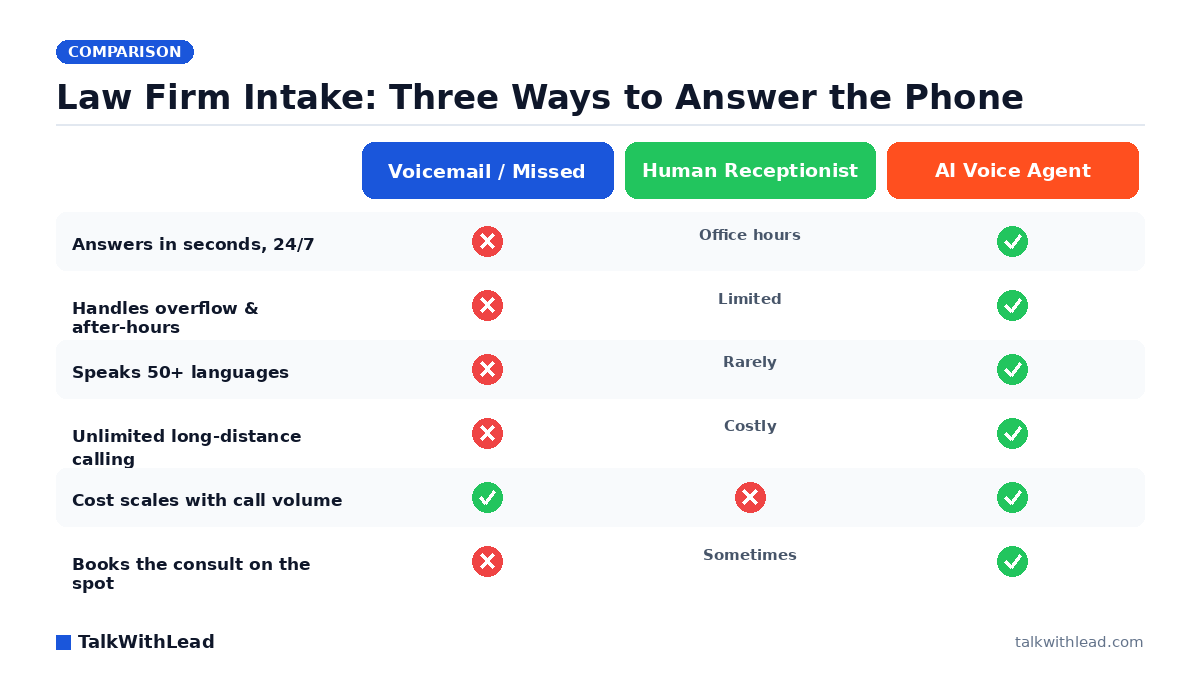
A great human receptionist is warm, judgment-rich, and irreplaceable for complex, sensitive conversations. But one person cannot answer three calls at once, work 24 hours, or speak fluent Spanish, Mandarin, and Portuguese on demand. An AI voice agent handles intake in more than 20 languages and offers free long-distance calling between supported countries, so a prospect anywhere can reach your firm without a toll barrier or a language wall.
The realistic model for most firms is not “AI instead of people” — it is AI catching the website enquiries your team cannot: after hours, weekends, and second-language visitors. For a deeper side-by-side, see AI voice agent vs human receptionist, and if you are weighing a service like Smith.ai, our Smith.ai alternative for law firms comparison covers the intake-specific tradeoffs.
Dimension
Voicemail / Missed
Human Receptionist
AI Voice Agent
Response time
Hours or never
Office hours only
Seconds, 24/7
Simultaneous calls
None
One at a time
Many at once
Languages
None
Usually one
20+
Long-distance reach
N/A
Costly
Unlimited
Monthly cost
$0 (but lost revenue)
Full salary + benefits
Low-hundreds, scales
Books consult on call
No
Sometimes
Yes
Best for: small and mid-size firms with steady website enquiry volume that lose intake to after-hours gaps, lunch, everyone being on another call, or non-English speakers, and want every prospect booked instead of buried in voicemail.
Not the right fit if: you handle only a few hand-selected, high-touch matters a year, answer every call personally, or require a licensed attorney to give legal advice on the very first contact.
What to look for before you buy an AI receptionist
The technology is moving fast — Gartner predicts agentic AI will autonomously resolve 80% of common customer service issues without human intervention by 2029, cutting operational costs by 30%. For a law firm, that future is only worth buying into if the tool fits how you actually intake clients. Check these before you sign up:
Does it sound human? A robotic voice gets hung up on. Test it yourself on a live call.
Can it book and route? Capturing a name is table stakes; scheduling the consult and escalating emergencies is what drives ROI.
Does it cover your callers’ languages and locations? more than 20 languages and free long-distance calling between supported countries widen the client pool you can serve.
The fastest way to judge worth is to hear it work on your own intake script. Try a live demo, then start capturing missed calls with a free signup and measure the booked consults against the math above.
FAQ
Is an AI receptionist worth it for a small law firm?
For most small firms, yes — if you are losing calls to voicemail after hours, during lunch, or when the office is busy. The break-even is low: recover one or two signed matters a month and the tool pays for itself many times over. Run your own missed-call math first so the decision is a number, not a guess.
How much does an AI receptionist cost for a law firm?
AI voice receptionists generally run in the low hundreds of dollars per month for a small firm, scaling with call volume — far less than a full-time human receptionist’s salary and benefits. See current tiers on the pricing page and compare against the revenue you lose to missed calls.
Can an AI receptionist replace my human front desk?
For most firms it complements rather than replaces. A human handles warm, complex, in-office conversations; the AI voice agent catches the website enquiries one person cannot — nights, weekends, and second-language visitors — so no web enquiry goes unanswered.
Can an AI receptionist handle clients who do not speak English?
Yes. A capable AI voice agent handles intake in more than 20 languages and offers free long-distance calling between supported countries, so prospects in other languages or regions can reach your firm without a toll or language barrier — widening the pool of clients you can serve.
Will an AI receptionist give legal advice to callers?
No, and it should not. Its job is intake and scheduling: qualifying the matter, capturing details, booking the consultation, and escalating genuine emergencies to an attorney. Legal advice stays with your licensed lawyers.
How do I know if an AI receptionist is right for my firm?
Estimate your monthly missed-call volume, the share that are real prospects, and your average matter value. If the recovered revenue clearly exceeds the monthly cost, it is worth it. The free missed-call revenue calculator makes that estimate in a couple of minutes.
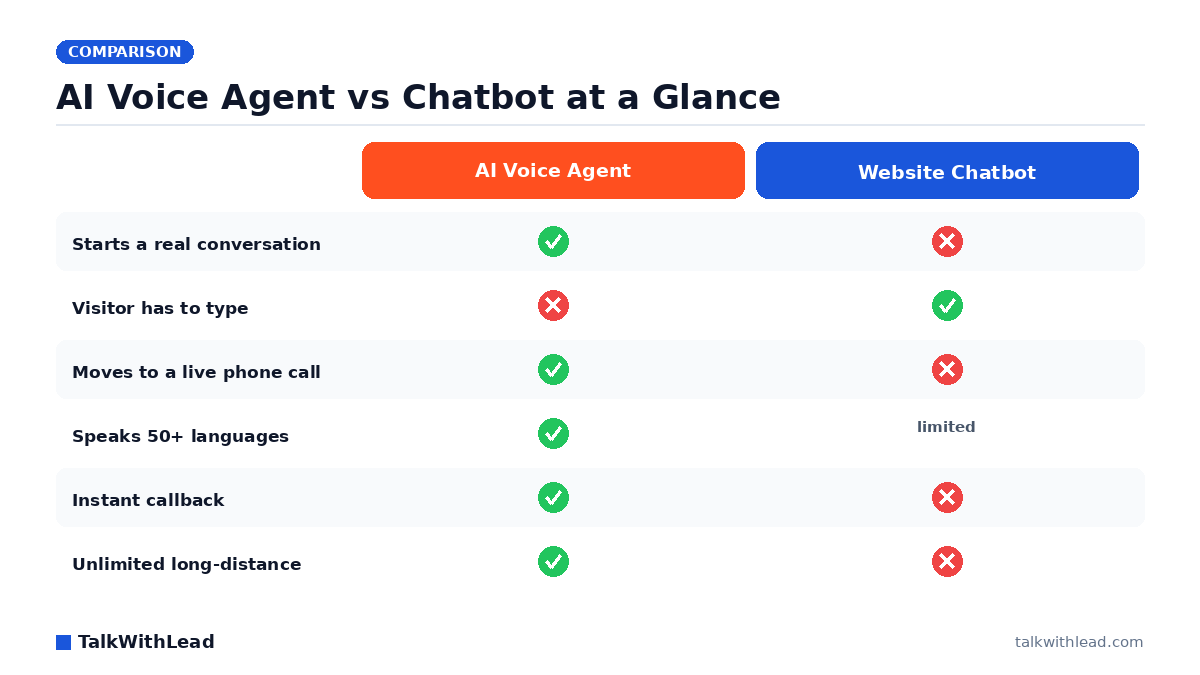
The ai voice agent vs chatbot conversion rate question usually gets answered with a feature checklist. The real answer is simpler: a voice agent starts a conversation, and a chatbot starts a chore. One asks a visitor to speak; the other asks them to read a greeting, type a question, wait, read again, and hope the bot understood. Every one of those extra steps is a place where a ready-to-buy visitor quietly leaves.
That matters because the visitor who lands on your pricing page at 9:47 p.m. is not browsing. They are deciding. A human-sounding AI voice agent can answer them out loud in seconds and offer to put them on a call right then. A chatbot, at best, captures an email and adds them to a queue you will work tomorrow, which is often a day too late.
How a chatbot actually loses high-intent visitors
Chatbots are not useless. They deflect support tickets and answer FAQs at scale. The trouble shows up on conversion-focused pages, where the goal is not to inform a visitor but to win one. Here is where the friction stacks up:
Typing tax. Most people speak far faster than they thumb-type on a phone. Forcing a buyer to type their question slows the whole exchange to a crawl.
Scripted dead-ends. The moment a visitor asks something off-script, a rules-based bot stalls and the visitor blames your brand for it.
No handoff to a human. Even when a chatbot senses high intent, the usual next step is “leave your email” — not “talk to someone now.”
Language walls. A buyer who prefers Spanish, Tagalog, or Portuguese often gets an English-only widget and bounces.
An AI voice agent flips the interaction. Instead of waiting for the visitor to compose a message, it greets them in a natural, human-sounding voice and handles the back-and-forth out loud. The visitor talks the way they would to a salesperson on the showroom floor, and the agent listens, answers, qualifies, and offers the next step.
Three capabilities change the math:
more than 20 languages. The agent meets visitors in their own language, so a multilingual market stops being a leak in your funnel.
Instant callbacks. If a visitor would rather get a call in two minutes, the agent arranges it instead of dropping them into a form.
Free long-distance calling between supported countries. A prospect three time zones away connects with no concern about call cost on your side.
The net effect is fewer steps between “interested visitor” and “live conversation.” That compression is the whole game. You can try a live demo and hear how the voice agent handles a real exchange before you decide anything.
An illustrative conversion comparison
The following numbers are an illustrative example, not measured results from a specific customer. They show how small per-step drop-offs compound differently for typing versus talking.
Imagine 1,000 high-intent visitors hit a service page in a month. With a chatbot, suppose 12% open the widget, 60% of those actually type a question, 50% of those leave an email, and 35% of those emails turn into a booked call. That chain leaves you with roughly 13 booked calls.
Now run the same 1,000 visitors past an AI voice agent. Suppose 12% engage, but because talking is effortless, 80% complete the conversation, and 55% of those accept an offer to connect to a live call or instant callback. That chain leaves you with roughly 53 booked calls from the same traffic. Same visitors, same intent — the difference is how much effort each path demands. Even if your real percentages differ, the shape holds: removing the typing tax and the email-then-wait gap raises the ai voice agent vs chatbot conversion rate every time.
Speed is the hidden multiplier
Conversion is not only about the channel; it is about the clock. A lead contacted within the first minute is far more likely to convert than one contacted an hour later, simply because intent decays fast. A chatbot that collects an email defers the real conversation. A voice agent has the conversation now.
This is the core idea behind speed-to-lead and why the first 60 seconds win most deals. When the agent can move a visitor straight into a call, you are not racing a competitor’s callback queue — you have already started the relationship. And when a call does slip through, missed-call automation catches the lead before they dial someone else.
When a chatbot is still the right call
Voice is not the answer for every box on every page. A chatbot earns its place when:
The job is high-volume, low-stakes support (order status, password resets, store hours).
The visitor genuinely prefers async text and may be mid-meeting.
You need a searchable transcript trail for compliance or routing.
The smart setup is layered: let text tools handle routine questions, and route the high-intent moments — pricing, demo requests, “talk to sales” — to a voice agent that can close the loop with a real call. If you are weighing widgets, the callback widget versus click-to-call versus live chat comparison helps you map each tool to the right page.
How to decide for your own site
Start with one question: on this page, is a captured email good enough, or do you actually want a conversation? On a blog post, an email is fine. On a pricing page for a high-ticket service, a booked call is worth many emails. Put the voice agent where the conversation is worth the most.
Then check three things: do you serve multiple languages, do prospects reach you from far away, and does your current widget end most sessions with “we’ll get back to you”? If you answered yes to any of them, the voice path is likely leaving money on the table for you today. You can start free and put a voice agent on your highest-intent page this week, or review pricing to size it for your traffic.
FAQ
Is an AI voice agent really better than a chatbot for conversions?
On high-intent pages, generally yes. A voice agent removes the typing tax and can move a visitor straight into a live call or instant callback, while most chatbots stop at capturing an email. The ai voice agent vs chatbot conversion rate gap is widest exactly where the visitor is closest to buying.
Does the voice agent sound robotic?
No. TalkWithLead’s agent is built to sound human and conversational, so visitors talk to it the way they would talk to a person, rather than navigating a menu. The fastest way to judge it is to hear it on a live demo.
What about visitors who do not speak English?
The voice agent handles more than 20 languages, so a buyer who prefers another language gets a natural conversation instead of an English-only wall. For multilingual markets, that alone can recover leads a text widget would lose.
Can I keep my existing chatbot and add a voice agent?
Yes, and that is often the best setup. Let the chatbot handle routine support questions and route high-intent moments — pricing, demo, “talk to sales” — to the voice agent that can connect a real call.
What happens if a visitor would rather be called back later?
The agent can schedule an instant callback instead of forcing a live conversation, and free long-distance calling between supported countries means it can reach prospects anywhere without a cost concern on your end.
How quickly can I test this on my own site?
You can sign up free and place a voice agent on your highest-intent page in a single sitting, then compare its booked-call rate against your current chatbot before rolling it out everywhere.
Your next lead is on your site right now — ready to talk.
TalkWithLead’s AI voice agent rings that visitor back in seconds, qualifies the lead in their language, and books the call before the prospect can open a competitor’s tab. Forms are slow. Chatbots make people type. Voice closes.
This is the TalkWithLead Widget. Click to see how it will work on your website!
Live AI voice agent
Turn website visitors into phone calls
This is the same TalkWithLead widget you can add to your site — a visitor enters their number, the system rings that visitor, and an AI voice agent talks with them in one of 23 published languages. Try it two ways: