

In this article
- How much does Bland AI cost?
- Bland AI plans compared (observed 23 September 2026)
- What the per-minute rate includes – and what it does not
- What Bland AI costs at real volumes
- How Bland’s pricing compares with Vapi and Retell – by Bland’s own account
- When you do not need a voice platform at all
- Who this is not for
- FAQ
How much does Bland AI cost?
Bland AI pricing looks simple: each plan has a per-minute rate and a platform fee. The real monthly bill adds telephony and a separate transfer-time charge, and call caps can decide your plan before the rate does.
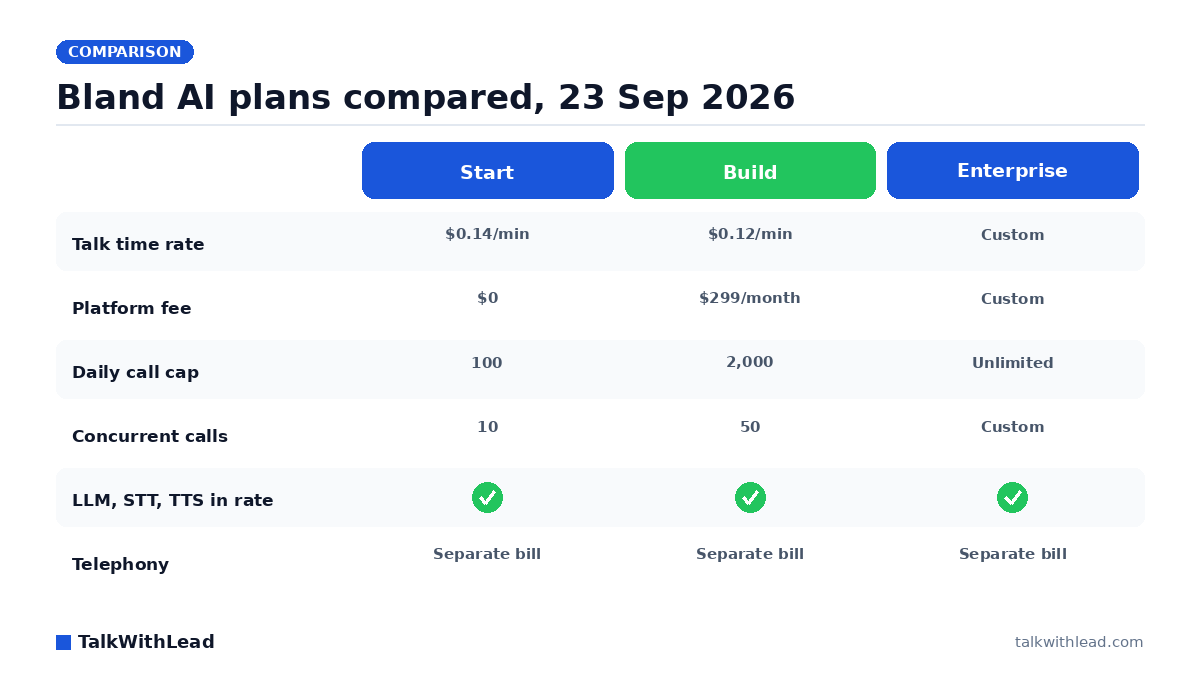
Direct answer: As of 23 September 2026, Bland’s pricing page lists three plans. Start costs $0.14 per minute with a $0 platform fee and no card required. Build costs $0.12 per minute plus a $299 per month platform fee. Enterprise is custom. The per-minute rate includes the LLM, speech-to-text and text-to-speech. Telephony is billed separately.
Every Bland figure below was read from that page on 23 September 2026 and is reported the way Bland prints it. Pricing pages can change without notice, so check the live page before you commit a budget.
Bland AI plans compared (observed 23 September 2026)
Bland describes Start as “for developers”, Build as “for teams” and Enterprise as “for organizations”. The table shows every published rate and limit for each plan.
| Plan | Talk time rate | Platform fee | Transfer time rate | Daily call cap | Hourly call cap | Concurrent calls | Voices | Knowledge bases |
|---|---|---|---|---|---|---|---|---|
| Start | $0.14 per minute | $0 | $0.05 per minute | 100 | 100 | 10 | 1 | 10 |
| Build | $0.12 per minute | $299 per month | $0.04 per minute | 2,000 | 1,000 | 50 | 5 | 50 |
| Enterprise | Custom | Custom | Custom | Unlimited | Unlimited | Custom | Unlimited | Unlimited |
A few terms are not in the table. Start needs no card. Signing up gives you 2 credits and an inbound number, which Bland values at $15 per month. Enterprise rates and concurrency are custom and set by contract according to volume. Enterprise can also include on-prem or VPC deployment, a forward deployed engineer, a BAA, SSO and data residency. Bland prints a 99.9% uptime SLA for all tiers.
On timing, Bland’s FAQ says most teams deploy a first agent within a day on the self-serve plans. Enterprise deployments follow a 28-day deployment framework. On security, Bland states SOC 2 Type I and Type II, HIPAA eligibility with a BAA, GDPR and PCI DSS. Those are Bland’s own statements; this page has not verified them.
What the per-minute rate includes – and what it does not
Bland’s per-minute rate covers three things: the LLM, with no token charges; real-time speech-to-text; and premium text-to-speech voices. The model the agent runs on does not come with a separate token bill.
Three costs are billed outside that rate:
- Telephony. Billed separately. You can use your own carrier or Bland’s built-in Twilio at pass-through cost. Bland also works with an existing Twilio account or SIP trunks.
- Transfer time. A separate per-minute charge on Bland’s price list: $0.05 per minute on Start and $0.04 per minute on Build. Bland says customers who bring their own telephony pay no transfer fees. This page uses “transfer time” only as the name of a billing line. Check Bland’s documentation for what counts toward it.
- The platform fee. $0 on Start, $299 per month on Build and custom on Enterprise. On Build it is a fixed monthly charge on top of the minutes.
To budget, multiply your talk minutes by the plan rate, then add the platform fee, telephony and any transfer minutes. Only the first two are fixed by the pricing page. Telephony depends on your carrier and the calls you make.
What Bland AI costs at real volumes
The calculations below use Bland’s list rates from 23 September 2026 and count talk minutes only. Telephony and transfer time are left out because both depend on your setup.
Illustrative example, not a quote: a team expects 2,000 talk minutes a month on Start. 2,000 × $0.14 = $280 a month, with no platform fee.
Illustrative example, not a quote: the same 2,000 talk minutes on Build. 2,000 × $0.12 = $240, plus the $299 platform fee = $539 a month.
Illustrative example, not a quote: Build saves $0.02 on every minute, so its $299 fee is paid back at 14,950 talk minutes a month ($299 ÷ $0.02). Below that volume, Start’s list rates give the smaller talk-time bill. Above it, Build’s do.
The caps can decide the plan before the price does. Start allows 100 calls a day, 100 calls an hour and 10 concurrent calls. Build raises those limits to 2,000 a day, 1,000 an hour and 50 concurrent. Illustrative example, not a quote: assume calls average three minutes. Start’s cap of 100 calls a day then allows at most 9,000 talk minutes in a 30-day month (100 × 30 × 3). That is well below the 14,950-minute break-even, so in this case the cap, not the rate, moves a team to Build. Size the plan on your busiest day and busiest hour first, then compare prices.
How Bland’s pricing compares with Vapi and Retell – by Bland’s own account
Bland’s FAQ includes its own comparison. According to Bland’s pricing page, Vapi lists $0.05 per minute and Retell about $0.07 per minute, and both figures cover voice infrastructure only. With typical providers added, Bland estimates the total at roughly $0.13-$0.30 per minute on Vapi and $0.11-$0.25 per minute on Retell.
These are Bland’s estimates, published by a company that competes with both. They are not our figures, and this page did not re-check Vapi’s or Retell’s prices. The real difference is how the prices are built. Bland puts the LLM, speech-to-text and text-to-speech into one rate. By Bland’s account, the Vapi and Retell headline rates leave those providers to be billed on top, so the total changes with the model, voice and carrier you choose.
For the vendors’ own pricing pages, see our dated comparison of AI voice agent pricing across callback products and programmable platforms. If Vapi is on your shortlist, Vapi alternatives: developer platforms and callback options separates the platforms you build on from the products that do one fixed job.
None of these vendors comes out ahead on paper. A fair comparison needs your own average call length, provider choices and daily peak, checked against each vendor’s live page.
When you do not need a voice platform at all
Bland, Vapi and Retell are platforms for building voice agents. You design the agent, supply or rent telephony, and pay for every minute it talks. Some teams looking up Bland AI pricing have a much narrower job in mind: calling back, quickly, the people who leave a phone number on their website. A different kind of product fits that job.
Speed is why that job matters. According to Harvard Business Review research (March 2011), companies that reach a web lead within an hour are nearly 7× more likely to qualify it than those that wait even an hour longer.
TalkWithLead does that one job. A visitor enters a phone number anywhere on your own website: the widget, a contact or quote form, or an abandoned-cart flow. A number can also come from your CRM or other software through the API. TalkWithLead then calls that number within seconds. Most customers let the AI voice agent speak with the person. In human mode, the system calls the visitor and your own staff at the same time, so the two people talk directly. The live demo page says the AI voice agent “can answer questions, collect contact details, qualify the lead, and help move that visitor closer to becoming a paying customer – even when you are busy, closed, or unavailable.”
Published features include:
- custom fields on the widget, to ask for extra details before or after the visitor requests the call
- optional call recording, with transcripts sent by email
- callbacks that ring several of your reps at once or take turns in round-robin order
- working hours you set; outside them, the widget offers a callback for when you are back
- your own number as caller ID
- an API for sending in numbers from other software
- conversations in more than 20 languages
The pricing works differently too. Plans are priced by the number of calls. There is no per-minute meter, no LLM bill and no telephony bill:
- Basic: $0, no payment method, 10 calls, 1 widget, 14-day free trial
- Standard: $99.99 USD a month, 100 calls, 3 widgets
- Advanced: $199.99 USD a month, 200 calls, 4 widgets
- Professional: $299.99 USD a month, 400 calls, 6 widgets
- Enterprise: $599.99 USD a month, 800 calls, 15 widgets
Paid plans need a card and also come with a 14-day trial. The full details are on the TalkWithLead pricing page. Illustrative example, not a result: a site that gets 100 callback requests a month fits the Standard plan at $99.99 USD a month, however long each conversation runs.
TalkWithLead is not a developer platform. There is nothing to build, no inbound number and no calling campaigns or list dialing. It has no call forwarding and no missed-call detection, and it does not text leads. Calls to the phone number on your site keep reaching you just as they do today. To hear it, open the live demo and enter your number in the widget. The AI voice agent will call you.
Who this is not for
TalkWithLead has real limits, and they matter if you came here to price Bland:
- You cannot design, script or deploy your own voice agents with it.
- It gives you no inbound number for people to dial.
- It does not run outbound calling campaigns. It only calls numbers that come from your website, CRM or API.
- It does not give you the developer-level control over the agent that Bland’s plans are built around.
- It does not write to your calendar or update your CRM, and the Basic plan stops at 10 calls.
Best for: a business that wants every phone number left on its website, whether in the widget, a contact or quote form, or an abandoned cart, called back within seconds by an AI voice agent or its own staff, for a fixed price per plan based on the number of calls.
Not the right fit if: you are building your own voice agents, need an inbound number, run outbound calling campaigns or need Bland-style developer controls. For that work, choose Bland, Vapi or Retell.
If your job is the narrow one, Basic is $0 with no credit card, 10 calls and a 14-day trial: start on the Basic plan. If it is not, take the arithmetic above to Bland’s live page and size Start or Build on your busiest day.
FAQ
How much does Bland AI cost per minute?
As of 23 September 2026, Bland charges $0.14 per minute of talk time on Start and $0.12 per minute on Build. Enterprise rates are custom. The rate includes the LLM, speech-to-text and text-to-speech. Telephony is billed separately.
Is Bland AI free?
Start has a $0 platform fee and needs no card, but every talk minute is billed at $0.14. Signing up gives you 2 credits and an inbound number, which Bland values at $15 per month.
What is Bland AI’s platform fee?
$0 on Start, $299 per month on Build and custom on Enterprise, according to Bland’s pricing page on 23 September 2026. On Build, the fee is paid back by the lower per-minute rate at 14,950 talk minutes a month.
Does Bland AI charge for telephony?
Yes, separately from the per-minute rate. You can use your own carrier or Bland’s built-in Twilio at pass-through cost. Bland also works with an existing Twilio account or SIP trunks.
What are transfer minutes on Bland AI?
Transfer time is a separate billing line on Bland’s price list: $0.05 per minute on Start and $0.04 per minute on Build. Bland says customers who bring their own telephony pay no transfer fees. Check Bland’s documentation for what counts toward it.
Is Bland AI cheaper than Vapi?
The two price in different ways, so the headline rates do not compare directly. Bland’s own FAQ says Vapi lists $0.05 per minute for voice infrastructure only and estimates about $0.13-$0.30 per minute once typical providers are added. That is Bland’s estimate, not ours. The real answer depends on your call length, provider choices and volume, so neither one is cheaper in every case.
Let’s Turn More Website Visitors Into Sales Conversations
Try the self-serve callback demo. Enter your phone number on the demo page to try the callback flow. Basic is $0, requires no card, and includes a 14-day trial.