An AI voice agent for a small-business website is software that holds a spoken conversation with a visitor and turns that visit into a phone call. TalkWithLead’s widget runs in one direction: a visitor types their number on your site, the system rings that visitor, and an AI voice agent talks with them. Switch the same widget to human mode and it bridges the visitor to your rep instead. It never answers calls placed to your business number.
What is an AI voice agent, and what does ours actually do?
The phrase covers a lot of ground, and that vagueness is where buyers get burned. Under the label “AI voice agent” you will find developer platforms that run a company’s phone lines, outbound dialers built for sales teams, and on-page widgets like ours. They share the speech engine and almost nothing else. Before you compare vendors, work out which of those jobs you are hiring for, because the wrong shelf wastes a month.
Ours is the on-page kind. A visitor on your website clicks the widget and enters a phone number. TalkWithLead calls that number, and a conversational AI voice agent picks up the other end and talks with them — it can, in the company’s own words on the live demo page, “answer questions, collect contact details, qualify the lead, and help move that visitor closer to becoming a paying customer — even when you are busy, closed, or unavailable.” The agent speaks 23 published languages, English, Spanish, French, German, Hindi and Arabic among them.
The second mode is the human bridge. Same widget, same visitor-typed number, except the system dials your rep at the same time and puts the two people on one call over a mobile, landline or SIP line. Which mode a widget uses is your choice; every plan includes both.
What matters for choosing is the thing both modes have in common: the visitor starts the call, from your website, and the number we dial is the visitor’s. That single design decision explains everything this tool is good at and everything it cannot do.
It is also the reason speed is the whole game here. According to Harvard Business Review research, companies that reach a web lead within an hour are nearly 7× more likely to qualify it than those that wait even an hour longer. A widget that rings the visitor while they are still reading your page is operating inside that window by construction; an email reply the next morning is not. For the qualifying half of that call in detail, see how AI lead qualification works on a website callback.
Four ways voice AI for business gets deployed
Feature grids are useless here because the products differ structurally, not by feature count. Most roundups of AI voice agents for business list all four of the models below side by side as if they were interchangeable, which is how buyers end up on the wrong shelf. The question that actually separates them is mechanical: who starts the call, and whose phone rings. Sort the market that way and the shortlist writes itself.
| Deployment model | Who starts the call | What number is dialled | What the business has to have | Best for |
|---|---|---|---|---|
| On-page AI voice-agent callback widget TalkWithLead; CallPage also pairs a widget with an AI agent | The website visitor, from a page on your site | The visitor’s own number, typed into the widget | A widget script on the site. No number to buy or port. For human mode, a mobile, landline or SIP line for the rep | Turning traffic you already have into phone conversations |
| Phone-line AI voice agent platform Retell AI, Vapi | Either side — both vendors document inbound and outbound calling | A number you buy or connect on the platform; inbound callers dial it | A purchased or ported number or SIP trunk, plus dashboard or developer setup (API keys, CLI) | Businesses that want their published line answered, or programmatic outbound calling |
| Website chatbot or live chat widget Tidio | The visitor, by typing | None — the exchange stays typed | A widget script on the site | Fast typed answers and support deflection |
| Human callback widget CallPage; TalkWithLead’s human mode | The visitor, by leaving a number | Both the visitor’s number and a rep’s number, bridged into one call | A widget script, plus a rep free to pick up | Teams with people available during the hours their traffic arrives |
How the competitor rows were checked, and what is missing. Every cell above comes from the vendor’s own published pages, read on 6 September 2026. Nothing is inferred from third-party roundups, and where a vendor’s public pages did not state something, it is left out of the table rather than guessed. Two things are genuinely undocumented anywhere public and so are deliberately absent: the per-conversation price each platform charges at small-business volumes, and how quickly each connects a website visitor specifically. Both vary by configuration; ask each vendor directly rather than trusting a grid.
- Retell AI — docs.retellai.com, Introduction, observed 6 Sep 2026: “Retell is a platform to build, test, deploy, and monitor AI voice and chat agents with telephony, prompts, tools, and analytics built in.” Its deploy section lists “Purchase phone number”, “Make & receive phone calls” and a website widget.
- Vapi — docs.vapi.ai, Phone calls quickstart, observed 6 Sep 2026: “Vapi makes it easy to build voice agents that can make and receive phone calls.” The quickstart steps are create an assistant, “Set up a phone number”, then make inbound and outbound calls, with API keys or the CLI for programmatic use.
- CallPage — callpage.io, observed 6 Sep 2026: “Visitors leave their phone number to request an instant callback or schedule a call for later. The system connects the available rep and the potential customer in seconds — or the AI Agent takes over.”
- Tidio — tidio.com, Live Chat, observed 6 Sep 2026: a typed chat widget — “Support customers in real-time with the #1 ecommerce live chat app.”
- TalkWithLead — the live demo page and pricing page, observed 5 September 2026: “When a visitor clicks the blue phone widget on your website, they get connected to your AI Voice Agent,” and, for the human mode, “When a visitor clicks the widget and enters their phone number, TalkWithLead can automatically call you and connect you with that visitor while they are still live on your website.”
If your shortlist is really widget-versus-widget rather than platform-versus-widget, the narrower breakdown in click-to-call vs callback widget vs AI voice agent goes a level deeper on the three on-page options.
What it costs, and ROI math you can check yourself
TalkWithLead prices by call volume on a flat monthly plan, not by the minute. The Basic plan is $0 with no payment method required and includes 10 calls, one widget, unlimited minutes and both the human and AI voice agent; paid plans start at $99.99 USD a month and step up by call allowance. Every plan gets a 14-day free trial, and the paid ones require a card while Basic does not. The pricing page carries the current numbers and the plan-by-plan detail. If you are budgeting across vendors rather than ours alone, what an AI voice agent actually costs per month sets the published entry prices of the developer platforms and the plan products side by side, each with the date it was read.
Two caveats worth reading before you budget. Ten calls is a trial allowance, not a free tier you can run a business on. And international calling is free between a published list of supported countries, with pay-as-you-go rates elsewhere — check that your market is on the list rather than assuming.
What follows is an illustrative scenario with assumed rates — not a customer result, not an average, and not a promise. Suppose your average new customer is worth $600 and your site produces 40 enquiries a month. Imagine that 1 in 4 of them arrive when nobody can respond quickly, so 10 leads a month go cold. If a voice agent turns 3 of those into live conversations and you close one, that single rescued customer covers a mid-tier monthly plan several times over. Change any assumption and the answer changes — which is the point of running it on your own numbers in the free missed-call revenue calculator or the speed-to-lead ROI calculator instead of trusting ours.
Who this is NOT for
Skipping this section is how trials end in a refund request. Four jobs people regularly try to hire an on-page voice agent for, and it does none of them:
- Answering your published business line. There is no inbound number and no call forwarding. Point your printed phone number at TalkWithLead and nothing happens — the product is not in that call path at all. If what you want is your own line answered, you want a phone-line platform or an answering service, and you should stop reading here. The AI voice agent vs human receptionist comparison lays out that trade-off.
- Missed-call text back is not something we do. Because we never sit in front of your phone line, we cannot detect that a call to it went unanswered and cannot text the caller afterwards. A tool that promises this has to be inside your telephony; we are not.
- Cold outbound campaigns. Every call starts with a visitor on your website typing their own number. There is no list upload, no dialer, no way to have the agent phone people who never asked. That is a deliberate limit, not a missing feature.
- SMS conversations with visitors. SMS here is a notification to you when a lead comes in. It is not a channel your visitor can hold a conversation in, and it is not a texting inbox.
One more honest limit: no published page says the AI agent can transfer a live caller to a person mid-conversation, or that it can pick up a caller’s language and change to it part-way through a call. Treat both as absent until a vendor page says otherwise — ours included.
What to look for when choosing the best AI voice agent
Once you know which shelf you are shopping on, the evaluation gets short. Six things separate the tools that earn their subscription from the ones that quietly stop being used:
- Does the conversation end in a phone call? If the agent’s best outcome is “I’ll pass your message along”, you have bought voicemail with better manners.
- Whose phone rings, and who dials? Ask this first, in these words. It resolves in one sentence whether the vendor is on your shelf, and it is the question most demo calls never reach.
- What does it cost at your volume? Per-minute billing makes your best month your biggest invoice. Flat, allowance-based pricing is easier to plan against — check where your real monthly call count lands on the plan ladder before you sign.
- Does it hold a conversation, or read a menu aloud? A decision tree with a voice bolted on breaks the moment someone asks something off-script. Test it with a question you did not prepare.
- Which languages, actually published? Vendors quote language counts loosely. Ask for the list, then check that the two or three languages your market speaks are on it.
- How long until it is live? A widget script goes on a site in an afternoon. A phone-line platform with a ported number and developer setup does not.
And judge the whole category on one number: extra booked conversations per month. Not features, not language counts, not a demo that sounded impressive. If you want to see how the on-page approach compares with the text tools it usually replaces, the AI voice agent vs chatbot breakdown covers that head-to-head, and how fast you should call a new lead covers the timing evidence.
Is an AI voice agent worth it for your small business?
Worth trying if: the best AI voice agent for small business use, in your case, is one that works your existing website traffic — you get real visitors, your revenue depends on inbound enquiries, and the deals close over the phone. Contractors, law firms, clinics, brokers, agencies and local service businesses all fit that shape, and so does any team whose visitors arrive in more than one language.
Not worth it if: your traffic is thin enough that you personally answer every enquiry within minutes, your sales complete in an e-commerce checkout with no conversation, or what you actually need is your published phone line answered. In the first two cases, keep your money. In the third, buy a different category.
The honest way to decide is to hear it. Try the live demo and talk to the agent yourself — if it does not sound good enough to represent your business, no feature list will fix that. Then run your own numbers in the calculator, and if the math holds, start on the free Basic plan, which costs $0 and needs no card. Ten calls is enough to find out whether visitors will talk to it.
FAQ
What is an AI voice agent?
An AI voice agent is software that speaks with a person over a phone or browser call instead of exchanging typed messages: it understands what the caller says, answers in a synthesised voice, and follows the goal it was configured for — qualifying a lead, answering questions, collecting contact details. The category splits by where the call comes from. Some run a company’s phone line; ours runs from a widget on the company’s website and calls the visitor.
What is the best AI voice agent for small business?
There is no single answer, because the products do different jobs. If the job is converting website visitors into phone conversations, look at on-page voice-agent widgets, TalkWithLead among them. If the job is answering the calls people place to your published number, look at phone-line platforms such as Retell AI or Vapi instead — they document buying or connecting a number and receiving inbound calls, which an on-page widget does not do. Decide the job first; the shortlist follows. For the developer platforms themselves — Vapi, Retell AI, Bland AI, Synthflow and ElevenLabs Agents — how the shortlist compares on published pricing and setup is broken out separately.
Can an AI voice agent answer my business phone number?
Not TalkWithLead’s. There is no inbound number, no forwarding and no missed-call detection — every call begins with a visitor on your website entering their number, and the number we dial is theirs. Platforms built around telephony do answer inbound calls; that is a different product category with different setup and different pricing.
How much does an AI voice agent cost per month?
TalkWithLead’s Basic plan is $0 with no payment method required and includes 10 calls; paid plans begin at $99.99 USD a month and are priced by call allowance rather than by the minute, with a 14-day free trial on every plan. Other vendors price per minute or per conversation, which is why two quotes can look similar and bill very differently at volume. Current figures are on the pricing page.
How many languages can a conversational AI voice agent speak?
Ours publishes 23 languages, including Arabic, Dutch, English, French, German, Hindi, Italian, Japanese, Korean, Polish, Portuguese, Spanish, Turkish and Vietnamese. Treat every vendor’s language count as a list to be checked rather than a headline number, and confirm that the specific languages your market speaks are on it. Nothing published says the agent detects and switches language part-way through a call, so assume it does not.
Can an AI voice agent really sound human?
Judge that yourself rather than taking anyone’s word for it — including ours. The live demo exists precisely so you can click the widget, take the call, and decide in the first two sentences whether it sounds like something you would put in front of your own prospects.
Is an AI voice agent better than a chatbot for getting leads?
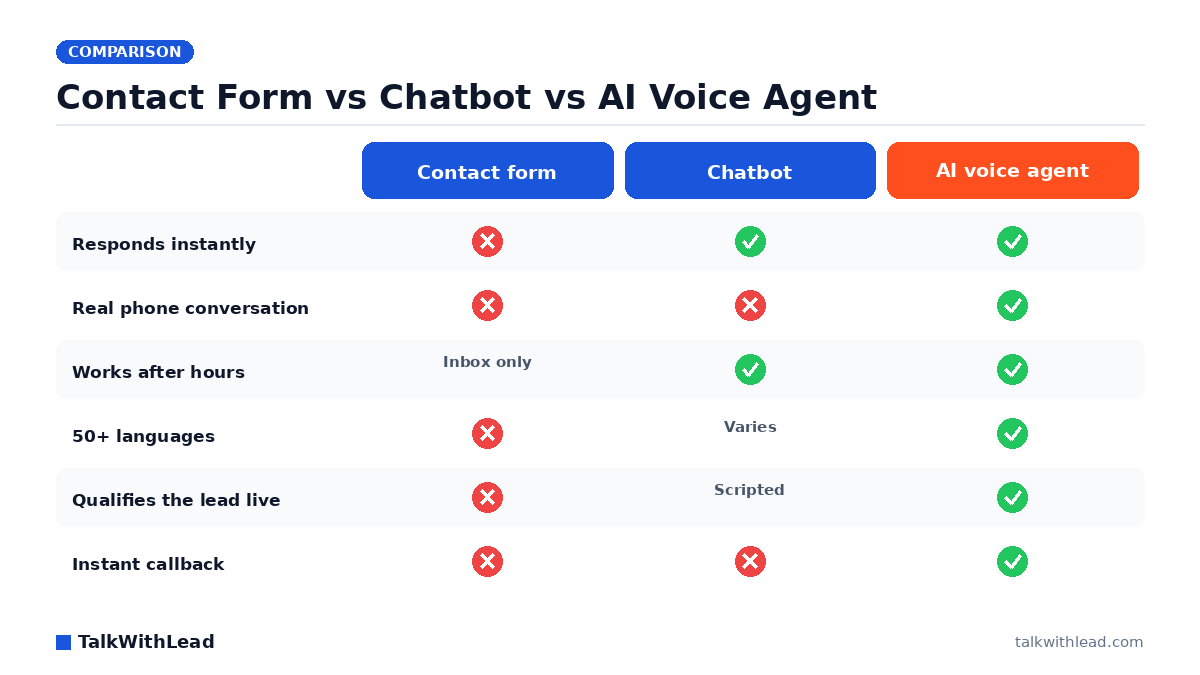
They do different things. A chatbot collects typed details and hands you a follow-up task; a voice agent puts the visitor into a spoken conversation immediately, while their interest is highest. For businesses that close over the phone, the voice route removes a step. For businesses that close in a checkout, the chatbot is often enough.
Do I need technical skills to add an AI voice agent to my website?
For an on-page widget, no — it installs as a snippet, the same effort as adding a live chat box, and the real work is business configuration: what you offer, what the agent should ask, where the conversation goes next. Phone-line platforms are a different story; their own quickstarts involve buying or connecting a number, API keys and, optionally, a command-line tool.
Will an AI voice agent work outside business hours?
A website visitor can request a call whenever they are on your site, and the AI agent can speak with them even when you are busy, closed or unavailable. Working hours are configurable, and outside them the widget can instead tell the visitor you are closed and offer a callback for when you are back. What it never does is answer calls placed to your own line at night — that is a different product.