
In this article
What is AI lead qualification?
Every phone number typed into your website is a lead, but a form record can’t tell your sales team who is ready to buy and who is just browsing. AI lead qualification sorts the two. The method you choose decides what you learn about each lead, and how soon you learn it.
Direct answer: AI lead qualification is software that decides whether a new lead is worth a salesperson’s time. It gathers and weighs need, budget, authority and timing (from form data, enrichment, a chat or a live conversation) and then routes the good leads to the right person. TalkWithLead is the conversation kind: a live phone call with a website lead, started when the lead enters a number.
That makes TalkWithLead one narrow kind of AI lead qualification. It is not a CRM scoring or enrichment tool, and it does not grade the records already in your database. It has no inbound number, so calls people dial to your published business number never reach it. It also runs no calling campaigns. It only rings numbers that a lead entered on your site or that your CRM sends through the API.
How AI lead qualification works
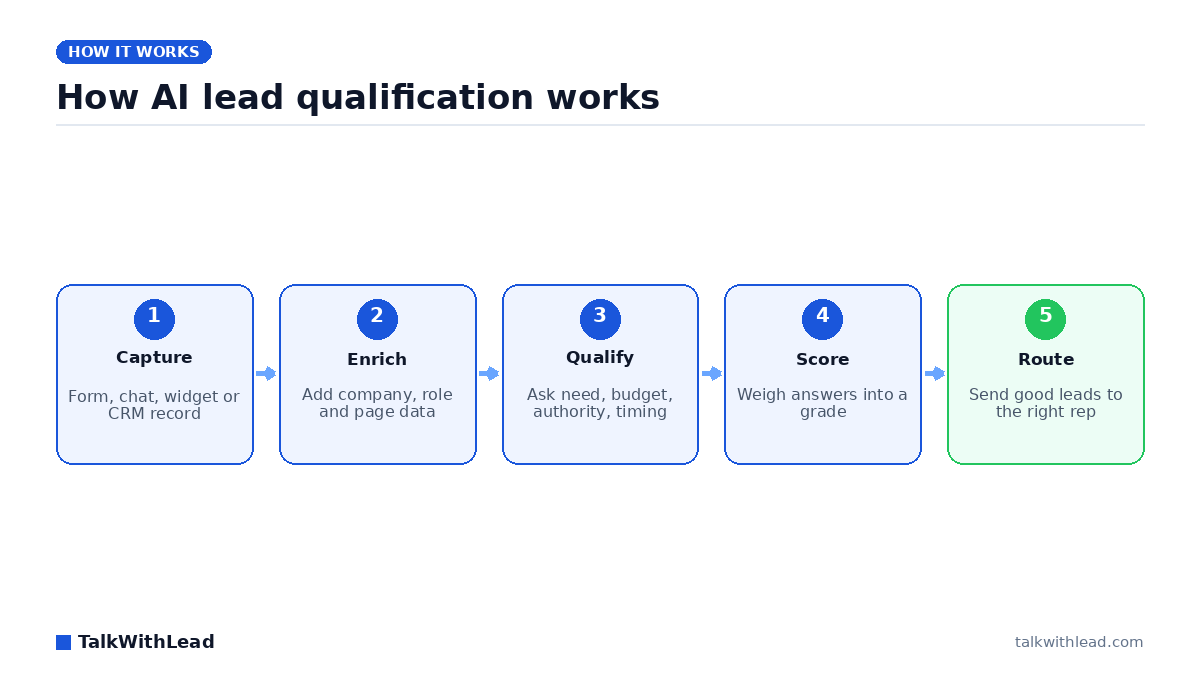
Vendor guides and AI-assistant answers mostly describe the same five steps. Each step can be automated separately, and most tools cover only one or two.
- Capture. The lead arrives as a form fill, a chat, a demo request, a phone number typed into a widget, or a record pushed in from another system.
- Enrich. Software adds what the lead didn’t tell you, such as company size, industry, job title, location and the pages they viewed.
- Qualify. Someone or something asks the questions that matter and records the answers: what the lead needs, what they can spend, who decides and how soon.
- Score. The answers and the enriched data are combined into a grade, a number or a simple hot, warm or cold label.
- Route. Good leads go to the right rep with the context attached. Weak ones go to nurture or get closed out.
People often confuse scoring with qualifying. Scoring works on a record. Nobody talks to the lead, and a model guesses intent from firmographics and behaviour. Qualifying happens in a conversation. The lead answers questions in their own words, and you learn things no form field captures, such as a current contract that ends on the 30th or a business partner who has to sign off. Much of the lead qualification AI in vendor guides is really scoring. Both are useful, but they answer different questions.
Four ways to run AI lead qualification, compared
Each approach learns different things about a lead, at a different moment, and asks the lead for different effort. Here are the four approaches side by side:
| Approach | What it learns about the lead | When it happens | What the lead has to do | Where it falls short |
|---|---|---|---|---|
| Form scoring and enrichment tools | Company size, industry, role, pages viewed | In the background after a form is submitted | Fill in a form | Infers intent; never hears the lead’s own words |
| Website chatbot | Typed answers to scripted questions | While the visitor is on the page | Type answers in a chat window | Easy to abandon; typed answers stay short |
| AI voice call to the lead (the TalkWithLead approach) | Spoken answers on need, budget, timing and who decides | Seconds after the lead enters a phone number | Enter a number and take the call | Needs a phone number; no record scoring or enrichment |
| Human SDR call | Full context, nuance and objections | Whenever a rep is free | Be available when the rep calls | Limited by rep hours and headcount |
You can combine these approaches. A team can score every record in the background and still want a real conversation with the leads who ask for one. What matters is who has that first conversation and how soon after the lead asks.
What questions qualify a lead?
BANT (budget, authority, need, timing) is still the usual framework, and it helps to add fit. Ask each part as a question a buyer will actually answer on a call, so the call doesn’t feel like an interrogation:
- Need: “What made you reach out today?” and “What isn’t working with how you handle it now?”
- Budget: “Is there a range you’re working to?” or “What do you pay for this today?”
- Authority: “Who else will weigh in before you decide?”
- Timing: “When do you need this in place?” and “Is anything setting that date, like a contract ending?”
- Fit: “Where are you located?” and “How big is the job, the team or the space?”
Here is an example of an AI voice agent calling a lead who has just asked for a quote.
Illustrative dialogue: a fictional commercial cleaning company, not a real customer.
AI voice agent: Hi, you just requested a cleaning quote on our website. Do you have two minutes?
Visitor: Sure, go ahead.
AI voice agent: What kind of space is it, roughly how big, and how often would you need cleaning?
Visitor: Offices on two floors, about 6,000 square feet. Three nights a week.
AI voice agent: When would you want to start, who signs off on the vendor, and is there a monthly budget you’re working to?
Visitor: Our current contract ends on the 30th. I decide with our operations director, and we’d want to stay a little under what we pay now.
AI voice agent: Thank you. I have the space, the schedule, your start date, the budget and both decision makers. All of it is going to the team now so they can prepare your quote.
That one short call covered need, scope, a firm start date, the decision makers and a budget. Instead of a name and a number, the team gets a lead they can quote.
Why speed decides how many leads you can qualify
You can only qualify a lead you actually reach, and web leads lose interest fast. According to Harvard Business Review (March 2011), companies that respond to a web lead within an hour are nearly 7 times more likely to have a meaningful conversation with a decision maker than companies that wait even an hour longer. The Lead Response Management study (2007) found that contacting a web lead within 5 minutes instead of 30 makes you about 21 times more likely to qualify it.
Illustrative example, not a result: say your site produces 200 form leads a month. Assume a rep calls back the next morning and reaches and qualifies 15% of them. That gives 30 qualified conversations. Now assume each lead gets a call within seconds, while they’re still on your site, and you reach and qualify an assumed 30%. That gives 60. With an assumed 20% close rate, the same traffic produces 6 new customers a month in the first case and 12 in the second. Every rate here is an assumption, so plug in your own.
For how fast counts as fast enough, and what a realistic response window looks like, see Speed to Lead: How Fast Should You Call a New Lead?
How TalkWithLead qualifies website leads
TalkWithLead uses AI for lead qualification at one specific moment: the seconds after a website visitor gives you a phone number. A call is triggered when a visitor enters a number anywhere on your own site, whether in the TalkWithLead widget, a contact or quote form, or an abandoned-cart flow. A call is also triggered when a number arrives from your CRM or other software through the API. TalkWithLead then rings that number within seconds.
You choose the mode before the call, and it decides what happens next:
- AI voice agent mode (the mode most customers use): the AI voice agent speaks with the lead, asks qualifying questions and captures the answers.
- Human mode: the system rings the visitor and your own staff at the same time, so the two people talk directly from the first second of the call.
The TalkWithLead live demo page says the AI voice agent “can answer questions, collect contact details, qualify the lead, and help move that visitor closer to becoming a paying customer — even when you are busy, closed, or unavailable.” You can click the widget on that page and talk to it yourself.
These published features are the ones that matter for qualification:
- Custom fields on the widget ask the visitor for extra information before or after they request the call, so some qualifying details arrive with the phone number.
- Call transcriptions by email let your team read what the lead actually said instead of relying on a summary field. Call recording is optional.
- Callbacks shared across your reps: the callback can ring several of your reps at once or rotate among them round-robin.
- Working hours you set: outside those hours, the widget offers a callback for when you’re back.
- Your own number as caller ID, so the lead sees your business number instead of an unknown one.
- More than 20 languages for leads who would rather talk in their own language.
It is just as important to know what it doesn’t do. It doesn’t score records numerically or enrich firmographics. It qualifies leads in conversation and makes sure the details reach your people. When the AI voice agent takes the call, it can also book the appointment into your calendar.
Who this is not for
A phone call is the right qualification step for some leads and the wrong one for others. Check these limits before you choose:
- It needs a phone number. A lead who only wants to type will not get a call.
- It works on new leads as they arrive. It doesn’t work on the thousands of records already in your CRM.
- It adds no company data. If you need firmographics, you need an enrichment tool.
- It doesn’t dial lists. It runs no calling campaigns and no outreach to purchased lists, and it doesn’t text leads.
- It has no inbound number and no call forwarding. Calls people dial to your published business number never reach it.
- The AI can’t switch a call over to a person partway through. You choose AI mode or human mode before the call starts.
Best for: businesses whose websites produce inbound leads such as quote requests, demo requests, consultation forms and abandoned carts, and who want each lead qualified in a real conversation within seconds rather than the next business day.
Not the right fit if: you need to score thousands of existing CRM records, enrich firmographics or dial purchased lists, or you want coverage for the calls people dial to your main business number.
How to choose an AI lead qualification approach
Pick the approach that matches where your leads come from and what you need to learn about them:
- A large CRM backlog with little context on each record: start with form scoring and enrichment.
- Visitors who prefer typing, and simple questions with short answers: a website chatbot can collect the basics.
- Website leads who give a phone number and need a real answer on price, scope or timing: an AI voice call within seconds of the request.
- High-value, complex deals where objections decide the sale: a human SDR who calls quickly, or human mode, which rings your rep and the lead together.
- A mix of the above: score records in the background, qualify by voice and give your reps the transcript.
If you’re comparing voice vendors, this buyer’s guide to AI voice agents for small business sets out what to check.
On price, TalkWithLead plans are priced by calls, not by the minute. Basic is $0 with no credit card and includes 10 calls, 1 widget and a 14-day free trial. Standard is $99.99 USD a month for 100 calls. The paid plans go up to Enterprise at $599.99 USD a month for 800 calls, and each paid plan requires a card and also includes a 14-day trial. The pricing page has every plan. To hear an AI voice agent qualify leads from your own website, start on the free Basic plan.
FAQ
What is AI lead qualification?
It is software that decides whether a new lead is worth a salesperson’s time. It gathers and weighs need, budget, authority and timing from form data, enrichment, a chat or a live conversation, and then routes the good leads to the right rep.
How does AI qualify leads?
It follows a capture, enrich, qualify, score and route workflow. Some tools score a record without any conversation. Others qualify leads by asking questions in a chat or on a phone call and recording the answers.
Can AI qualify leads over the phone?
Yes. An AI voice agent can call a lead who has just entered a phone number on your website, ask about need, budget, timing and who decides, and send the details to your team. TalkWithLead works this way: it rings the lead within seconds and emails the call transcription to your team.
Is AI lead qualification better than a human SDR?
It depends, because they do different jobs. An AI voice agent can call every website lead within seconds, including outside business hours, in more than 20 languages. A human SDR brings judgement, rapport and objection handling to complex deals. Many teams use AI to reach and qualify leads quickly and save their people for the conversations that need them.
What questions should I ask to qualify a lead?
Cover need, budget, authority, timing and fit in plain language. Ask what made them reach out, what range they’re working to, who else decides, when they need it in place and how big the job is. Ask one or two questions at a time so the call feels like a conversation.
Does TalkWithLead score or enrich leads in my CRM?
No. TalkWithLead qualifies website leads in a live phone conversation and emails your team the transcription. It doesn’t score records or enrich firmographics, so pair it with other tools if you need those jobs done. It does connect to your CRM through its API, so a new lead entered there can trigger the call.
Let’s Turn More Website Visitors Into Sales Conversations
Try the self-serve callback demo. Enter your phone number on the demo page to try the callback flow. Basic is $0, requires no card, and includes a 14-day trial.