
TalkWithLead
AI Voice-First Lead Conversion

AI Voice Agents That Turn Website Visitors Into Real Conversations

TalkWithLead is the AI voice-first widget that turns a website visitor into a phone call. The visitor enters their number, the system rings them, and an AI voice agent talks with them — multilingual, extremely human-sounding, and free to call between a list of supported countries. More calls. More leads. More closed deals.

Extremely human-sounding voice 23 published languages out of the box Unlimited minutes on every plan Instant callback widget

Tag: per-minute pricing

  • Bland AI Pricing: Plans, Per-Minute Costs, When a Callback Fits

    Bland AI Pricing: Plans, Per-Minute Costs, When a Callback Fits

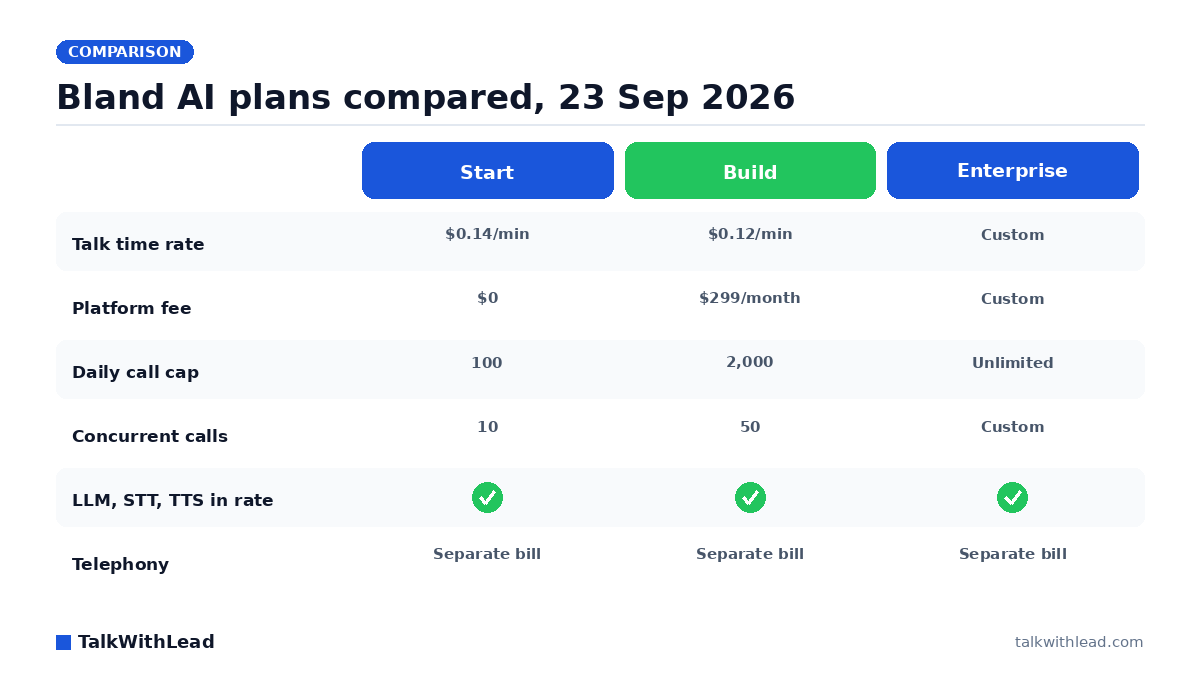
    Bland AI plans compared, 23 Sep 2026 — TalkWithLead original infographic (comparison diagram).
    Bland AI plans compared, 23 Sep 2026

    How much does Bland AI cost?

    Bland AI pricing looks simple: each plan has a per-minute rate and a platform fee. The real monthly bill adds telephony and a separate transfer-time charge, and call caps can decide your plan before the rate does.

    Direct answer: As of 23 September 2026, Bland’s pricing page lists three plans. Start costs $0.14 per minute with a $0 platform fee and no card required. Build costs $0.12 per minute plus a $299 per month platform fee. Enterprise is custom. The per-minute rate includes the LLM, speech-to-text and text-to-speech. Telephony is billed separately.

    Every Bland figure below was read from that page on 23 September 2026 and is reported the way Bland prints it. Pricing pages can change without notice, so check the live page before you commit a budget.

    Bland AI plans compared (observed 23 September 2026)

    Bland describes Start as “for developers”, Build as “for teams” and Enterprise as “for organizations”. The table shows every published rate and limit for each plan.

    PlanTalk time ratePlatform feeTransfer time rateDaily call capHourly call capConcurrent callsVoicesKnowledge bases
    Start$0.14 per minute$0$0.05 per minute10010010110
    Build$0.12 per minute$299 per month$0.04 per minute2,0001,00050550
    EnterpriseCustomCustomCustomUnlimitedUnlimitedCustomUnlimitedUnlimited

    A few terms are not in the table. Start needs no card. Signing up gives you 2 credits and an inbound number, which Bland values at $15 per month. Enterprise rates and concurrency are custom and set by contract according to volume. Enterprise can also include on-prem or VPC deployment, a forward deployed engineer, a BAA, SSO and data residency. Bland prints a 99.9% uptime SLA for all tiers.

    On timing, Bland’s FAQ says most teams deploy a first agent within a day on the self-serve plans. Enterprise deployments follow a 28-day deployment framework. On security, Bland states SOC 2 Type I and Type II, HIPAA eligibility with a BAA, GDPR and PCI DSS. Those are Bland’s own statements; this page has not verified them.

    What the per-minute rate includes – and what it does not

    Bland’s per-minute rate covers three things: the LLM, with no token charges; real-time speech-to-text; and premium text-to-speech voices. The model the agent runs on does not come with a separate token bill.

    Three costs are billed outside that rate:

    • Telephony. Billed separately. You can use your own carrier or Bland’s built-in Twilio at pass-through cost. Bland also works with an existing Twilio account or SIP trunks.
    • Transfer time. A separate per-minute charge on Bland’s price list: $0.05 per minute on Start and $0.04 per minute on Build. Bland says customers who bring their own telephony pay no transfer fees. This page uses “transfer time” only as the name of a billing line. Check Bland’s documentation for what counts toward it.
    • The platform fee. $0 on Start, $299 per month on Build and custom on Enterprise. On Build it is a fixed monthly charge on top of the minutes.

    To budget, multiply your talk minutes by the plan rate, then add the platform fee, telephony and any transfer minutes. Only the first two are fixed by the pricing page. Telephony depends on your carrier and the calls you make.

    What Bland AI costs at real volumes

    The calculations below use Bland’s list rates from 23 September 2026 and count talk minutes only. Telephony and transfer time are left out because both depend on your setup.

    Illustrative example, not a quote: a team expects 2,000 talk minutes a month on Start. 2,000 × $0.14 = $280 a month, with no platform fee.

    Illustrative example, not a quote: the same 2,000 talk minutes on Build. 2,000 × $0.12 = $240, plus the $299 platform fee = $539 a month.

    Illustrative example, not a quote: Build saves $0.02 on every minute, so its $299 fee is paid back at 14,950 talk minutes a month ($299 ÷ $0.02). Below that volume, Start’s list rates give the smaller talk-time bill. Above it, Build’s do.

    The caps can decide the plan before the price does. Start allows 100 calls a day, 100 calls an hour and 10 concurrent calls. Build raises those limits to 2,000 a day, 1,000 an hour and 50 concurrent. Illustrative example, not a quote: assume calls average three minutes. Start’s cap of 100 calls a day then allows at most 9,000 talk minutes in a 30-day month (100 × 30 × 3). That is well below the 14,950-minute break-even, so in this case the cap, not the rate, moves a team to Build. Size the plan on your busiest day and busiest hour first, then compare prices.

    How Bland’s pricing compares with Vapi and Retell – by Bland’s own account

    Bland’s FAQ includes its own comparison. According to Bland’s pricing page, Vapi lists $0.05 per minute and Retell about $0.07 per minute, and both figures cover voice infrastructure only. With typical providers added, Bland estimates the total at roughly $0.13-$0.30 per minute on Vapi and $0.11-$0.25 per minute on Retell.

    These are Bland’s estimates, published by a company that competes with both. They are not our figures, and this page did not re-check Vapi’s or Retell’s prices. The real difference is how the prices are built. Bland puts the LLM, speech-to-text and text-to-speech into one rate. By Bland’s account, the Vapi and Retell headline rates leave those providers to be billed on top, so the total changes with the model, voice and carrier you choose.

    For the vendors’ own pricing pages, see our dated comparison of AI voice agent pricing across callback products and programmable platforms. If Vapi is on your shortlist, Vapi alternatives: developer platforms and callback options separates the platforms you build on from the products that do one fixed job.

    None of these vendors comes out ahead on paper. A fair comparison needs your own average call length, provider choices and daily peak, checked against each vendor’s live page.

    When you do not need a voice platform at all

    Bland, Vapi and Retell are platforms for building voice agents. You design the agent, supply or rent telephony, and pay for every minute it talks. Some teams looking up Bland AI pricing have a much narrower job in mind: calling back, quickly, the people who leave a phone number on their website. A different kind of product fits that job.

    Speed is why that job matters. According to Harvard Business Review research (March 2011), companies that reach a web lead within an hour are nearly 7× more likely to qualify it than those that wait even an hour longer.

    TalkWithLead does that one job. A visitor enters a phone number anywhere on your own website: the widget, a contact or quote form, or an abandoned-cart flow. A number can also come from your CRM or other software through the API. TalkWithLead then calls that number within seconds. Most customers let the AI voice agent speak with the person. In human mode, the system calls the visitor and your own staff at the same time, so the two people talk directly. The live demo page says the AI voice agent “can answer questions, collect contact details, qualify the lead, and help move that visitor closer to becoming a paying customer – even when you are busy, closed, or unavailable.”

    Published features include:

    • custom fields on the widget, to ask for extra details before or after the visitor requests the call
    • optional call recording, with transcripts sent by email
    • callbacks that ring several of your reps at once or take turns in round-robin order
    • working hours you set; outside them, the widget offers a callback for when you are back
    • your own number as caller ID
    • an API for sending in numbers from other software
    • conversations in more than 20 languages

    The pricing works differently too. Plans are priced by the number of calls. There is no per-minute meter, no LLM bill and no telephony bill:

    • Basic: $0, no payment method, 10 calls, 1 widget, 14-day free trial
    • Standard: $99.99 USD a month, 100 calls, 3 widgets
    • Advanced: $199.99 USD a month, 200 calls, 4 widgets
    • Professional: $299.99 USD a month, 400 calls, 6 widgets
    • Enterprise: $599.99 USD a month, 800 calls, 15 widgets

    Paid plans need a card and also come with a 14-day trial. The full details are on the TalkWithLead pricing page. Illustrative example, not a result: a site that gets 100 callback requests a month fits the Standard plan at $99.99 USD a month, however long each conversation runs.

    TalkWithLead is not a developer platform. There is nothing to build, no inbound number and no calling campaigns or list dialing. It has no call forwarding and no missed-call detection, and it does not text leads. Calls to the phone number on your site keep reaching you just as they do today. To hear it, open the live demo and enter your number in the widget. The AI voice agent will call you.

    Who this is not for

    TalkWithLead has real limits, and they matter if you came here to price Bland:

    • You cannot design, script or deploy your own voice agents with it.
    • It gives you no inbound number for people to dial.
    • It does not run outbound calling campaigns. It only calls numbers that come from your website, CRM or API.
    • It does not give you the developer-level control over the agent that Bland’s plans are built around.
    • It does not write to your calendar or update your CRM, and the Basic plan stops at 10 calls.

    Best for: a business that wants every phone number left on its website, whether in the widget, a contact or quote form, or an abandoned cart, called back within seconds by an AI voice agent or its own staff, for a fixed price per plan based on the number of calls.

    Not the right fit if: you are building your own voice agents, need an inbound number, run outbound calling campaigns or need Bland-style developer controls. For that work, choose Bland, Vapi or Retell.

    If your job is the narrow one, Basic is $0 with no credit card, 10 calls and a 14-day trial: start on the Basic plan. If it is not, take the arithmetic above to Bland’s live page and size Start or Build on your busiest day.

    FAQ

    How much does Bland AI cost per minute?

    As of 23 September 2026, Bland charges $0.14 per minute of talk time on Start and $0.12 per minute on Build. Enterprise rates are custom. The rate includes the LLM, speech-to-text and text-to-speech. Telephony is billed separately.

    Is Bland AI free?

    Start has a $0 platform fee and needs no card, but every talk minute is billed at $0.14. Signing up gives you 2 credits and an inbound number, which Bland values at $15 per month.

    What is Bland AI’s platform fee?

    $0 on Start, $299 per month on Build and custom on Enterprise, according to Bland’s pricing page on 23 September 2026. On Build, the fee is paid back by the lower per-minute rate at 14,950 talk minutes a month.

    Does Bland AI charge for telephony?

    Yes, separately from the per-minute rate. You can use your own carrier or Bland’s built-in Twilio at pass-through cost. Bland also works with an existing Twilio account or SIP trunks.

    What are transfer minutes on Bland AI?

    Transfer time is a separate billing line on Bland’s price list: $0.05 per minute on Start and $0.04 per minute on Build. Bland says customers who bring their own telephony pay no transfer fees. Check Bland’s documentation for what counts toward it.

    Is Bland AI cheaper than Vapi?

    The two price in different ways, so the headline rates do not compare directly. Bland’s own FAQ says Vapi lists $0.05 per minute for voice infrastructure only and estimates about $0.13-$0.30 per minute once typical providers are added. That is Bland’s estimate, not ours. The real answer depends on your call length, provider choices and volume, so neither one is cheaper in every case.
  • AI Voice Agent Pricing: Callback Products vs Programmable Platforms

    AI Voice Agent Pricing: Callback Products vs Programmable Platforms

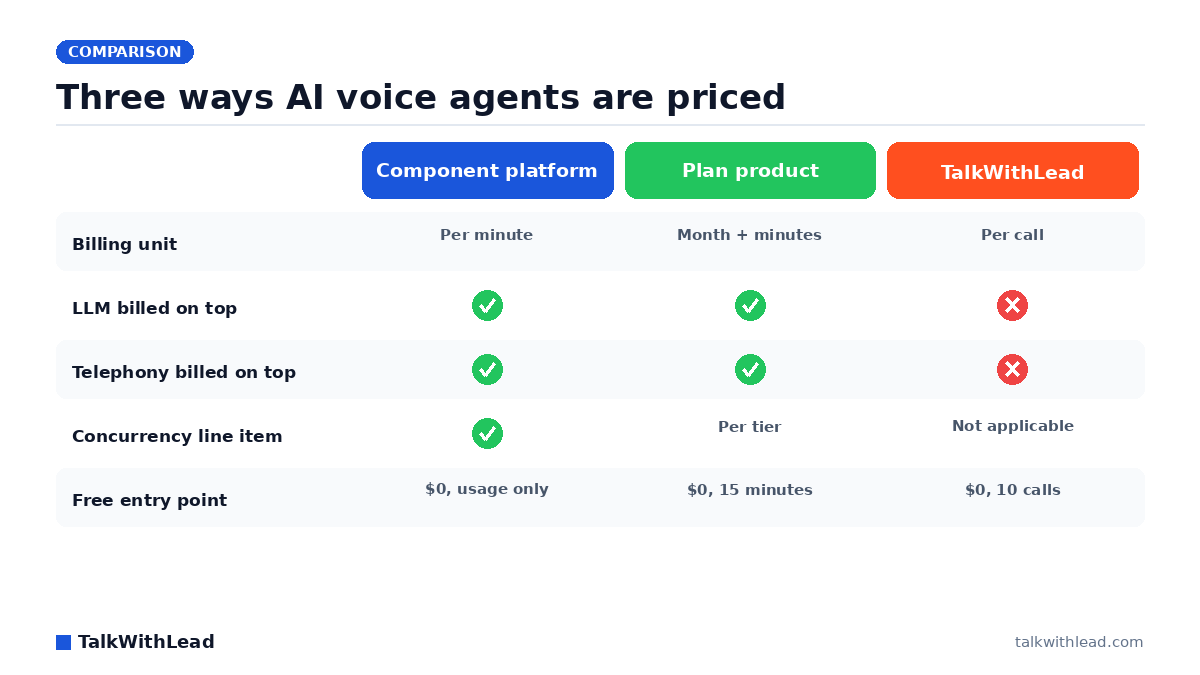
    Three ways AI voice agents are priced — TalkWithLead original infographic (comparison diagram).
    Three ways AI voice agents are priced

    What AI voice agent pricing looks like in September 2026

    Search for a monthly budget number and you get two kinds of answers that do not add up to each other. Some vendors quote a fee per minute before you add the models that do the talking; others quote a flat plan with minutes included. That is why ai voice agent pricing is confusing on first contact, and why this page starts with the shape of the market rather than a single figure.

    Direct answer (every figure below read from the vendor’s own pricing page as of 15 September 2026): Component platforms charge their own fee per minute, from $0.05 (Vapi) to $0.055 (Retell AI), before the language model, voice and telephony you add. Bundled per-minute pricing runs $0.12 to $0.14 per minute plus telephony (Bland AI). Plan products run $0 to $990 per month with included minutes (ElevenLabs Agents). TalkWithLead prices by calls, not minutes, from $0, for one narrow job: ringing back the leads that arrive through your own website. For more detail, see Bland ai alternatives.

    To be equally plain about what TalkWithLead is not: it is not a developer platform, there is no agent to build — the API only triggers a callback, there is no inbound number at all, and it runs no calling campaigns. If you need any of those, the platforms below are the right place to look, and this page will not steer you away from them.

    Two pricing models: component platforms versus plan products

    Most ai voice agent software is sold either as components or as a plan. A component platform sells the plumbing. You pay the platform’s own per-minute fee, then pay separately for speech-to-text, the language model, text-to-speech and the phone line, usually at each provider’s list price. Vapi publishes exactly this structure: each component at the provider’s listed price with no markup, plus a flat $0.05 per minute hosting fee. Retell AI does the same with a $0.055 per minute voice infrastructure charge, then adds text-to-speech, an LLM rate by model and telephony on top.

    A plan product sells a monthly price with usage included. ElevenLabs Agents lists tiers from $0 to $990 per month, each with a pool of call minutes and a concurrency limit, and bills extra minutes at a flat rate. Bland AI sits between the two: one bundled per-minute rate covers the LLM, speech-to-text and text-to-speech, but telephony is still billed separately. For Bland on its own, tier by tier with its call caps, see Bland AI pricing explained.

    The consequence is simple. A $0.05 platform fee and a $99 plan are not comparable until you have priced every component each vendor bills separately, and a plan’s included minutes mean nothing until you know how long your average call lasts. The small-business AI voice agent guide covers capability fit; this page stays on price.

    AI voice agent pricing compared: six options side by side

    Every figure below was read from the vendor’s own pricing page on 15 September 2026. Where a vendor does not publish a figure, the cell says so.

    OptionPricing modelPublished entry price (observed 15 September 2026)What the published price includesConcurrent calls includedWhat you add
    VapiComponent, per minute$0 to start, usage only; $0.05 per minute hosting feeHosting; components at provider list price with no markup; 1 phone number4Transcription, LLM, voice, transport; optional success packages
    Retell AIComponent, per minute$0 to start with $10 in free credits; $0.055 per minute voice infrastructureVoice infrastructure only; no platform fee20Text-to-speech, LLM by model, telephony; phone numbers $2.00 per month
    Bland AIBundled, per minuteStart: $0.14 per minute, $0 platform feeLLM, speech-to-text and text-to-speech, no token charges10 on Start, 50 on BuildTelephony at pass-through cost; Build adds a $299 per month platform fee
    SynthflowEnterprise contractFrom $30,000 annuallyScoped around volume, concurrency, telephony, integrations, security and launch supportNot documentedNot documented; no self-serve tier on the pricing page
    ElevenLabs AgentsPlan, monthly with included minutesFree $0 per month (15 minutes); paid from $6 per monthIncluded call minutes per tier; extra minutes $0.08 per minute4 on Free, 40 on BusinessLLM usage and telephony at cost; burst minutes $0.16 per minute
    TalkWithLeadPlan, monthly by call volumeBasic $0, no payment method, 10 calls; paid from $99.99 USD per monthAI and human voice agent, unlimited minutes per call, forms, notifications, recording, APINot applicable – priced per callNothing: no LLM, telephony or concurrency line items

    How much does an AI voice agent cost per month?

    It depends on which model you are buying into, so here are the published facts per vendor, dated, with each vendor’s own page linked so you can re-check them.

    Vapi (vapi.ai/pricing, observed 15 September 2026):

    • Flat $0.05 per minute hosting fee; speech-to-text, LLM, text-to-speech and transport at the provider’s listed price with no markup.
    • $0 to start, pre-paid usage, 4 concurrent calls, 1 included phone number, no minimum minutes, no cap on agents or minutes.
    • Component ranges printed on the page: Deepgram transcription $0.0095-$0.0099 per minute, OpenAI model $0.0077-$0.0452 per minute, ElevenLabs voice $0.0146-$0.0238 per minute; transport free on Vapi SIP, $0.008 per minute inbound and $0.014 per minute outbound on Twilio.
    • Optional success packages buy support, SLAs, concurrency and compliance, never minutes: Core $29 per month (10 concurrent calls, 5 phone numbers); Pro at one-tenth of the Vapi hosting fee with a $999 per month minimum (30 concurrent calls, 10 phone numbers); Premier custom, direct sales only. Add-ons: extra concurrency $10 per line per month, extra organizations $20 per organization per month.
    • Vapi’s own estimate for 1,000 minutes per month on its default stack with no success package is $82-$129 per month. That estimate is Vapi’s, not ours.

    Retell AI (retellai.com/pricing, observed 15 September 2026):

    • Pay-as-you-go from $0 with $10 in free credits, no platform fee, no minimums, no contracts.
    • Marketed at $0.07-$0.31 per minute, assembled from Retell voice infrastructure at $0.055 per minute, text-to-speech at $0.015 per minute for platform voices or $0.040 per minute for ElevenLabs voices, and an LLM rate by model on the standard tier (GPT 4.1 at $0.045 per minute, GPT 5.5 at $0.16 per minute).
    • Telephony separate: Retell-provided US Twilio numbers at $0.015 per minute, bring-your-own SIP trunking at no charge from Retell, phone numbers $2.00 per month.
    • 20 concurrent calls included; additional concurrency $8.00 per concurrent call per month. Billing is tracked to the nearest second on accumulated minutes, and Retell states that silence and hold time are billed because speech-to-text stays active. Enterprise is custom.

    Bland AI (bland.ai/pricing, observed 15 September 2026):

    • Start: $0.14 per minute, $0 platform fee, no card required, 10 concurrent calls, 100 calls per day.
    • Build: $0.12 per minute plus a $299 per month platform fee, 50 concurrent calls, 2,000 calls per day.
    • One rate covers the LLM, speech-to-text and text-to-speech with no token charges; telephony is billed separately on your own carrier or Bland’s at pass-through cost. Enterprise is a custom contract.

    Synthflow (synthflow.ai/pricing, observed 15 September 2026):

    • One published option: enterprise contracts from $30,000 annually, scoped around call volume, concurrency, telephony setup, integrations, security needs and launch support. A self-serve tier is not documented on the pricing page.

    ElevenLabs Agents (elevenlabs.io/pricing/agents, observed 15 September 2026):

    • Free $0 per month (15 minutes, 4 concurrent); Starter $6 per month (75 minutes, 6 concurrent); Creator $22 per month (275 minutes, 10 concurrent); Pro $99 per month (1,238 minutes, 20 concurrent); Scale $299 per month (3,738 minutes, 30 concurrent); Business $990 per month (12,375 minutes, 40 concurrent); Enterprise custom.
    • Additional minutes $0.08 per minute on every tier and burst pricing above your concurrency limit at $0.16 per minute. The LLM and any telephony are billed separately on usage, telephony at cost, and ElevenLabs states its prices exclude taxes.

    TalkWithLead (pricing page, read 7 September 2026):

    • Basic $0, no payment method required, 10 calls, 1 widget, 14-day free trial. Standard $99.99 USD a month (100 calls, 3 widgets); Advanced $199.99 USD a month (200 calls, 4 widgets); Professional $299.99 USD a month (400 calls, 6 widgets); Enterprise $599.99 USD a month (800 calls, 15 widgets). Paid plans need a card and also include a 14-day trial.
    • Priced by call volume, with unlimited minutes per call and no per-minute meter.

    Illustrative example, not a quote: assume 300 website leads a month, an average conversation of 4 minutes, and a component stack on Retell AI using a platform voice, GPT 4.1 on the standard tier and a Retell-provided US number. Per minute that is $0.055 + $0.015 + $0.045 + $0.015 = $0.13, so 1,200 minutes come to about $156, plus $2.00 for the number, before any extra concurrency. Change the model, the voice, the call length or the carrier and the figure moves; that is the whole point of pricing the components first.

    Why TalkWithLead prices by the call, not the minute

    TalkWithLead does a narrower job than the platforms above, and the pricing follows the job. According to TalkWithLead, a visitor enters a phone number somewhere on your own site — the widget, a contact or quote form, an abandoned-cart flow — or a number reaches TalkWithLead from your CRM or another tool through the API. TalkWithLead then rings that lead. Either the AI voice agent speaks with them, in more than 20 languages, or, in human mode, the widget rings the visitor and your own staff together so both are on the call from its first second.

    That is the whole trigger model. TalkWithLead never answers a call placed to your published business number; there is no inbound number, there are no calling campaigns, and there is nothing to build. Because every call starts from a lead your site already captured, the unit that matters is the call, not the minute. Every plan includes unlimited minutes per call, the human and the AI voice agent, unlimited websites, automatic calls from web forms, your own number as caller ID, SMS and email notifications to you, call recording and transcripts, integrations and an API, and free international calling between a published list of supported countries with pay-as-you-go elsewhere. Cancel anytime.

    Speed is the reason the job is worth paying for at all. According to Harvard Business Review research, companies that reach a web lead within an hour are nearly 7× more likely to qualify it than those that wait even an hour longer. A per-call plan turns that into one fixed monthly line: Basic is $0 with no credit card, 10 calls and a 14-day trial, and the paid tiers are listed in USD on the pricing page. Try the self-serve callback demo before you decide anything: enter your phone number on the live demo page and take the call yourself.

    Which plan your own call volume lands on

    Because the unit is the call, the only input you need is how many of your web leads you expect to ring back in a month. These are the published USD figures, read from the pricing page; every tier carries unlimited minutes inside each call, both voice modes, auto web form calls, your own number as caller ID, SMS and email notifications, integrations and the API, and free international calling between a published list of countries.

    PlanPrice per monthCalls includedWidgetsTo start
    Basic$0101No payment method
    Standard$99.99 USD1003Card required
    Advanced$199.99 USD2004Card required
    Professional$299.99 USD4006Card required
    Enterprise$599.99 USD80015Card required

    Illustrative arithmetic, not a quote: say 80 of your web leads a month ask to be called. Standard covers them at $99.99 USD for 100 calls, which is about a dollar a call with no meter running inside the conversation. Price those same 80 conversations on the component stack costed above, at $0.13 a minute and a four-minute average, and you are near $42 in usage: cheaper on the meter, before you add the build, the telephony account, the model choice and the hours that keep them working. That is the real trade on this page, and which side of it you want depends on whether you are buying an outcome or a toolkit. Swap in your own lead count and average call length before you decide.

    What you install, and what installing it involves

    Setup effort is a real line in a voice-agent budget and the per-minute tables never show it. On a component platform you are building: prompts, functions, a telephony account, a deployment, then the maintenance of all four. Here you are pasting a script.

    • One snippet. It loads Librarytwl.js from widgets.talkwithlead.com and carries two values belonging to your account: your user key, and the number to dial on your side.
    • jQuery is a prerequisite. WordPress already ships it; a stripped-back theme or a hand-built page needs the jQuery tag above the snippet.
    • Head placement, any platform. The snippet goes in the site head (or the header/footer field your platform provides) — any platform where you can add HTML to the head will carry it, from a WordPress header field or code-insertion plugin to a hosted store or site builder’s code-injection setting, or the template of a static HTML site — and the loader adds its own asynchronous script at run time, so it stays off your render path.
    • It draws into your page, not an iframe. On window load the script fetches its configuration and injects the widget into your document, so your CSS applies to it. So does any performance plugin that delays JavaScript until a visitor interacts, which is the usual reason a correctly pasted widget never appears; excluding widgets.talkwithlead.com from that setting fixes it.
    • Forms and CRMs need no extra code. Auto web form calls cover a phone number typed into forms you already have, and the API covers a number that arrives from a CRM or another tool.

    There is no model to choose, no voice to license, no telephony account to open and no concurrency to size. Less control than a platform, far less to build, and one monthly figure instead of a stack of meters.

    Who this is not for

    TalkWithLead is a configured product, not a programmable one, and that cuts both ways.

    • You cannot build a custom agent through an API, choose your own LLM or voice provider, or tune the stack component by component. If that is the job, Vapi and Retell AI are built for it.
    • There is no inbound number, so it does nothing for the number printed on your business card.
    • There are no calling campaigns and no dialer; the only call it makes is the one a captured lead asked for.
    • Concurrency is not a published concept for the plans; usage is capped by calls per month, and Basic stops at 10 calls.
    • The widget renders through JavaScript on your own page, so a visitor with scripts blocked, or a page where a performance plugin never lets the script load, sees nothing to click.
    • It does not answer your published business number, and it cannot see a missed call on that line, so missed-call text-back is not part of it.

    Best for: a business whose leads arrive through its own website, forms, cart or CRM, that wants those people rung back and spoken with in their own language, and that wants one monthly line item instead of a per-minute stack.

    Not the right fit if: you need to design agent behaviour in code, you need an agent for an existing inbound number, you want to run calling campaigns, or you price usage by the minute across thousands of hours.

    How to estimate your real monthly cost before you compare vendors

    Start from the requirement, not the headline price.

    • You want to assemble your own stack and control every component: a component platform (Vapi or Retell AI). Price the LLM, voice, transcription and telephony lines yourself.
    • You want one per-minute rate and will supply telephony: a bundled platform (Bland AI).
    • You want a monthly plan with minutes included and will add LLM and telephony usage: a plan product (ElevenLabs Agents).
    • You need a scoped enterprise contract with launch support: Synthflow, from $30,000 annually.
    • You want the leads on your own website rung back, with no stack to build: TalkWithLead, priced per call from $0. Start on the Basic plan, $0 with no credit card, 10 calls and a 14-day trial.

    Before you compare any two vendors, put a number on each of these:

    1. Expected calls per month and average minutes per call, which together give minutes per month.
    2. The platform or hosting fee per minute, if any.
    3. The LLM rate per minute for the model you will actually run.
    4. Text-to-speech and speech-to-text rates per minute.
    5. Telephony per minute plus the monthly cost of each phone number.
    6. Concurrent calls you need at peak, and the price of each extra line.
    7. Fixed monthly fees: platform tiers, success packages, minimums.
    8. How silence and hold time are billed, since some vendors meter them.

    Then compare on the same volume. If you would rather see the cost of slow follow-up before the cost of the software, the speed-to-lead ROI calculator runs the maths on your own numbers, and the click-to-call versus callback widget versus AI voice agent comparison covers which capture mechanism belongs on the page.

    FAQ

    What does it take to install an AI voice agent like this?

    For TalkWithLead, one snippet in the site head (or the header/footer field your platform provides): the widget library from widgets.talkwithlead.com plus two values from your account, with jQuery available before it (WordPress already ships jQuery). Any platform that accepts a script tag can carry it, and forms you already have can trigger the call without extra code. On a component platform such as Vapi or Retell AI, installation means building and hosting the agent itself, which is where the cost difference between the two models really lives.

    How much does an AI voice agent cost per minute?

    On the pricing pages observed 15 September 2026, the platform’s own fee runs $0.05 per minute (Vapi) to $0.055 per minute (Retell AI) before you add the LLM, voice, transcription and telephony. Bundled rates run $0.12 to $0.14 per minute plus telephony (Bland AI), and plan overage is $0.08 per minute (ElevenLabs Agents). TalkWithLead has no per-minute rate; plans are priced by calls with unlimited minutes per call.

    How much does Vapi cost per minute?

    Vapi charges a flat $0.05 per minute hosting fee and passes through speech-to-text, LLM, text-to-speech and transport at each provider’s listed price with no markup. Vapi’s own on-page estimate for 1,000 minutes a month on its default stack is $82-$129 per month, observed 15 September 2026.

    How much does Retell AI cost per minute?

    Retell AI’s voice infrastructure is $0.055 per minute, plus text-to-speech at $0.015 per minute (platform voices) or $0.040 per minute (ElevenLabs voices), plus the LLM by model, plus telephony at $0.015 per minute on a Retell-provided US number. Retell markets the assembled range as $0.07-$0.31 per minute, observed 15 September 2026.

    Is there a free AI voice agent plan?

    Yes, in several shapes. Vapi is $0 to start on pre-paid usage, Retell AI starts at $0 with $10 in free credits, ElevenLabs Agents has a Free tier with 15 minutes a month, and TalkWithLead’s Basic plan is $0 with no payment method, 10 calls, 1 widget and a 14-day trial. Bland AI’s Start tier has a $0 platform fee but bills every minute.

    Why is AI voice agent pricing billed per minute?

    Because the underlying costs are metered by time: transcription, the language model and the voice all run for as long as the call does, and carriers bill telephony by the minute. Platforms pass those meters through, and Retell states that silence and hold time are billed for the same reason. A per-call plan such as TalkWithLead’s folds that meter into a monthly call allowance instead.

    Do I have to pay for the LLM separately?

    On Vapi, Retell AI and ElevenLabs Agents, yes: the LLM is billed on top, by usage or by model. On Bland AI the LLM is inside the bundled per-minute rate. On TalkWithLead there is no LLM bill, no telephony bill and no concurrency line item; the plan price is the whole price.

Your next lead is on your site right now — ready to talk.

TalkWithLead’s AI voice agent rings that visitor back in seconds, qualifies the lead in their language, and books the call before the prospect can open a competitor’s tab. Forms are slow. Chatbots make people type. Voice closes.

Just curious about plans? See pricing →