TalkWithLead
AI Voice-First Lead Conversion

AI Voice Agents That Turn Website Visitors Into Real Conversations

TalkWithLead is the AI voice-first widget that turns a website visitor into a phone call. The visitor enters their number, the system rings them, and an AI voice agent talks with them — multilingual, extremely human-sounding, and free to call between a list of supported countries. More calls. More leads. More closed deals.

Extremely human-sounding voice 23 published languages out of the box Unlimited minutes on every plan Instant callback widget

Tag: speed to lead

  • Speed to Lead: How Fast Should You Call a New Lead?

    Speed to Lead: How Fast Should You Call a New Lead?

    Call a new web lead within five minutes, and start the conversation in seconds if you can — while the person is still on your site. Harvard Business Review found companies that reach a web lead within an hour are nearly 7× more likely to qualify it than those that wait an hour longer. The MIT Lead Response Management study puts the five-minute-versus-thirty-minute gap at roughly 21×.

    That is the answer. The rest of this page is the working: what speed to lead means, the published statistics behind the five-minute rule, an honest comparison of the five ways businesses actually respond to a new lead, a calculator you can put your own numbers into, and a plain list of the situations where none of this applies to you.

    What speed to lead means

    Speed to lead is the elapsed time between a prospect raising their hand and your first real attempt to talk to them. The clock starts when the form is submitted, the quote request is sent, the number is typed into a widget, or the cart is abandoned. It stops when a conversation begins — not when an automated email lands, and not when the lead is assigned to somebody in a CRM.

    Two words in that definition do most of the work. Elapsed means nights, weekends and holidays count, so a Saturday-evening enquiry answered on Monday morning has a response time measured in days, not in the minutes your team would quote you. Conversation means an auto-reply promising that somebody will be in touch shortly does not stop the clock. Lead response time is the same measurement under a more formal name, and the terms are used interchangeably in the research below.

    Speed to lead is worth measuring separately from conversion rate because it is the one input you control completely. You cannot make a market want your product this quarter. You can decide that nobody who fills in a form waits more than five minutes.

    The speed-to-lead statistics, with sources you can check

    The five-minute rule comes from published lead-response research rather than from sales-floor lore, and the same finding keeps reappearing in independent studies over fifteen years. Each figure below links to its source so you can read the methodology rather than take a number on trust.

    • 21× at five minutes versus thirty. The MIT Lead Response Management study found you are about 21× more likely to qualify a lead contacted within five minutes than one contacted at thirty minutes. The study covered three years of data across six companies, 15,000+ leads and 100,000+ call attempts.
    • Nearly 7× within the hour. According to Harvard Business Review research, companies that reach a web lead within an hour are nearly 7× more likely to qualify it than those that wait even an hour longer — an audit of 2,241 U.S. companies published in 2011.
    • The first responder takes 35-50% of the sales. Research popularised by InsideSales and Dr. James Oldroyd found that roughly 35-50% of sales go to the company that responds first.
    • The average company takes 47 hours. According to Drift’s lead-response study of 433 B2B companies, the average company took 47 hours to respond to an inbound lead, only 7% responded within five minutes, and 27% never responded at all. A secret shopper submitted real forms to every one of those sites.

    Read together, those four say something narrower than “speed matters”. They say the curve is steep at the start and almost flat later. The difference between one minute and five minutes is large. The difference between four hours and eight hours barely registers, because by then the decision has usually been made by whoever answered first.

    One caveat. The two most-quoted studies date from 2011, and both were run on B2B lead sets. Treat the multipliers as the shape of the curve rather than as a promise about your own funnel. The 2021 Drift replication is the useful sanity check — a full decade later, with better tooling available, the average was again measured in days rather than minutes.

    Five ways to respond to a new lead, compared

    Every business already has a response method, even if nobody chose it deliberately. Here are the five that account for almost all of them, side by side on the questions that decide response time.

    Response methodWho starts contactTypical response timeWhat it needsBest for
    Manual call-back
    A person on your team dials the lead
    Your team, after the lead has left the siteMinutes when someone is free; hours or the next business day otherwiseA person available at that moment, plus the discipline to check between other jobsLow lead volume that one owner genuinely covers within minutes
    Email autoresponder
    Automated reply on form submit
    Nobody — it is a message, not a contactInstant, but it is an acknowledgement rather than a conversationA form and an email toolPaper trail, long consideration cycles, scheduling links
    SMS and text-back tools
    Third-party category; Podium’s WebChat is one example
    The tool sends the first message; a person continues the threadInstant first message; the reply speed after that depends on who is watching the inboxA messaging number and somebody monitoring the thread during working hoursBuyers who prefer typing, and teams already staffed for messaging
    Website chatbot or live chat
    Third-party category; Tidio is one example
    The visitor, by typing into the widgetInstant typed answer; a phone conversation only if the visitor asks and somebody is freeA widget script and content for the bot to answer fromQuick typed answers and support deflection
    Instant AI voice callback
    TalkWithLead
    The visitor, by entering a phone number; the system then rings that numberSeconds — the visitor’s own phone rings while they are still on the pageA widget script, or a form, cart or CRM record wired through the API. No number to buy or portTurning website traffic you already pay for into phone conversations without adding headcount
    Five response methods for a new web lead. The two third-party rows were observed on 7 September 2026 from the vendors’ own public pages; the TalkWithLead row is described from its own published pages, verified 5 September 2026.

    Where the third-party rows come from. Both were read on 7 September 2026 on the vendor’s own site, not in a roundup. Podium’s WebChat page describes the product as making “your website textable” and continuing conversations over text, which is what puts it in the messaging row. Tidio’s live chat page sells typed support and an AI chat agent, which is the chatbot row. Neither vendor’s marketing figures are repeated here — those are vendor claims, not vetted statistics, and quoting them would put an unsourced number in this table.

    Email and chat are not bad tools; they are simply not answers to the speed-to-lead question, because neither ends in the medium where a deal is usually agreed. And the manual row wins outright when you are small enough to work it — an owner who answers every enquiry personally within four minutes does not need any of the other four rows. For a wider view of the widget categories specifically, the click-to-call versus callback widget versus AI voice agent comparison takes them apart mechanism by mechanism.

    Why most teams cannot hit five minutes by hand

    Almost every owner agrees with the five-minute rule. Almost none hit it consistently. The reasons are structural rather than motivational:

    • Leads arrive when you are busy. Your best salespeople are on calls, on site or in meetings precisely because they are good at the job. The form fill lands in an inbox and waits.
    • Leads arrive when you are closed. According to MediaAlpha, the insurance lead marketplace, about 45% of leads on its platform are generated during nights and weekends — outside standard agency hours. Different market, same shape: a large slice of demand shows up when nobody is at a desk.
    • Handoffs add lag. Form to CRM to notification to assignment to dial: five hops, each one a few minutes on a good day, and any broken link in the chain adds days rather than minutes.
    • Expectations have moved. Salesforce research found 83% of customers expect to engage with someone immediately when they contact a company. A next-business-day reply is not slow by 2010 standards; it is slow by the standard your prospect is applying today.
    • Language and geography. If enquiries arrive from other regions or in other languages, “call them back fast” quietly becomes “call them back tomorrow, in English, and hope”.

    Hiring your way out is expensive and still leaves the evenings uncovered. Forms do not fix it — a form is a device for postponing the conversation. And a chatbot keeps a high-intent visitor typing instead of talking, which is a different problem examined in AI voice agent versus chatbot.

    How an instant AI voice callback closes the gap

    The five-minute rule assumes the lead leaves and you chase them. The stronger play is to never let the gap open at all. If the phone conversation can begin while interest is still peaking, your speed to lead stops being a target you miss and becomes a property of the page.

    That is what TalkWithLead is built to do, and the mechanism is worth spelling out because it is narrower than the category name suggests. The trigger is a phone number entered somewhere on your own site: the widget, a contact or quote form, a checkout somebody abandoned, or — according to TalkWithLead — a record created in your CRM and pushed through the API. The system then rings that number. On the other end is an AI voice agent that speaks with the person and asks qualifying questions. Set the same widget to human mode instead and it rings the visitor and your rep together, on the same call from the start.

    Three consequences follow from that design. The visitor never has to dial anything, so the friction of “we will call you back” disappears. The agent speaks more than 20 languages, so an enquiry in Spanish or Hindi is not parked until somebody bilingual is free. And international calling is free between a published list of supported countries, pay-as-you-go elsewhere, so geography stops being a reason to delay.

    The honest limit of the design is on the same page as its strength: everything begins on your website. Reading about how conversational it sounds is far less convincing than talking to it, which takes about two minutes on the live demo. The general buyer’s guide to AI voice agents for small business covers how to evaluate this category against the phone-line platforms, which solve a different problem.

    Screen recording of the TalkWithLead widget’s call-back panel on our own live-demo page, made by our team on September 16, 2026. The phone number typed is a fictional example and no call is placed. This is our own product, not a customer’s call.

    Run your own numbers in the speed-to-lead ROI calculator

    Rather than quote somebody else’s revenue figure, put yours in: the free speed-to-lead ROI calculator takes four inputs — monthly leads, how fast you respond today, average deal value and your current close rate — and returns the deals and revenue that response time alone could be worth over twelve months.

    State the assumptions before you trust the output. The calculator starts from the deals you already close (your leads multiplied by your close rate), then applies a speed multiplier tied to how quickly you respond now — 1.0× if you already answer under five minutes, rising to 2.5× for next-day responders. The extra deals are multiplied by your deal value across twelve months. Those multipliers are deliberately far smaller than the 21× and 7× figures in the research above, so the projection stays conservative. It is an estimate driven entirely by your inputs, not a forecast and not a promise. If unanswered phone calls are a separate leak for you, the missed-call revenue guide covers that side.

    An illustrative worked example, with every assumption stated and none of it drawn from a customer: imagine a business taking 100 web enquiries a month, an average customer worth $2,000, and a close rate that improves from 8 to 15 of those 100 once responses land in seconds rather than hours. That is seven extra customers a month, or $14,000 of monthly revenue riding on nothing but the clock — same leads, same ad spend, same pitch. Swap in your own figures before you believe any of it.

    How to build a five-minute (or five-second) response system

    Whatever tools you pick, the sequence is the same:

    1. Measure your real response time first. Pull your last twenty enquiries and calculate the honest gap between arrival and first human contact — including the ones that came in on a Sunday. The figure is usually worse than the team estimates, and it is the baseline every later change is judged against.
    2. Answer at the source. Put a voice-first option on the pages where intent peaks: pricing, service pages, contact. The best response time is the one where nobody has to wait for a call at all.
    3. Cover every place a number gets typed. A widget on the pricing page is a start; quote forms, abandoned carts and CRM records are the same event arriving through a different door, and each one left unwired is a slow lane you did not know you had.
    4. Automate the first touch, not the relationship. Let the AI voice agent take the instant conversation and qualify; let your people take the ones that are ready to buy. Speed wins the conversation; your team still closes it.
    5. Track it weekly. Response time behaves like any other metric. What gets measured gets faster, and what gets reviewed on a Monday stays fast.

    Getting started does not need a project plan. You can start on the free Basic plan — $0, no payment method required — add the widget, and have an AI voice agent taking enquiries the same day. Paid plans start at $99.99 USD a month and are priced by call volume; the details are on the pricing page. Note the material caveat: Basic includes ten calls, which is a trial allowance rather than a free tier.

    Who this is NOT for

    Speed to lead is close to universal advice. An instant AI voice callback is not. Here is where it is the wrong tool, stated plainly so you can rule it out in thirty seconds instead of a sales call:

    • You need the number you publish to be answered. TalkWithLead does not answer calls placed to a business’s own published number. There is no inbound number and no call forwarding, so if your problem is people ringing you and getting voicemail, buy from a different category — a human answering service or a phone-line AI platform.
    • You want a text reply when a call is missed. The product is not in the path of your phone line, so it cannot detect that a call was missed. That is a different product.
    • You want to work a purchased list. There is no list upload and no outbound dialer. Every call starts from something a person did on your own site or in your own systems.
    • Your sales cycle has no phone step. Pure self-serve checkout does not need this. Neither does a business whose buyers genuinely prefer email and would resent a ringing phone.
    • You already answer within minutes yourself. If you personally reply to every enquiry inside five minutes and your volume is not growing, you have already solved this and adding software will not improve the number.
    • You are counting on a mid-call handover. Nothing published states that the AI agent can pass a live call to a person, or that it detects and changes language during a conversation. Assume neither exists until a vendor page says so. The choice between AI mode and human mode is made before the call is placed, not during it.

    FAQ

    What is speed to lead?

    Speed to lead is the elapsed time between a prospect submitting an enquiry and your first genuine attempt to talk to them. It is measured in wall-clock time, so evenings and weekends count, and it stops when a conversation starts rather than when an automated acknowledgement is sent.

    What does speed to lead mean in sales?

    In a sales context it means the same thing as lead response time: how long a new inbound lead waits before somebody, or something, actually engages them. It is treated as a separate metric from conversion rate because it is one of the few inputs a team controls outright, and because the MIT Lead Response Management study found qualification odds fall steeply within the first half hour. What happens inside that first conversation is its own subject: AI lead qualification for website leads covers which questions get asked and what your team receives afterwards.

    What are the key speed-to-lead statistics?

    Four are quoted most often. The MIT Lead Response Management study found roughly 21× better qualification odds at five minutes versus thirty. Harvard Business Review found companies responding within an hour were nearly 7× more likely to qualify a web lead. Research popularised by InsideSales and Dr. James Oldroyd put 35-50% of sales with the first responder. And Drift’s study of 433 B2B companies measured an average response time of 47 hours, with 27% never responding at all.

    What is a good lead response time?

    Under five minutes during working hours is the standard the research supports, and anything past an hour should be treated as a leak rather than a target. Seconds is better still, because a conversation that begins while the visitor is on the page skips the callback entirely. If enquiries arriving in the evening currently wait until the next business day, closing that gap is usually the single largest improvement available, since those leads face the longest delays.

    Why does speed to lead matter in real estate?

    Property enquiries are unusually perishable: a buyer looking at a listing at nine on a Sunday evening is comparing several agents at once, and the one who talks to them first frames every conversation that follows. Agents are also mobile by definition, which makes a five-minute manual call-back genuinely hard to sustain. The speed-to-lead playbook for real estate covers the listing-page mechanics, and the mortgage version covers the loan side of the same transaction.

    How do I respond to leads in under five minutes outside office hours?

    Automate the first conversation rather than the follow-up. When a visitor enters a phone number on your site, an AI voice agent can ring that number within seconds, in more than 20 languages, and qualify the enquiry — so a Sunday-evening enquiry gets a real conversation instead of a Monday-morning voicemail. Working hours remain configurable, and outside them the widget can offer the visitor a callback for when you are back.

    Is an AI voice agent better than a chatbot for lead response?

    For phone-driven businesses, usually. A chatbot keeps a high-intent visitor typing into a text box; a voice agent moves them into the medium where deals are normally agreed. Chat still wins for quick factual questions and for buyers who simply do not want to speak to anyone, which is why plenty of sites run both.
  • Live Chat Alternative for Real Estate Agents

    Live Chat Alternative for Real Estate Agents

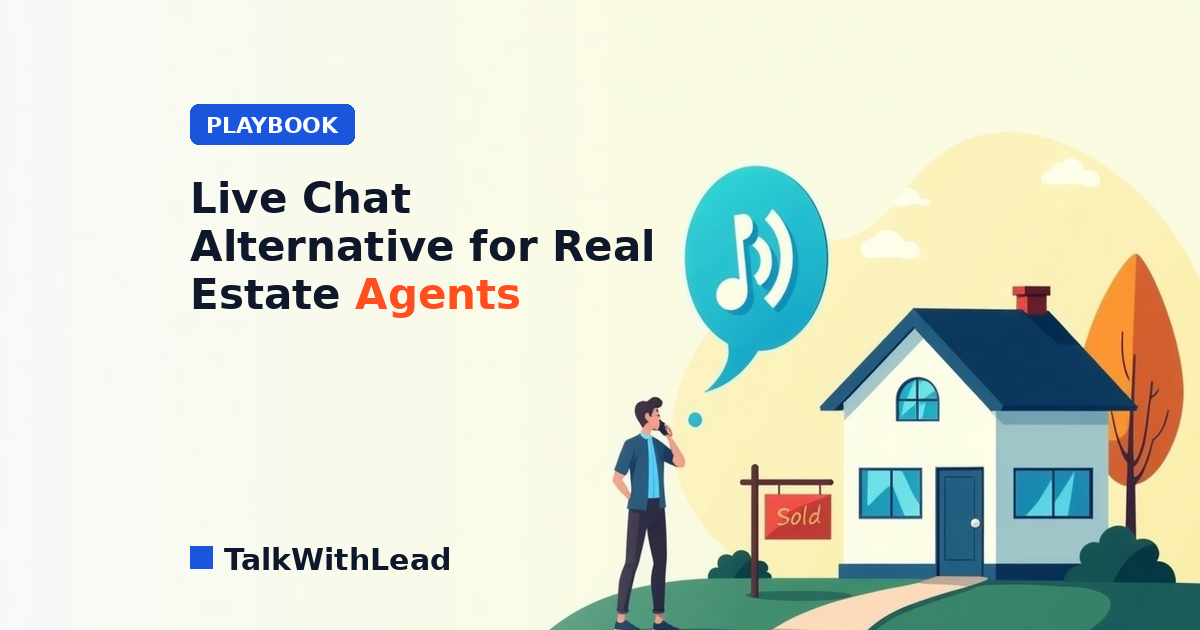
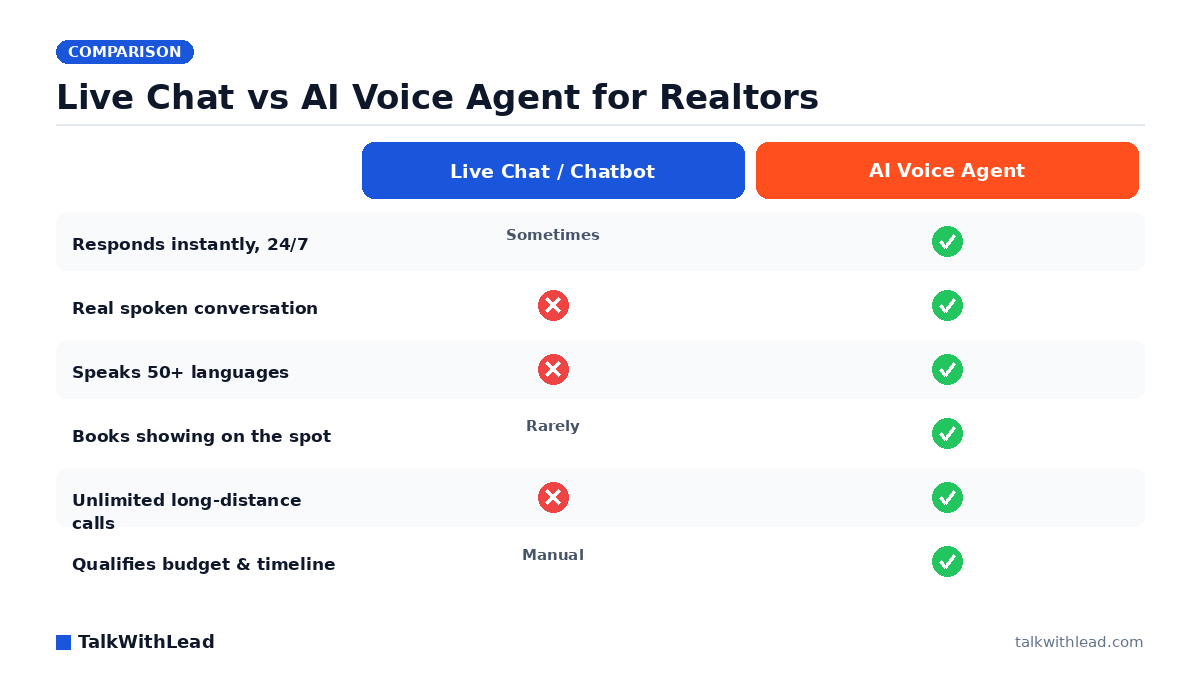
    Live Chat vs AI Voice Agent for Realtors — TalkWithLead original infographic (comparison diagram).
    Live Chat vs AI Voice Agent for Realtors

    A buyer lands on your listing at 9:47 p.m., loves the kitchen, and clicks your live chat. A box pops up: “We’re away right now, leave your email.” They don’t. They open the next agent’s site instead. That single silent moment is why so many real estate agents are hunting for an ai voice agent alternative to live chat for real estate agent websites — something that actually talks back the second interest is highest.

    TL;DR: The strongest live-chat alternative for real estate is a human-sounding AI voice agent that answers the instant a visitor asks to talk, holds a real spoken conversation in more than 20 languages, qualifies budget and timeline, and books the showing on the call. Instead of collecting a typed email you may never follow up on, it turns the website visit into a live phone conversation while the buyer is still excited.

    Why live chat quietly loses real estate leads

    Live chat felt modern a decade ago, but for property buyers it introduces friction at the worst possible moment. A serious buyer researching a home doesn’t want to thumb-type questions about square footage, school districts, and closing timelines into a tiny widget. They want to ask and get an answer.

    Three things go wrong with chat on an agent site:

    • It’s usually unstaffed. Agents are at showings, in the car, or asleep. “Live” chat becomes a form that promises a human and delivers a delay.
    • It caps the emotion. Buying a home is a phone-call decision, not a text-thread decision. Typing strips out the tone and reassurance that move someone toward booking.
    • It stalls exactly when speed wins. According to Harvard Business Review research, companies that reach a web lead within an hour are nearly 7× more likely to qualify it than those that wait even an hour longer. A chat transcript sitting unread until morning burns that window.

    We break the chat-versus-bot tradeoff down further in Live Chat vs Chatbot: Pros, Cons, and the AI Voice Upgrade, but the short version is simple: both make the buyer wait or type. Voice does neither.

    What is an AI voice agent alternative to live chat for real estate agent websites?

    An AI voice agent is a widget you drop on your site that lets a visitor start talking — out loud — the moment they want to. Instead of a chat bubble, they get an extremely human-sounding voice that greets them, answers questions about the listing, and offers to set a showing. It runs on your site around the clock and never sends anyone to voicemail.

    Picture the same 9:47 p.m. visitor. They click “Talk now,” and within a second a warm voice says, “Hi, I can help with the Maple Street listing — are you looking to tour it this week?” It asks their timeline, whether they’re pre-approved, and which neighborhoods they’re considering, then books a showing straight into your calendar. That’s a booked appointment from a visit that live chat would have turned into an ignored transcript.

    Because it’s voice-first, it also does things chat structurally can’t:

    • more than 20 languages. A relocating engineer or an overseas investor gets answered in their own language, instantly.
    • Free long-distance calling between supported countries. An out-of-state buyer relocating for work talks to “your office” with no toll barrier.
    • Instant callbacks. If a visitor would rather be called, the agent rings them in seconds while they’re still on the page.

    Want to hear it? Try a Live Demo and talk to the agent the way your buyers would.

    Live chat vs AI voice agent: how they compare

    Here’s the honest, side-by-side view for a real estate website, on the dimensions that decide whether a browsing visitor becomes a booked showing.

    CapabilityLive chat / chatbotAI voice agent
    Calls back instantly, 24/7Only if staffedYes, always
    Real spoken conversationNo — typing onlyYes
    Speaks more than 20 languagesRarelyYes
    Qualifies budget & timelineManual or scriptedYes, conversationally
    Books a showing on the spotSeldomYes
    Free long-distance calling between supported countriesNoYes

    Best for: real estate agents and teams whose listing pages get after-hours or out-of-area traffic and who lose leads to slow follow-up.

    Not the right fit if: you only ever work referral clients you already know by name and your site isn’t meant to capture new buyer or seller inquiries.

    The same speed logic drives our piece on Speed to Lead Real Estate: Book More Showings — the agent who talks first usually books first.

    How much does an AI voice agent cost, and is it worth it?

    Cost anxiety is fair, so let’s make it concrete with clearly-labeled example math (your numbers will differ). Say your site gets 400 listing-page visitors a month and, like most agent sites relying on forms and chat, only a small slice ever contacts you.

    Illustration: imagine even 12 of those visitors would have talked if someone picked up, and your average commission on a closed buyer is a conservative figure you can plug in. If the voice agent books showings with just 3 of those 12 and one becomes a client, a single deal dwarfs a monthly software subscription. That’s the ROI shape for lead-conversion tools — one saved deal covers a year of the tool.

    To pressure-test your own numbers, run them through our free missed-call revenue calculator — it turns “how many leads am I leaving on the table” into a dollar figure. For plan-level pricing on the voice agent itself, see TalkWithLead pricing; a straightforward monthly subscription typically runs a small fraction of one real estate commission.

    If you’re weighing website voice against hiring an answering service or receptionist for your phone line, the same tradeoffs we cover in AI Receptionist for Contractors: 2026 Cost & ROI apply to agents: an AI voice agent calls back every visitor at once, never takes a lunch break, and doesn’t cost per-minute for long calls.

    Booking showings faster than the competition

    Real estate is a speed sport. When a buyer requests information, they usually reach out to several agents. Whoever converts that interest into a scheduled conversation first tends to win the relationship. A voice agent compresses that race to seconds.

    Here’s what changes on your site the day you replace chat with voice:

    • No dead ends after hours. Evening and weekend traffic — when most buyers browse — gets a real conversation instead of a “leave a message” box.
    • Qualified, not just captured. By the time you see the lead, budget, timeline, financing status, and target neighborhoods are already noted.
    • Fewer lost relocations. Long-distance and multilingual buyers, historically the hardest to convert through text, actually get served.

    You can layer it on the systems you already trust; the goal isn’t to replace your CRM, it’s to stop the leak between “visited your listing” and “talked to you.” See how the widget mechanics compare across formats in Callback Widget vs Click-to-Call vs Live Chat.

    The setup is quick and there’s no reason to keep bleeding after-hours leads. Start free with TalkWithLead and let a voice agent answer your next midnight listing visitor.

    FAQ

    What is the best live chat alternative for a real estate agent website?

    A human-sounding AI voice agent is the strongest alternative because it removes the two biggest weaknesses of chat: the wait and the typing. It calls back by voice within seconds, qualifies the buyer, and books a showing on the spot — even at night and even in more than 20 languages.

    Can an AI voice agent actually book showings on its own?

    Yes. It holds a natural spoken conversation, asks the qualifying questions you’d ask, and schedules the appointment during the call, then hands you a qualified lead with the details already captured.

    Will it work for out-of-state or international buyers?

    That’s one of its biggest advantages. With more than 20 languages and free long-distance calling between supported countries, relocating and overseas buyers get answered in their own language with no toll barrier — exactly the segment that typed chat tends to lose.

    Is an AI voice agent worth the cost for a solo agent?

    For most agents, one additional closed deal covers the tool for a long stretch, so it usually pays for itself quickly. Run your own traffic and commission numbers through a missed-lead calculator to see your specific payback before deciding.

    Does it replace live chat entirely or run alongside it?

    You can run either way. Many agents lead with the voice agent because it converts higher, while still offering a text option for visitors who prefer to type. The point is that no interested visitor hits a silent dead end.

    How fast can I get it live on my site?

    Setup is designed to take minutes, not a developer project — you add the widget, connect your calendar, and it starts answering visitors. You can try it first with a live demo to hear the voice quality before you commit.

  • Speed to Lead Real Estate: Book More Showings

    Speed to Lead Real Estate: Book More Showings

    A buyer lands on your listing at 9:14 p.m., loves the kitchen, and wants to see the place this weekend. If you call back tomorrow morning, that buyer has already booked two showings with agents who answered first. Speed to lead in real estate is won in minutes, not mornings — and most agents are still losing it to a contact form and a 12-hour reply gap.

    TL;DR: The fastest way for real estate agents to book more showings is to replace slow web forms with an instant callback widget backed by a human-sounding AI voice agent. It calls the buyer back in seconds, talks through their questions in their own language at any hour, and books the showing while interest is still hot — turning anonymous website traffic into real phone conversations before a competitor responds.

    Why does speed to lead matter so much in real estate?

    Real estate buyers shop in tabs. A single property search ends with five or six listings open at once, and the agent who turns that browsing into a live conversation first usually wins the relationship. The gap you are competing against is brutal: according to the MIT Lead Response Management study, you are roughly 21× more likely to qualify a lead contacted within 5 minutes than one contacted at 30 minutes. In a market where the listing itself is public, response speed is one of the few advantages you fully control.

    Now picture the inverse. Say even 1 in 10 of the after-hours inquiries you currently reply to “first thing tomorrow” was a ready buyer — that is a handful of booked showings a month walking straight to the agent who picked up first. The cost of slow is not theoretical; it is the listing down the street getting the offer.

    What is an instant callback widget, and how does it book showings?

    An instant callback widget is a small button on your website and landing pages that offers the visitor a phone call right now, with no form to fill out. The visitor taps it, and instead of waiting in a queue, they get a call back in seconds. When that call connects to a human-sounding callback widget powered by an AI voice agent, the conversation starts immediately — the buyer talks, the agent listens, and a showing time gets proposed before the buyer ever closes the tab.

    This is the core difference between voice-first and the slow alternatives. A web form collects a name and disappears into an inbox. A chatbot makes the buyer type, wait, and re-type. A voice callback does the one thing real estate runs on: it gets two people talking. See the side-by-side in our breakdown of AI voice agents vs chatbots for which actually converts website visitors.

    Best for: agents and teams who get steady website or listing-page traffic but lose after-hours and weekend inquiries to slow follow-up.
    Not the right fit if: you have almost no inbound web traffic yet — fix lead generation first, because a callback widget converts demand, it does not create it.

    How an AI voice agent covers the leads you can’t

    No agent can answer every call. You are at a closing, in a showing, asleep, or already on another line. That is exactly when the next buyer is browsing. A human-sounding AI voice agent answers those inquiries the moment they come in — 24/7, in more than 20 languages — so a relocating buyer from another country or a night-shift worker scrolling at midnight gets a real conversation instead of a voicemail.

    Two real-estate-specific wins matter here:

    • more than 20 languages — a multilingual market like Miami, Toronto, or Houston means buyers who would hang up on an English-only line instead get qualified in their own language.
    • Free long-distance calling between supported countries — out-of-state and international buyers relocating into your market reach you with zero toll friction, and you reach them right back.

    The AI voice agent qualifies the buyer, answers the obvious questions (price, square footage, is it still available, can I see it Saturday), and books or routes the showing. When you are free, it hands you a warm lead instead of a cold callback list. It is the difference between capturing the lead before they call a competitor and finding out Monday that they already toured three other homes.

    Want to hear how human it actually sounds? Try the live demo and talk to the AI voice agent the way your next buyer would.

    Voice-first vs forms and chatbots for real estate leads

    Most agent websites still funnel inquiries through a “Request Info” form or a typing chatbot. Both leak buyers at the exact moment intent peaks. Here is how the three stack up on what a showing actually depends on:

    CapabilityWeb formChatbotInstant callback + AI voice
    Response timeHoursMinutes of typingSeconds, by phone
    Works 24/7Collects onlyYesYes, and it talks
    more than 20 languages spokenNoLimitedYes
    Books a showing on the spotNoRarelyYes
    Long-distance buyers reachedNoNoUnlimited calling
    Becomes a real conversationNoNoYes

    The pattern is consistent: forms and chatbots are holding pens, while a voice callback is a conversation. For the deeper trade-offs between typing-based tools, our piece on live chat vs chatbot, and the AI voice upgrade walks through why voice closes the gap. And if you want the data behind responding inside the first minute, read why the first 60 seconds win most deals.

    What does this cost, and is it worth it for an agent?

    The honest framing: an instant callback tool runs a predictable monthly subscription, far below the cost of a single lost commission. To see whether it pencils out for your pipeline, here is illustrative ROI math (your numbers will differ):

    Example: Say your site gets 200 listing-page inquiries a month and your current form-and-follow-up flow converts 4% of them into showings — 8 showings. If answering instantly by voice lifts that to a still-modest 7%, that is 14 showings, or 6 extra showings a month. In real estate, even one of those turning into a closed deal can cover a year of the tool. Plug your own traffic and average commission into the free speed-to-lead ROI calculator to see your version of the number.

    The math leans this way because of who responds first. Research popularized by InsideSales and Dr. James Oldroyd found roughly 35-50% of sales go to the company that responds first — in real estate, “responds first” means “got the showing.” You can compare the plan tiers on the pricing page and start converting your existing traffic with a free signup.

    How to add speed to lead to your real estate site this week

    You do not need a website rebuild. A practical rollout looks like this:

    1. Put the callback widget on high-intent pages first — individual listings, the “book a showing” page, and any paid-ad landing page where buyers arrive ready.
    2. Set the AI voice agent to call web leads back instantly at night and on weekends so those enquiries, made when buyers actually browse, stop going nowhere.
    3. Turn on the languages your market speaks so multilingual buyers get qualified instead of dropping off.
    4. Let it book or route showings, then review the transcripts weekly to sharpen the questions it asks.

    The goal is simple and measurable: every inquiry becomes a phone conversation in seconds, not a form sitting in an inbox. If you want to compare voice against booking by chatbot specifically, our look at which one books more calls makes the case. When you are ready, run the live demo on your own phone before you put it in front of a buyer.

    FAQ

    What does speed to lead mean in real estate?

    Speed to lead is how fast you respond to a new buyer or seller inquiry from your website, ads, or listings. In real estate it usually decides who gets the showing, because the first agent to start a real conversation tends to win the relationship before competitors even reply.

    How fast should a real estate agent respond to a web lead?

    Within minutes, ideally seconds. Qualification rates drop sharply after the first five minutes, so an instant callback that connects the buyer to a live or AI voice conversation right away dramatically outperforms a same-day or next-morning reply.

    Can an AI voice agent really book showings for real estate?

    Yes. A human-sounding AI voice agent answers the inquiry instantly, qualifies the buyer, answers common questions about the property, and proposes or books a showing time. It works 24/7 in more than 20 languages and hands you warm, already-engaged leads instead of a callback list.

    Is an instant callback widget better than a chatbot for real estate?

    For booking showings, voice usually wins. A chatbot makes the buyer type and wait, while a callback widget gets two people talking in seconds — which is how real estate deals actually move. Voice also handles tone, urgency, and follow-up questions that text struggles with.

    How much does an instant callback tool cost for agents?

    It is a monthly subscription, typically far less than a single lost commission. Whether it pays off depends on your traffic and conversion lift — you can estimate your own return with the free speed-to-lead ROI calculator before committing to a plan.

    Does it work for out-of-state or international buyers?

    Yes. Free long-distance calling between supported countries removes the toll barrier for relocating buyers, and support for more than 20 languages means buyers who would hang up on an English-only line get qualified in their own language instead.

  • AI Voice Agent vs Chatbot Conversion Rate

    AI Voice Agent vs Chatbot Conversion Rate

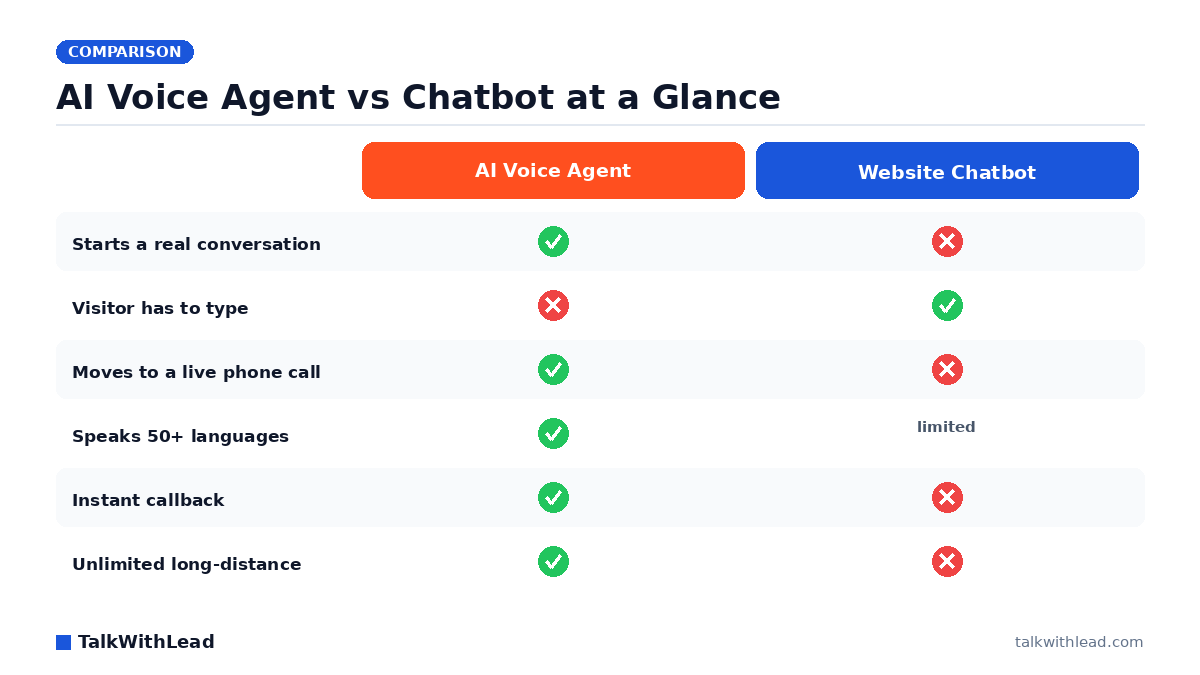
    AI Voice Agent vs Chatbot at a Glance — TalkWithLead original infographic (comparison diagram).
    AI Voice Agent vs Chatbot at a Glance

    Why the conversion gap is bigger than it looks

    The ai voice agent vs chatbot conversion rate question usually gets answered with a feature checklist. The real answer is simpler: a voice agent starts a conversation, and a chatbot starts a chore. One asks a visitor to speak; the other asks them to read a greeting, type a question, wait, read again, and hope the bot understood. Every one of those extra steps is a place where a ready-to-buy visitor quietly leaves.

    That matters because the visitor who lands on your pricing page at 9:47 p.m. is not browsing. They are deciding. A human-sounding AI voice agent can answer them out loud in seconds and offer to put them on a call right then. A chatbot, at best, captures an email and adds them to a queue you will work tomorrow, which is often a day too late.

    How a chatbot actually loses high-intent visitors

    Chatbots are not useless. They deflect support tickets and answer FAQs at scale. The trouble shows up on conversion-focused pages, where the goal is not to inform a visitor but to win one. Here is where the friction stacks up:

    • Typing tax. Most people speak far faster than they thumb-type on a phone. Forcing a buyer to type their question slows the whole exchange to a crawl.
    • Scripted dead-ends. The moment a visitor asks something off-script, a rules-based bot stalls and the visitor blames your brand for it.
    • No handoff to a human. Even when a chatbot senses high intent, the usual next step is “leave your email” — not “talk to someone now.”
    • Language walls. A buyer who prefers Spanish, Tagalog, or Portuguese often gets an English-only widget and bounces.

    If you want a deeper breakdown of where text-based tools fall short, our piece on live chat versus chatbots and the AI voice upgrade walks through each option side by side.

    What an AI voice agent does differently

    An AI voice agent flips the interaction. Instead of waiting for the visitor to compose a message, it greets them in a natural, human-sounding voice and handles the back-and-forth out loud. The visitor talks the way they would to a salesperson on the showroom floor, and the agent listens, answers, qualifies, and offers the next step.

    Three capabilities change the math:

    • more than 20 languages. The agent meets visitors in their own language, so a multilingual market stops being a leak in your funnel.
    • Instant callbacks. If a visitor would rather get a call in two minutes, the agent arranges it instead of dropping them into a form.
    • Free long-distance calling between supported countries. A prospect three time zones away connects with no concern about call cost on your side.

    The net effect is fewer steps between “interested visitor” and “live conversation.” That compression is the whole game. You can try a live demo and hear how the voice agent handles a real exchange before you decide anything.

    An illustrative conversion comparison

    The following numbers are an illustrative example, not measured results from a specific customer. They show how small per-step drop-offs compound differently for typing versus talking.

    Imagine 1,000 high-intent visitors hit a service page in a month. With a chatbot, suppose 12% open the widget, 60% of those actually type a question, 50% of those leave an email, and 35% of those emails turn into a booked call. That chain leaves you with roughly 13 booked calls.

    Now run the same 1,000 visitors past an AI voice agent. Suppose 12% engage, but because talking is effortless, 80% complete the conversation, and 55% of those accept an offer to connect to a live call or instant callback. That chain leaves you with roughly 53 booked calls from the same traffic. Same visitors, same intent — the difference is how much effort each path demands. Even if your real percentages differ, the shape holds: removing the typing tax and the email-then-wait gap raises the ai voice agent vs chatbot conversion rate every time.

    Speed is the hidden multiplier

    Conversion is not only about the channel; it is about the clock. A lead contacted within the first minute is far more likely to convert than one contacted an hour later, simply because intent decays fast. A chatbot that collects an email defers the real conversation. A voice agent has the conversation now.

    This is the core idea behind speed-to-lead and why the first 60 seconds win most deals. When the agent can move a visitor straight into a call, you are not racing a competitor’s callback queue — you have already started the relationship. And when a call does slip through, missed-call automation catches the lead before they dial someone else.

    When a chatbot is still the right call

    Voice is not the answer for every box on every page. A chatbot earns its place when:

    • The job is high-volume, low-stakes support (order status, password resets, store hours).
    • The visitor genuinely prefers async text and may be mid-meeting.
    • You need a searchable transcript trail for compliance or routing.

    The smart setup is layered: let text tools handle routine questions, and route the high-intent moments — pricing, demo requests, “talk to sales” — to a voice agent that can close the loop with a real call. If you are weighing widgets, the callback widget versus click-to-call versus live chat comparison helps you map each tool to the right page.

    How to decide for your own site

    Start with one question: on this page, is a captured email good enough, or do you actually want a conversation? On a blog post, an email is fine. On a pricing page for a high-ticket service, a booked call is worth many emails. Put the voice agent where the conversation is worth the most.

    Then check three things: do you serve multiple languages, do prospects reach you from far away, and does your current widget end most sessions with “we’ll get back to you”? If you answered yes to any of them, the voice path is likely leaving money on the table for you today. You can start free and put a voice agent on your highest-intent page this week, or review pricing to size it for your traffic.

    FAQ

    Is an AI voice agent really better than a chatbot for conversions?

    On high-intent pages, generally yes. A voice agent removes the typing tax and can move a visitor straight into a live call or instant callback, while most chatbots stop at capturing an email. The ai voice agent vs chatbot conversion rate gap is widest exactly where the visitor is closest to buying.

    Does the voice agent sound robotic?

    No. TalkWithLead’s agent is built to sound human and conversational, so visitors talk to it the way they would talk to a person, rather than navigating a menu. The fastest way to judge it is to hear it on a live demo.

    What about visitors who do not speak English?

    The voice agent handles more than 20 languages, so a buyer who prefers another language gets a natural conversation instead of an English-only wall. For multilingual markets, that alone can recover leads a text widget would lose.

    Can I keep my existing chatbot and add a voice agent?

    Yes, and that is often the best setup. Let the chatbot handle routine support questions and route high-intent moments — pricing, demo, “talk to sales” — to the voice agent that can connect a real call.

    What happens if a visitor would rather be called back later?

    The agent can schedule an instant callback instead of forcing a live conversation, and free long-distance calling between supported countries means it can reach prospects anywhere without a cost concern on your end.

    How quickly can I test this on my own site?

    You can sign up free and place a voice agent on your highest-intent page in a single sitting, then compare its booked-call rate against your current chatbot before rolling it out everywhere.

  • AI Voice Agent vs Human Receptionist: Best for Insurance?

    AI Voice Agent vs Human Receptionist: Best for Insurance?

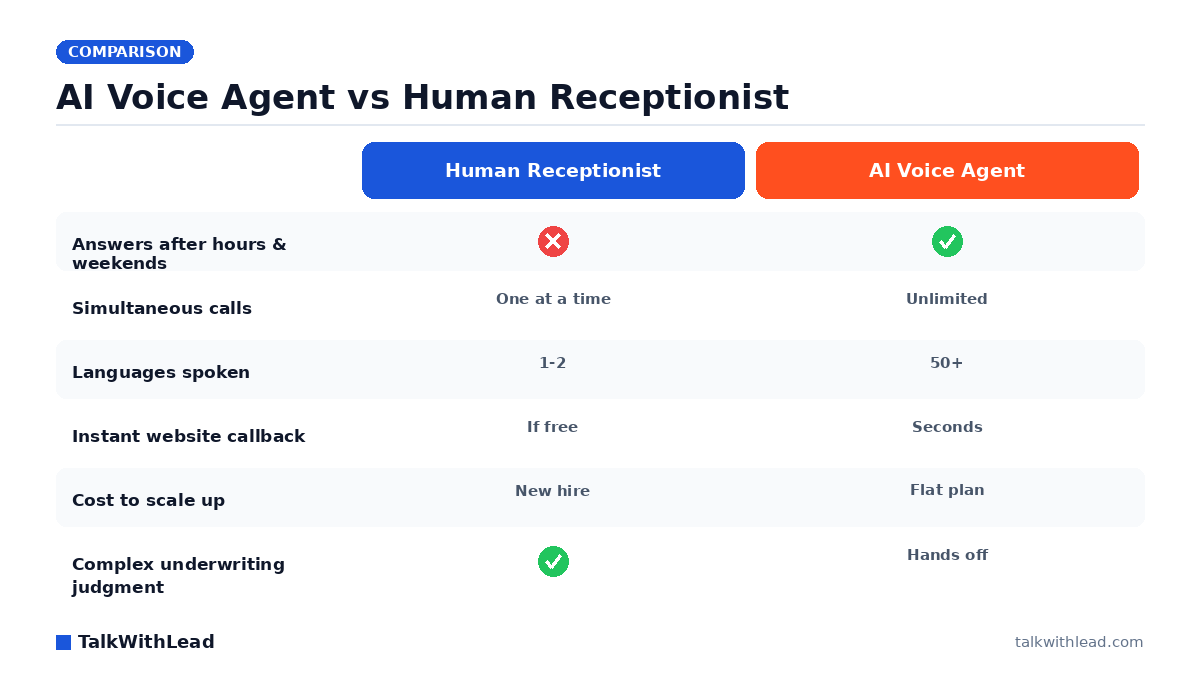
    AI Voice Agent vs Human Receptionist — TalkWithLead original infographic (comparison diagram).
    AI Voice Agent vs Human Receptionist

    The real question insurance owners are asking

    An insurance shopper lands on your site at 9:14 p.m., scans your auto and home page, and wants a quote now. Your receptionist went home at five. That gap is the whole debate. The ai voice agent vs human receptionist question is not really about technology preference — it is about which option actually answers the visitor while they still care.

    A human receptionist is warm, judgment-driven, and great on the phone. But she works set hours, holds one line at a time, and speaks one or two languages. An AI voice agent calls back every visitor instantly, around the clock, in more than 20 languages, and never puts a quote-ready prospect on hold. For an insurance agency that lives and dies on first contact, that difference shows up directly in bound policies.

    Short answer: An AI voice agent calls back every web visitor 24/7 — including nights, weekends, and lunch breaks — while a human receptionist covers only set hours. For an insurance agency, the AI agent is best for never missing an after-hours quote request and handling many callers at once in more than 20 languages; a human receptionist is best for warm relationship moments and complex judgment calls. Most agencies get the best of both by using the AI voice agent to catch every lead instantly and routing the ones that need a person to a human.

    This matters because so much insurance shopping happens off-hours. According to MediaAlpha, the insurance lead marketplace, about 45% of leads are generated during nights and weekends — outside standard agency hours, exactly when a human front desk is closed but an AI voice agent still answers.

    Where a human receptionist still wins

    Let’s be fair to the front desk. A skilled receptionist reads tone, calms an upset claimant, and knows when a commercial policy needs a senior agent rather than a script. For relationship-heavy moments — a customer disputing a renewal, a referral from a long-time client, a complex multi-property quote — a human is the right answer.

    The limits are structural, not personal:

    • Coverage windows. Even a great receptionist covers maybe 45 of the 168 hours in a week. The other 123 hours of website traffic hit a voicemail.
    • One call at a time. During an open-enrollment rush or a storm-claim spike, callers four through ten get a busy signal or a callback promise that comes too late.
    • Language reach. Insurance buyers are often shopping in a second language. If your front desk speaks only English, you lose the Spanish, Mandarin, or Portuguese speaker to whoever answers in their language.

    None of this means fire your receptionist. It means stop asking one person to be the entire first-response layer for a 24/7 website.

    Where an AI voice agent pulls ahead

    An AI voice agent sits on your website and talks — out loud, in a natural human-sounding voice — the moment a visitor wants to engage. It is not a chatbot making people type, and not a form dumping leads into an inbox. It starts a real phone conversation, qualifies the lead, and either books the call or sends your team an instant alert with the summary of a hot prospect.

    For insurance specifically, the advantages stack up:

    • Always on. The 9:14 p.m. auto-quote shopper gets answered, not a voicemail. Speed-to-lead is the single biggest lever in insurance, and we cover why in Speed-to-Lead: Why the First 60 Seconds Win Most Deals.
    • Unlimited simultaneous calls. Ten storm claims at once? Every caller gets a live conversation, not a queue.
    • more than 20 languages. The agent switches to the visitor’s language automatically, so you stop forfeiting non-English shoppers.
    • Free long-distance calling between supported countries and instant callbacks. A prospect anywhere can reach you, and a visitor who half-fills a quote form gets a callback in seconds instead of next business day.

    Here is an illustrative example of the math. Say your agency site gets 1,200 visitors a month and 6% are quote-ready — that’s 72 high-intent prospects. If a receptionist-only setup catches the third who call during business hours, you talk to roughly 24. An always-on AI voice agent that engages even half the rest could start conversations with 50+. Same traffic, same ad budget, and in this example, potentially close to double the quote conversations. (Illustrative numbers, not a guarantee.) You can try a live demo and hear how the voice agent handles an insurance inquiry yourself.

    Cost: salary vs flat plan

    A full-time receptionist in many markets runs well past $40,000 a year before benefits, and that buys you single-threaded coverage for about a quarter of the week. To cover nights and weekends you are hiring two or three people or paying an answering service per minute.

    An AI voice agent is a flat monthly cost that covers all 168 hours, every language, and unlimited concurrent calls without a new hire each time volume jumps. The point is not to replace your team’s salary line — it is to stop paying for missed leads. Every after-hours quote shopper who hits a voicemail is acquisition spend you already paid for, leaking out the back. Compare what coverage actually costs on the pricing page.

    You don’t have to choose just one

    The framing of one versus the other is a trap. The best insurance front office runs both in layers:

    1. AI voice agent answers first — every visitor, every hour, every language. It qualifies, captures contact details, and books the quote call.
    2. Humans take it from there — your licensed agents get warm, pre-qualified prospects and a written summary instead of cold voicemails, and your receptionist handles the relationship and judgment calls AI shouldn’t.

    That’s the same logic behind catching calls you’d otherwise lose, which we break down in Missed Call Automation for Websites. The AI doesn’t compete with your people; it feeds them.

    What about chatbots and forms?

    Some agencies try to close the after-hours gap with a chatbot or a quote form. Both make the prospect do the work — typing, waiting, hoping someone follows up. A voice conversation is faster, warmer, and converts a hesitant shopper far better than a text box. We compared these head-to-head in Live Chat vs Chatbot: Pros, Cons, and the AI Voice Upgrade. The short version: voice beats typing when money and trust are on the line, and insurance is exactly that.

    If you want to put an always-on voice agent in front of your insurance traffic this week, you can start a free signup and have it talking to visitors fast.

    AI voice agent vs human receptionist: side-by-side

    AI voice agent vs human receptionist (insurance agency)
    FactorHuman receptionistAI voice agent (TalkWithLead)
    CoverageSet hours (~45 of 168 hours/week)24/7, including nights and weekends
    Simultaneous callersOne at a timeUnlimited simultaneous calls
    Speed to answer a web leadOnly when freeSeconds, every time
    LanguagesWhatever they speakmore than 20 languages
    After-hours quote requestsGo to voicemailAnswered or called back instantly
    Relationship / judgment callsStrong — human nuanceRoutes complex cases to your team
    Cost shapeSalary + benefits (full-time)Flat plan; scales without new hires

    Bottom line.

    Best for: Insurance agencies that lose quote requests after hours, on weekends, or when the front desk is busy. An AI voice agent is the best fit for instant, always-on first contact and for handling many shoppers at once across languages — which matters because Harvard Business Review research found companies that reach a web lead within an hour are nearly 7× more likely to qualify it than those that wait even an hour longer, so a quote request sitting in voicemail until morning is usually a lost deal.

    Not the best fit for: It isn’t a full replacement for the human relationship side — complex judgment, sensitive claims conversations, and warm in-person service still belong with your team. The strongest setup pairs the AI agent for instant capture with humans for the high-touch moments.

    In one line: AI voice agent to catch every lead instantly and 24/7; humans for the relationship and judgment calls.

    FAQ

    Can an AI voice agent replace my insurance receptionist entirely?

    It can, but most agencies get better results keeping both. The AI voice agent handles instant first response, after-hours website coverage, the web enquiries nobody is free to call back, and non-English web leads, while your receptionist and licensed agents handle complex underwriting, claims empathy, and relationship closing. Think layers, not a swap.

    Will insurance shoppers know they’re talking to an AI?

    The voice is designed to sound natural and human, and the conversation feels like a real phone call rather than a robotic menu. The goal is a smooth, helpful exchange that qualifies the lead and books the quote call — not to deceive anyone. Many agencies are upfront that callers are speaking with an AI assistant.

    How does an AI voice agent help with after-hours insurance leads?

    Most quote shopping happens evenings and weekends when your front desk is closed. The AI voice agent answers those visitors instantly, qualifies them, and either books a callback or hands a hot lead to your team for the morning — so traffic you already paid for doesn’t leak to a competitor who answered first.

    What languages can the AI voice agent handle for my agency?

    It speaks more than 20 languages and switches automatically based on the visitor, so Spanish, Mandarin, Portuguese, and other shoppers get answered in their language. A single-language front desk simply can’t match that reach.

    Is an AI voice agent cheaper than hiring more receptionists?

    For most agencies, yes. One receptionist covers roughly a quarter of the week and one call at a time. An AI voice agent is a flat monthly cost covering all hours, unlimited concurrent calls, and every language — so you scale coverage without a new salary each time volume spikes. Check current plans on the pricing page.

    How many insurance leads come in after business hours?

    A large share. According to MediaAlpha, the insurance lead marketplace, about 45% of leads are generated during nights and weekends — outside standard agency hours. That’s exactly when a human receptionist isn’t there but an AI voice agent still answers, qualifies the shopper, and books the quote call.

    Can an AI voice agent handle multiple insurance callers at the same time?

    Yes. Unlike one receptionist who can take one call at a time, an AI voice agent handles unlimited simultaneous calls, so a rush of quote shoppers during a storm or a promotion never ends up in voicemail. Every caller gets a live conversation instead of a busy signal or a callback promise that arrives too late.

    What does an AI voice agent cost compared to hiring another receptionist?

    A full-time receptionist runs well past a salary plus benefits and still covers only set hours and one call at a time. An AI voice agent runs on a flat plan and scales to 24/7 coverage and unlimited simultaneous calls without a new hire each time volume spikes. (Treat any specific dollar figures as illustrative, not a quoted price — check current plans on the pricing page.)

Your next lead is on your site right now — ready to talk.

TalkWithLead’s AI voice agent rings that visitor back in seconds, qualifies the lead in their language, and books the call before the prospect can open a competitor’s tab. Forms are slow. Chatbots make people type. Voice closes.

Just curious about plans? See pricing →